Skrzep-Poloczek Bronisława, Idzik Maciej, Michalczyk Katarzyna, Chełmecka Elżbieta, Kukla Michał, Zalejska-Fiolka Jolanta, Poloczek Jakub, Bogielski Bartosz, Jochem Jerzy, Nowak Damian, Stygar Dominika
Department of Physiology, Faculty of Medical Sciences in Zabrze, Medical University of Silesia, Jordana 19 Street, 41-808 Zabrze, Poland.
Independent Public Health Care, Opole Cancer Center Prof. Tadeusz Koszarowski, Katowicka 45-061 Street, 46-020 Opole, Poland.
J Clin Med. 2023 Jul 25;12(15):4881. doi: 10.3390/jcm12154881.
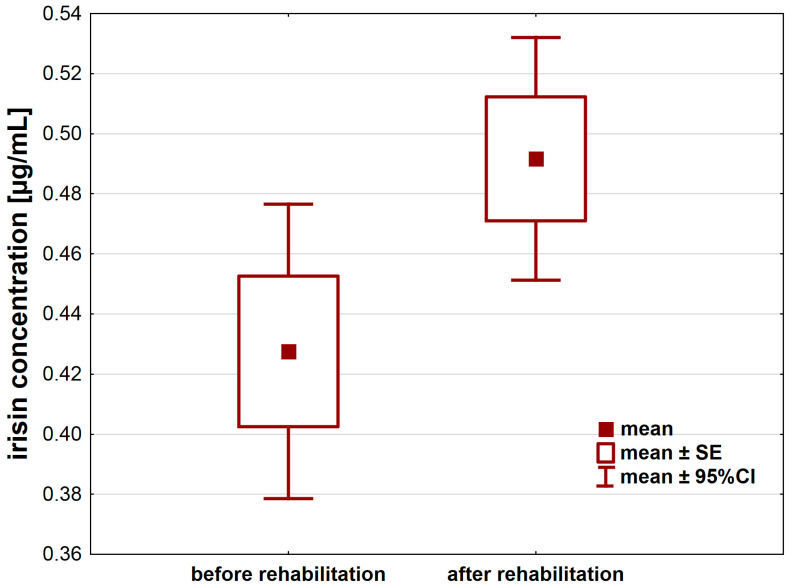
Osteoarthritis (OA) is the most frequent worldwide cause of adult population disabilities. The study evaluated the effects of a 21-day individual rehabilitation exercise training program focused on improving patients' functional capacity. The study analyzed the changes in irisin, chemerin, and BDNF serum levels in 36 OA patients subjected to an individually-adjusted rehabilitation program 90 days after surgical hip or knee replacement. The changes in irisin, chemerin, and BDNF serum levels were measured using enzyme-linked immunosorbent assay (ELISA) kits. A 21-day individual rehabilitation exercise training program significantly increased irisin and BDNF, and decreased chemerin serum levels. The presented study indicates that individually-adjusted exercise training is an important modulator influencing serum levels of anti- and pro-inflammatory factors, leading to positive clinical outcomes in osteoarthritis therapy. Selected factors are considered potential markers of various pathophysiological conditions. The presented study brings new details to the discussion.
骨关节炎(OA)是全球范围内导致成人群体残疾的最常见原因。该研究评估了一项为期21天的个体化康复运动训练计划对改善患者功能能力的效果。该研究分析了36名接受髋关节或膝关节置换手术90天后接受个体化调整康复计划的骨关节炎患者血清鸢尾素、趋化素和脑源性神经营养因子(BDNF)水平的变化。使用酶联免疫吸附测定(ELISA)试剂盒测量鸢尾素、趋化素和BDNF血清水平的变化。一项为期21天的个体化康复运动训练计划显著提高了鸢尾素和BDNF水平,并降低了趋化素血清水平。本研究表明,个体化调整的运动训练是影响抗炎和促炎因子血清水平的重要调节因素,可在骨关节炎治疗中带来积极的临床结果。所选因素被认为是各种病理生理状况的潜在标志物。本研究为该讨论带来了新的细节。