Von Steinbuechel Nicole, Zeldovich Marina, Greving Sven, Olabarrieta-Landa Laiene, Krenz Ugne, Timmermann Dagmar, Koerte Inga K, Bonfert Michaela Veronika, Berweck Steffen, Kieslich Matthias, Brockmann Knut, Roediger Maike, Lendt Michael, Staebler Michael, Schmidt Silke, Muehlan Holger, Cunitz Katrin
Institute of Medical Psychology and Medical Sociology, University Medical Center Göttingen, Waldweg 37A, 37073 Göttingen, Germany.
Institute of Psychology, University Innsbruck, Innrain 52f, 6020 Innsbruck, Austria.
J Clin Med. 2023 Jul 26;12(15):4898. doi: 10.3390/jcm12154898.
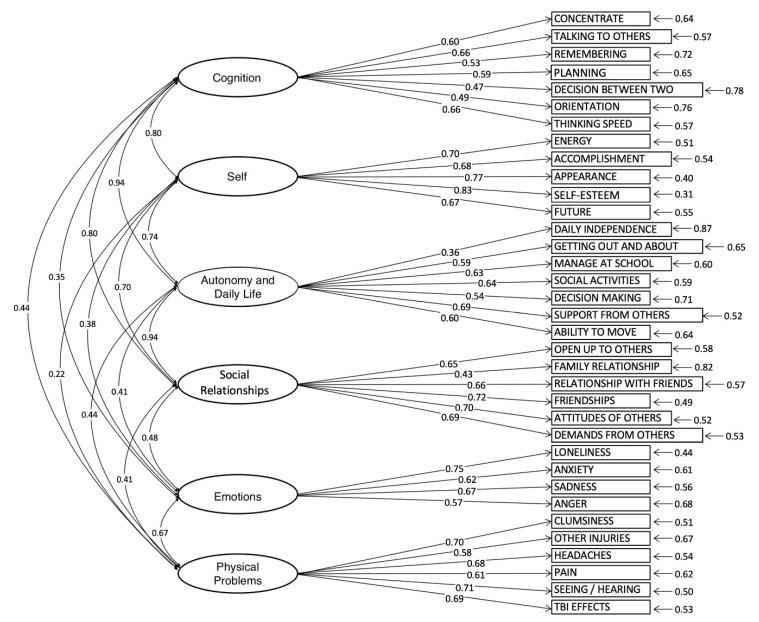
The subjective impact of the consequences of pediatric traumatic brain injury (pTBI) on different life dimensions should be assessed multidimensionally and as sensitively as possible using a disease-specific health-related quality of life (HRQoL) instrument. The development and psychometrics of the first such self-report questionnaire for children and adolescents after TBI are reported here. Focus group interviews with children, adolescents, and their parents, cognitive debriefing, item pool generation and reduction using Delphi expert panels were performed. The resulting version was psychometrically tested on 300 individuals aged 8-17 years. After item reduction based on factor analyses, differential item functioning, reliability, and validity were investigated. The final 35 items were associated with six scales (Cognition, Self, Daily Life and Autonomy, Social Relationships, Emotions, Physical Problems). Internal consistency and construct validity were satisfactory. Health-related Quality of life (HRQoL) was significantly lower in older and in female participants, as well as those with cognitive disabilities, anxiety, depression and post-concussion symptoms, than in comparative groups. The new QOLIBRI-KID/ADO is a comprehensive, multidimensional, reliable, and valid instrument, comparable in content and items to the QOLIBRI adult version. Therefore, disease-specific HRQoL can now be measured across the lifespan and may support the amelioration of treatment, care, rehabilitation, and daily life of children and adolescents after TBI.
小儿创伤性脑损伤(pTBI)后果对不同生活维度的主观影响,应使用特定疾病的健康相关生活质量(HRQoL)工具进行多维度评估,并尽可能做到敏感评估。本文报告了首个针对脑损伤后儿童和青少年的此类自我报告问卷的开发及心理测量学情况。对儿童、青少年及其父母进行了焦点小组访谈,进行了认知反馈、通过德尔菲专家小组生成并精简条目池。最终版本在300名8至17岁个体上进行了心理测量学测试。基于因子分析进行条目精简后,对差异项目功能、信度和效度进行了研究。最终的35个条目与六个量表相关(认知、自我、日常生活与自主性、社会关系、情绪、身体问题)。内部一致性和结构效度令人满意。与对照组相比,年龄较大的参与者、女性参与者以及患有认知障碍、焦虑、抑郁和脑震荡后症状的参与者的健康相关生活质量(HRQoL)显著较低。新的QOLIBRI-KID/ADO是一个全面、多维度、可靠且有效的工具,在内容和条目上与QOLIBRI成人版相当。因此,现在可以在整个生命周期内测量特定疾病的HRQoL,这可能有助于改善脑损伤后儿童和青少年的治疗、护理、康复及日常生活。