Luo Yang, Chen Huiqin, Gui Mingzhen
Department of Neurology, Xiangya Hospital, Central South University, Changsha 410083, China.
Department of Radiology, Xiangya Hospital, Central South University, Changsha 410083, China.
Diagnostics (Basel). 2023 Jul 27;13(15):2511. doi: 10.3390/diagnostics13152511.
Current research on the prediction of movement complications associated with levodopa therapy in Parkinson's disease (PD) is limited. levodopa-induced dyskinesia (LID) is a movement complication that seriously affects the life quality of PD patients. One-third of PD patients develop LID within 1 to 6 years of levodopa treatment. This study aimed to construct models based on radiomics and machine learning to predict early LID in PD.
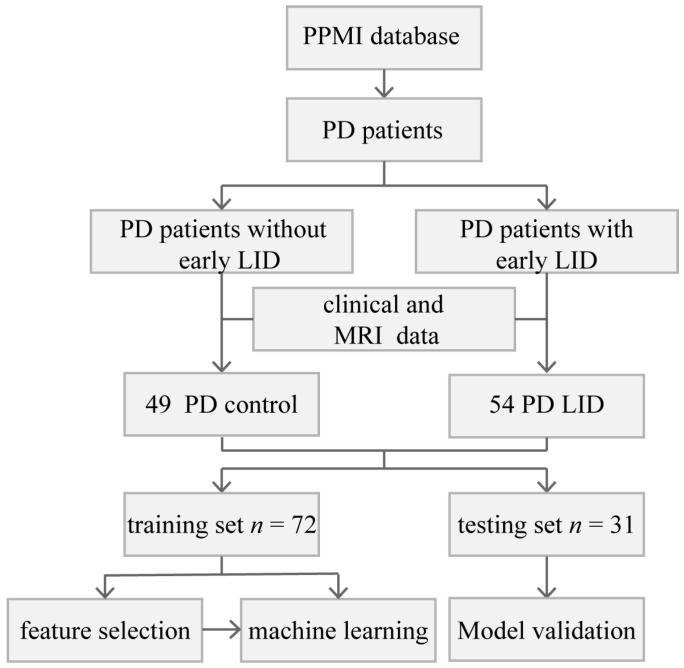
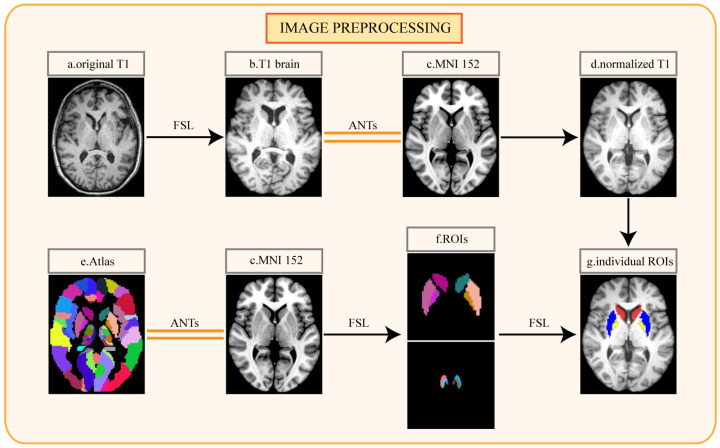
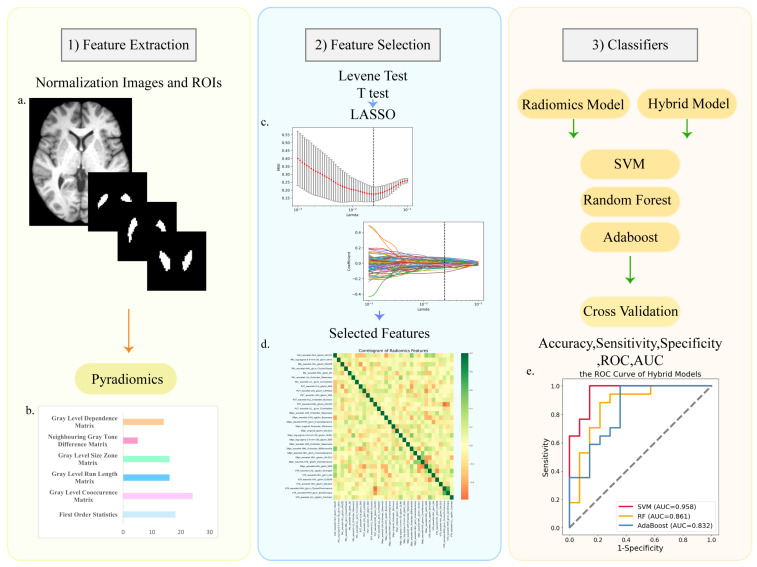
We extracted radiomics features from the T1-weighted MRI obtained in the baseline of 49 PD control and 54 PD with LID in the first 6 years of levodopa therapy. Six brain regions related to the onset of PD were segmented as regions of interest (ROIs). The least absolute shrinkage and selection operator (LASSO) was used for feature selection. Using the machine learning methods of support vector machine (SVM), random forest (RF), and AdaBoost, we constructed radiomics models and hybrid models. The hybrid models combined the radiomics features and the Unified Parkinson's Disease Rating Scale part III (UPDRS III) total score. The five-fold cross-validation was performed and repeated 20 times to validate the stability of the classifiers. We used sensitivity, specificity, accuracy, receiver operating characteristic (ROC) curves, and area under the ROC curve (AUC) for model validation.
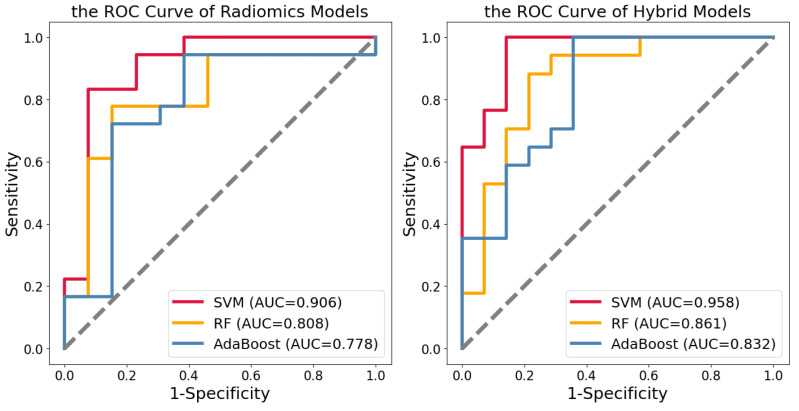
We selected 33 out of 6138 radiomics features. In the testing set of the radiomics model, the AUC values of the SVM, RF, and AdaBoost classifiers were 0.905, 0.808, and 0.778, respectively, and the accuracies were 0.839, 0.742, and 0.710. The hybrid models had better prediction performance. In the testing set, the AUC values of SVM, RF, and AdaBoost classifiers were 0.958, 0.861, and 0.832, respectively, and the accuracies were 0.903, 0.806, and 0.774.
Our results indicate that T1-weighted MRI is valuable in predicting early LID in PD. This work demonstrates that the combination of radiomics features and clinical features has good potential and value for identifying early LID in PD.
目前关于帕金森病(PD)左旋多巴治疗相关运动并发症预测的研究有限。左旋多巴诱导的异动症(LID)是一种严重影响PD患者生活质量的运动并发症。三分之一的PD患者在左旋多巴治疗1至6年内会出现LID。本研究旨在构建基于放射组学和机器学习的模型,以预测PD患者的早期LID。
我们从49例PD对照患者和54例在左旋多巴治疗前6年内出现LID的PD患者的基线T1加权MRI中提取放射组学特征。将与PD发病相关的6个脑区分割为感兴趣区域(ROI)。使用最小绝对收缩和选择算子(LASSO)进行特征选择。使用支持向量机(SVM)、随机森林(RF)和AdaBoost等机器学习方法,我们构建了放射组学模型和混合模型。混合模型结合了放射组学特征和统一帕金森病评定量表第三部分(UPDRS III)总分。进行五折交叉验证并重复20次,以验证分类器的稳定性。我们使用敏感性、特异性、准确性、受试者工作特征(ROC)曲线和ROC曲线下面积(AUC)进行模型验证。
我们从6138个放射组学特征中选择了33个。在放射组学模型的测试集中,SVM、RF和AdaBoost分类器的AUC值分别为0.905、0.808和0.778,准确率分别为0.839、0.742和0.710。混合模型具有更好的预测性能。在测试集中,SVM、RF和AdaBoost分类器的AUC值分别为0.958、0.861和0.832,准确率分别为0.903、0.806和0.774。
我们的结果表明,T1加权MRI在预测PD患者的早期LID方面具有价值。这项工作表明,放射组学特征与临床特征的结合在识别PD患者早期LID方面具有良好的潜力和价值。