Adnan Mohammad, Akhter Md Habban, Afzal Obaid, Altamimi Abdulmalik S A, Ahmad Irfan, Alossaimi Manal A, Jaremko Mariusz, Emwas Abdul-Hamid, Haider Tanweer, Haider Md Faheem
Faculty of Pharmacy, Integral University, Lucknow 226026, Uttar Pradesh, India.
School of Pharmaceutical and Population Health Informatics (SoPPHI), DIT University, Dehradun 248009, Uttarakhand, India.
Molecules. 2023 Aug 5;28(15):5905. doi: 10.3390/molecules28155905.
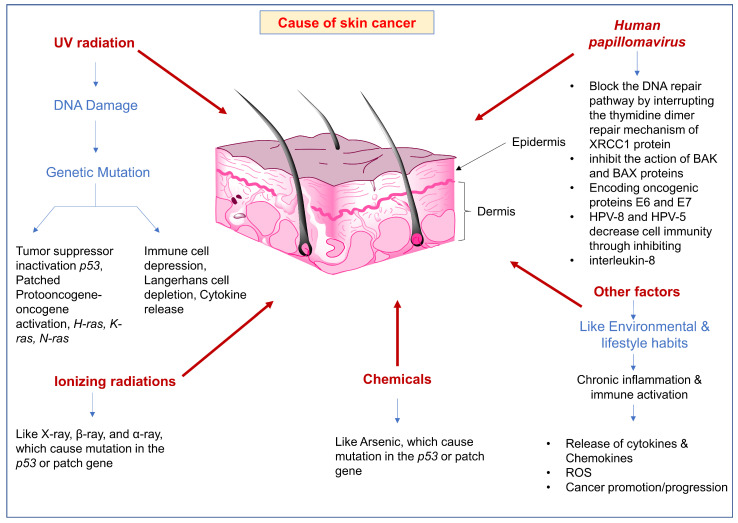
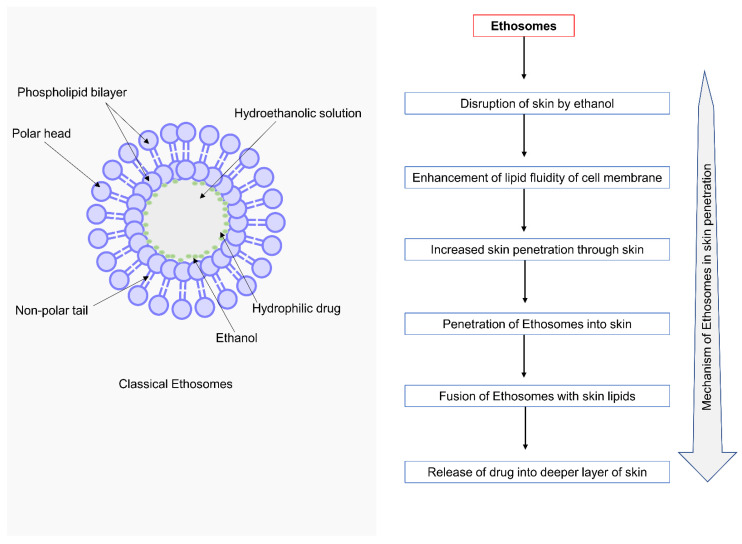
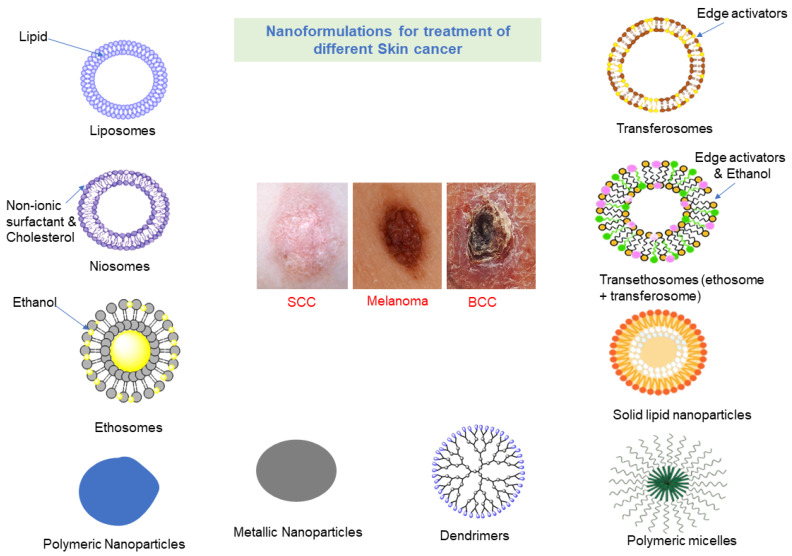
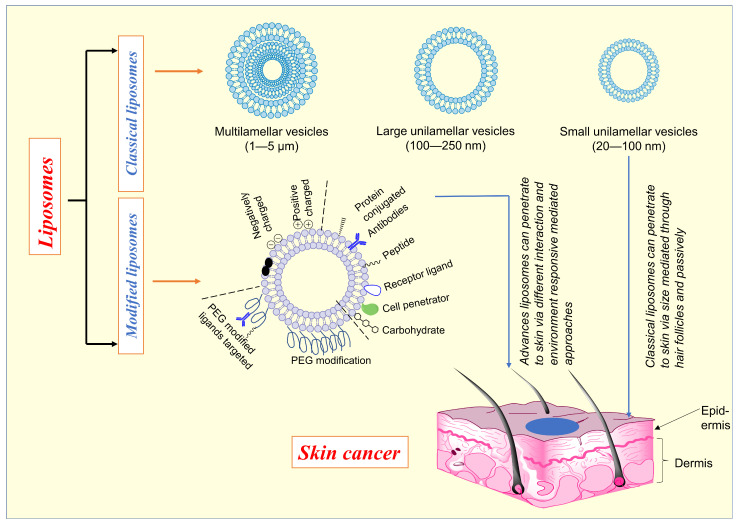
Cancer is a progressive disease of multi-factorial origin that has risen worldwide, probably due to changes in lifestyle, food intake, and environmental changes as some of the reasons. Skin cancer can be classified into melanomas from melanocytes and nonmelanoma skin cancer (NMSC) from the epidermally-derived cell. Together it constitutes about 95% of skin cancer. Basal cell carcinoma (BCC) and cutaneous squamous cell carcinoma (CSCC) are creditworthy of 99% of NMSC due to the limited accessibility of conventional formulations in skin cancer cells of having multiple obstacles in treatment reply to this therapeutic regime. Despite this, it often encounters erratic bioavailability and absorption to the target. Nanoparticles developed through nanotechnology platforms could be the better topical skin cancer therapy option. To improve the topical delivery, the nano-sized delivery system is appropriate as it fuses with the cutaneous layer and fluidized membrane; thus, the deeper penetration of therapeutics could be possible to reach the target spot. This review briefly outlooks the various nanoparticle preparations, i.e., liposomes, niosomes, ethosomes, transferosomes, transethosomes, nanoemulsions, and nanoparticles technologies tested into skin cancer and impede their progress tend to concentrate in the skin layers. Nanocarriers have proved that they can considerably boost medication bioavailability, lowering the frequency of dosage and reducing the toxicity associated with high doses of the medication.
癌症是一种多因素起源的进展性疾病,在全球范围内呈上升趋势,这可能部分归因于生活方式、食物摄入和环境变化等因素。皮肤癌可分为源自黑素细胞的黑色素瘤和源自表皮细胞的非黑色素瘤皮肤癌(NMSC)。两者共同构成了约95%的皮肤癌。由于传统制剂在皮肤癌细胞中的可及性有限,在应对这种治疗方案时存在多种障碍,基底细胞癌(BCC)和皮肤鳞状细胞癌(CSCC)占NMSC的99%。尽管如此,它在靶向给药时往往会遇到不稳定的生物利用度和吸收问题。通过纳米技术平台开发的纳米颗粒可能是更好的局部皮肤癌治疗选择。为了改善局部给药,纳米尺寸的给药系统是合适的,因为它能与皮肤层和流化膜融合;因此,治疗药物有可能更深入地渗透到达靶点。这篇综述简要展望了各种纳米颗粒制剂,即脂质体、非离子型脂质体、醇质体、传递体、转醇质体、纳米乳剂以及已在皮肤癌中进行测试的纳米颗粒技术,并且阻碍它们进展的因素往往集中在皮肤层。纳米载体已证明它们可以显著提高药物的生物利用度,降低给药频率并减少与高剂量药物相关的毒性。