Akullo Jolly Oder, Kiage-Mokua Beatrice N, Nakimbugwe Dorothy, Ng'ang'a Jeremiah, Kinyuru John
Department of Animal Production and Management, Faculty of Agriculture and Animal Sciences, Busitema University, Uganda.
Department of Human Nutrition Sciences, School of Food and Nutrition Sciences, Jomo Kenyatta University of Agriculture and Technology, Kenya.
Heliyon. 2023 Jul 30;9(8):e18806. doi: 10.1016/j.heliyon.2023.e18806. eCollection 2023 Aug.
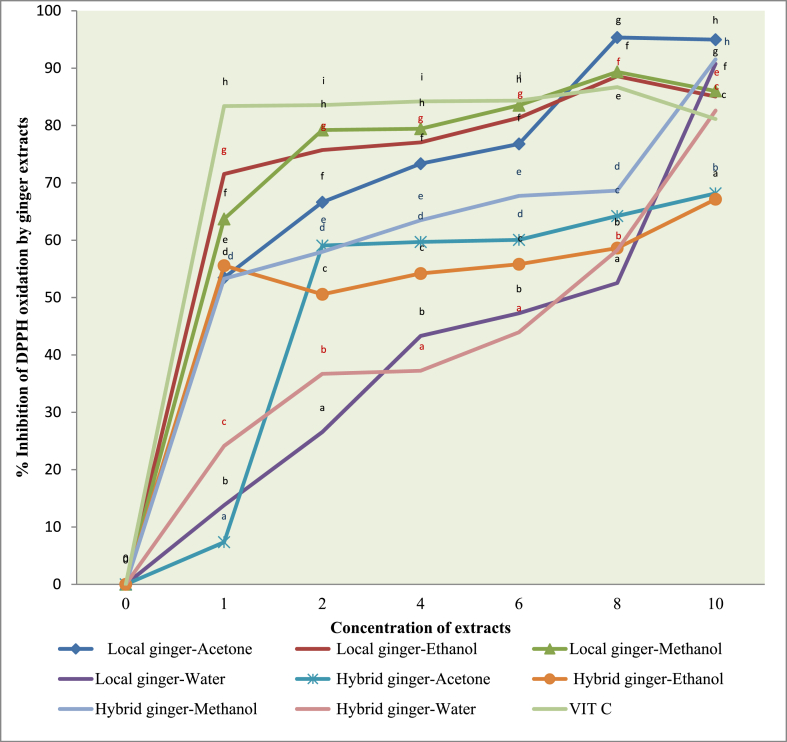
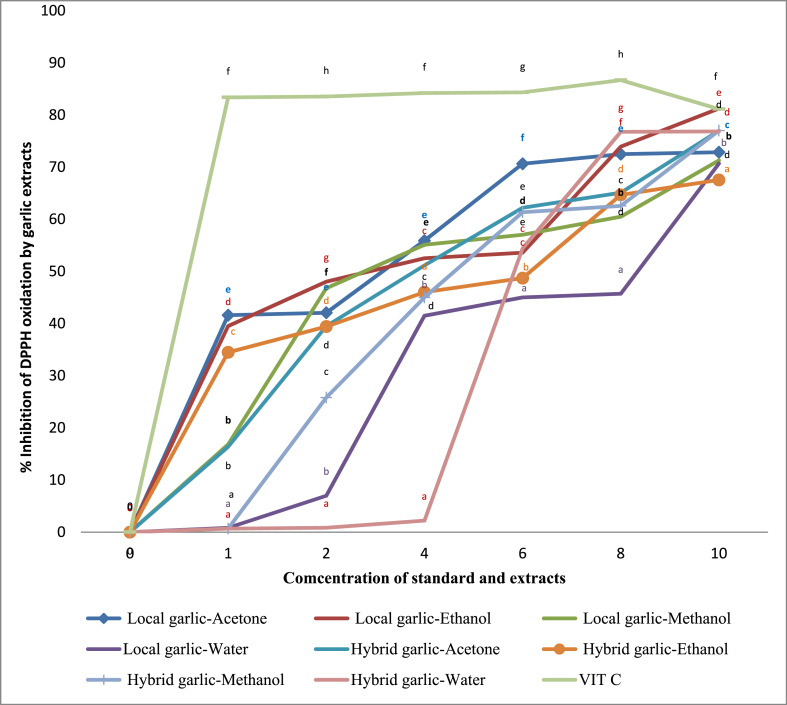
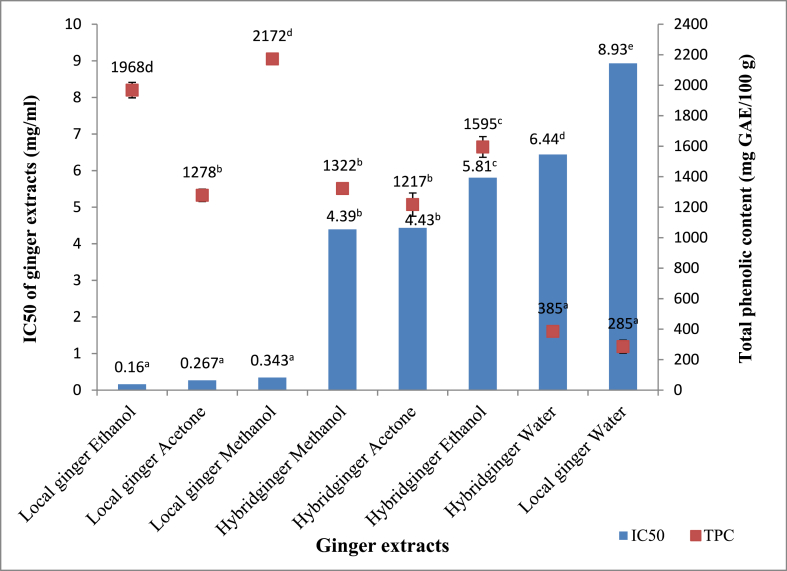
There is limited information on the phytochemical profile and antioxidant activity of ginger and garlic consumed in Uganda. This could have an impact on its widespread use and industrial application. Thus, this study was done to determine the phytochemical profile and antioxidant activity of two varieties of ginger and garlic commonly consumed in Uganda. Fresh ginger rhizomes and garlic cloves of "local" and "hybrid" varieties were acquired from a local food market, washed, grated, and extracted using acetone, ethanol, methanol, and water. Standard techniques were used to determine the phytochemical composition. Total phenolic and flavonoid content were measured using Folin-Ciocalteu and aluminium chloride assays, respectively. Antioxidant activity was determined using the 2, 2-Diphenyl-1-picryl hydrazyl (DPPH) assays. Ginger extracts exhibited significantly higher total phenolic and flavonoid content compared to garlic (p˂0.05). The highest total phenolic and flavonoid content was in ethanol and methanol extracts of local ginger: 1968.49 and 2172.65 mg GAE/100 g; 254.24 and 184.62 mg QE/100 g, respectively. Tannins, alkaloids, saponins, and terpenoids were in varying concentrations in the extracts. Levels of Vitamin C were significantly high in aqueous extracts (p˂0.05), 38.34 and 40.80 AAE/100 g in local and hybrid ginger; 33.65 and 35.24 mg AAE/100 g in local and hybrid garlic, respectively. The free radical scavenging activity of extracts varied depending on concentration, with a strong positive correlation between antioxidant activity and total phenolic and flavonoid content. The half maximal inhibitory concentration (IC50) ranged from 0.16 to 8.93 mg/ml in local ginger, 4.43-6.44 mg/ml in hybrid ginger, 3.93-5.64 mg/ml in local garlic, and 4.44-5.27 mg/ml in hybrid garlic. The best antioxidant activity was exhibited by ethanol extracts of the local ginger. According to the findings, the two varieties of ginger and garlic have strong antioxidant activity due to their different phytochemical compositions, which could make them useful as natural antioxidants in food and medicine applications.
关于乌干达食用的生姜和大蒜的植物化学特征及抗氧化活性的信息有限。这可能会影响其广泛使用和工业应用。因此,本研究旨在确定乌干达常见的两种生姜和大蒜品种的植物化学特征及抗氧化活性。从当地食品市场获取“本地”和“杂交”品种的新鲜姜根茎和蒜瓣,洗净、磨碎,并用丙酮、乙醇、甲醇和水进行提取。采用标准技术测定植物化学成分。分别使用福林 - 酚法和氯化铝法测定总酚和黄酮含量。使用2,2 - 二苯基 - 1 - 苦基肼(DPPH)法测定抗氧化活性。与大蒜相比,生姜提取物的总酚和黄酮含量显著更高(p˂0.05)。本地生姜的乙醇和甲醇提取物中总酚和黄酮含量最高:分别为1968.49和2172.65毫克没食子酸当量/100克;254.24和184.62毫克芦丁当量/100克。提取物中含有不同浓度的单宁、生物碱、皂苷和萜类化合物。水提取物中维生素C含量显著较高(p˂0.05),本地和杂交生姜中分别为38.34和40.80毫克抗坏血酸当量/100克;本地和杂交大蒜中分别为33.65和35.24毫克抗坏血酸当量/100克。提取物的自由基清除活性因浓度而异,抗氧化活性与总酚和黄酮含量之间呈强正相关。本地生姜的半数抑制浓度(IC50)范围为0.16至8.93毫克/毫升,杂交生姜为4.43 - 6.44毫克/毫升,本地大蒜为3.93 - 5.64毫克/毫升,杂交大蒜为4.44 - 5.27毫克/毫升。本地生姜的乙醇提取物表现出最佳的抗氧化活性。根据研究结果,这两种生姜和大蒜品种因其不同的植物化学成分而具有较强的抗氧化活性,这可能使其在食品和医药应用中作为天然抗氧化剂具有用途。