Pan Sijia, Liu Shuangqing, Tai Shuhong, Yu Jing, Yuan Enwu, Duan Yitao
Department of Clinical Laboratory, The Third Affiliated Hospital of Zhengzhou University, Zhengzhou, People's Republic of China.
Department of Clinical Laboratory, The Second Hospital of Tianjin Medical University, Tianjin, People's Republic of China.
Infect Drug Resist. 2023 Aug 8;16:5077-5084. doi: 10.2147/IDR.S420635. eCollection 2023.
The ST167 clone is the globally dominant ST among extraintestinal pathogenic (ExPEC) and is frequently associated with carbapenem resistance. This study reports genomic characterization of a pandrug-resistant ST167 isolate (ECO3183) and the possibility of the type strains' transmission.
Antibiotic susceptibility testing was performed using disk diffusion and the VITEK 2 automated system. The ECO3183 genome was sequenced. We used the genome to analyze the phylogenetic relationship, phylogenetic group, sequence type (ST), acquired antibiotic resistance genes (ARGs), IS elements, genomics islands, the replicon type and transferability of the plasmids. The conjugative transfer of plasmids was assessed using filter mating experiments.
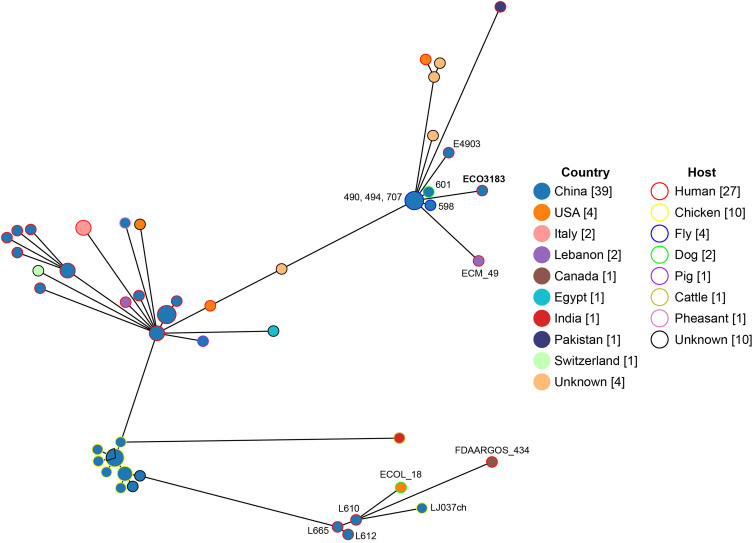
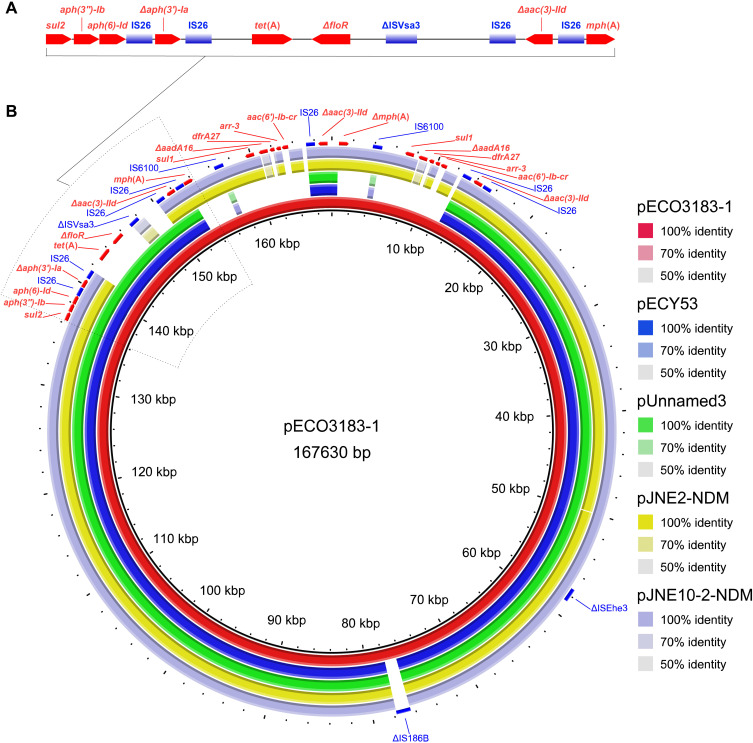
ECO3183 contained a 4.87-Mb chromosome and two plasmids [pECO3183-1 (167.63 Kb) and pECO3183-2 (46.16 Kb)]. It belonged to phylogenetic group A, clonal complex 10 (CC10), and ST167. ECO3183 is a pandrug-resistant strain nonsusceptible to 24 tested antimicrobials representing 8 different antimicrobial classes. Among 55 isolates phylogenetically related to ECO3183, 47% (26/55) were from humans, while 35% (19/55) were from animals. Further analysis revealed that among 1140 ST167 isolates (in the EnteroBase database), 4% (47/1140) originated from environments, 17% (192/1140) were isolated from humans, and 78% (890/1140) were obtained from animals. The pECO3183-1 contained two identical repeats of a 9633 bp region (IS6100--IS26) and a 17.88-kb resistance island (-IS26--IS26-(A)--ΔISVsa3-IS26--IS26-(A)), and these three regions contained most of ECO3183 carrying ARGs. It was identified as a conjugative plasmid, which confers MDR resistance and has the potential to spread.
ECO3183 exhibited pandrug-resistance phenotype that was mediated by pECO3183-1 carrying MDR ARGs and pECO3183-2 carrying . Source analysis of strains indicated that ST167 might be transmitted between species from animals to humans, which needs continued monitoring.
ST167克隆是肠外致病性大肠杆菌(ExPEC)中全球占主导地位的序列型,且常与碳青霉烯耐药性相关。本研究报告了一株泛耐药ST167分离株(ECO3183)的基因组特征以及该型菌株传播的可能性。
采用纸片扩散法和VITEK 2自动系统进行药敏试验。对ECO3183基因组进行测序。我们利用该基因组分析系统发育关系、系统发育群、序列型(ST)、获得性抗生素耐药基因(ARG)、插入序列元件、基因组岛、复制子类型及质粒的可转移性。通过滤膜接合试验评估质粒的接合转移。
ECO3183含有一条4.87 Mb的染色体和两个质粒[pECO3183 - 1(167.63 Kb)和pECO3183 - 2(46.16 Kb)]。它属于系统发育群A、克隆复合体10(CC10)和ST167。ECO3183是一株泛耐药菌株,对代表8种不同抗菌类别的24种受试抗菌药物均不敏感。在55株与ECO3183系统发育相关的分离株中,47%(26/55)来自人类,而35%(19/55)来自动物。进一步分析显示,在1140株ST167分离株(EnteroBase数据库中)中,4%(47/1140)来源于环境,17%(192/1140)从人类分离得到,78%(890/1140)从动物获得。pECO3183 - 1包含一个9633 bp区域(IS6100 - IS26)的两个相同重复序列和一个17.88 kb的耐药岛(-IS26 - IS26 - (A) - ΔISVsa3 - IS26 - IS26 - (A)),这三个区域包含了ECO3183携带的大部分ARG。它被鉴定为一种接合性质粒,赋予多重耐药性且具有传播潜力。
ECO3183表现出由携带多重耐药ARG的pECO3183 - 1和携带……的pECO3183 - 2介导的泛耐药表型。菌株来源分析表明,ST167可能在动物到人类的物种间传播,这需要持续监测。