Departments of Medicine Biomedical Genetics, Boston University Chobanian & Avedisian School of Medicine, Boston, Massachusetts, USA.
Departments of Medicine Infectious Disease, Boston University Chobanian & Avedisian School of Medicine, Boston, Massachusetts, USA.
Alzheimers Dement. 2024 Jan;20(1):253-265. doi: 10.1002/alz.13414. Epub 2023 Aug 14.
Multiple infectious agents, including viruses, bacteria, fungi, and protozoa, have been linked to Alzheimer's disease (AD) risk by independent lines of evidence. We explored this association by comparing the frequencies of viral species identified in a large sample of AD cases and controls.
DNA sequence reads that did not align to the human genome in sequences were mapped to viral reference sequences, quantified, and then were tested for association with AD in whole exome sequences (WES) and whole genome sequences (WGS) datasets.
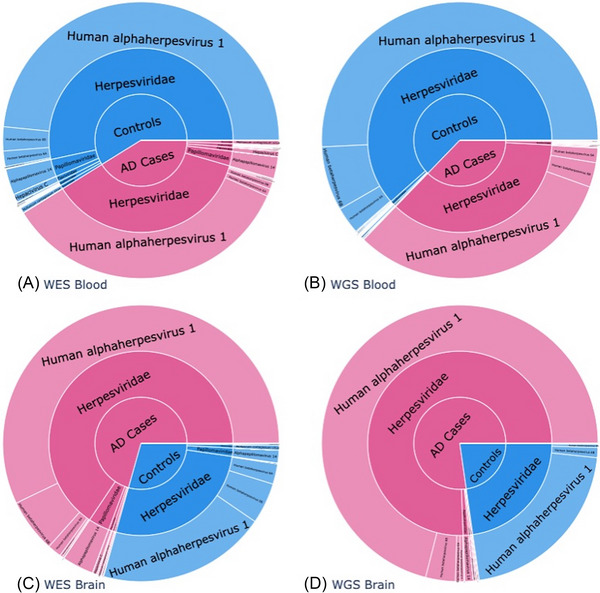
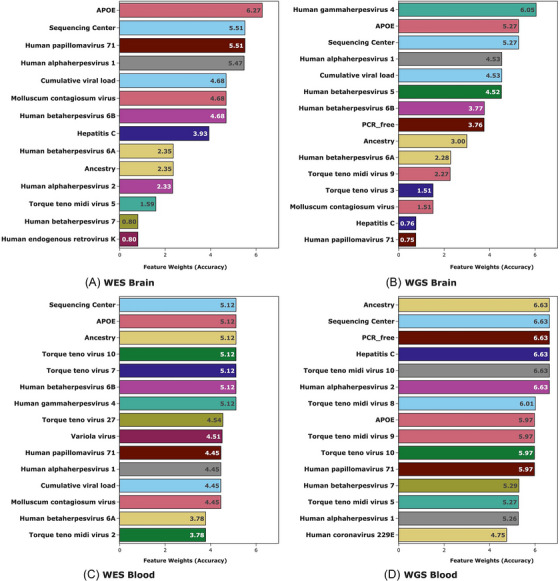
Several viruses were significant predictors of AD according to the machine learning classifiers. Subsequent regression analyses showed that herpes simplex type 1 (HSV-1) (odds ratio [OR] = 3.71, p = 8.03 × 10⁻⁴) and human papillomavirus 71 (HPV-71; OR = 3.56, p = 0.02), were significantly associated with AD after Bonferroni correction. The phylogenetic-related cluster of Herpesviridae was significantly associated with AD in several strata of the data (p < 0.01).
Our results support the hypothesis that viral infection, especially HSV-1, is associated with AD risk.
多项独立证据表明,包括病毒、细菌、真菌和原生动物在内的多种传染因子与阿尔茨海默病(AD)的发病风险相关。我们通过比较大量 AD 病例和对照样本中鉴定出的病毒种类的频率来探究这种关联。
在序列中未与人基因组比对的 DNA 序列读取被映射到病毒参考序列,进行定量,然后在全外显子组序列(WES)和全基因组序列(WGS)数据集上进行与 AD 的关联测试。
根据机器学习分类器,几种病毒是 AD 的显著预测因子。随后的回归分析显示,单纯疱疹病毒 1(HSV-1)(比值比 [OR] = 3.71,p = 8.03×10⁻⁴)和人乳头瘤病毒 71(HPV-71;OR = 3.56,p = 0.02)在经过 Bonferroni 校正后与 AD 显著相关。疱疹病毒科的系统发育相关簇在数据的几个分层中与 AD 显著相关(p < 0.01)。
我们的结果支持这样一种假设,即病毒感染,特别是 HSV-1,与 AD 风险相关。