Davids Charlie J, Roberts Llion A, Bjørnsen Thomas, Peake Jonathan M, Coombes Jeff S, Raastad Truls
Sport, Performance, and Nutrition Research Group, School of Allied Health, Human Services and Sport, La Trobe University, Melbourne, Australia.
School of Human Movement and Nutrition Sciences, The University of Queensland, Brisbane, QLD, Australia.
Sports Med. 2023 Nov;53(11):2077-2093. doi: 10.1007/s40279-023-01900-6. Epub 2023 Aug 14.
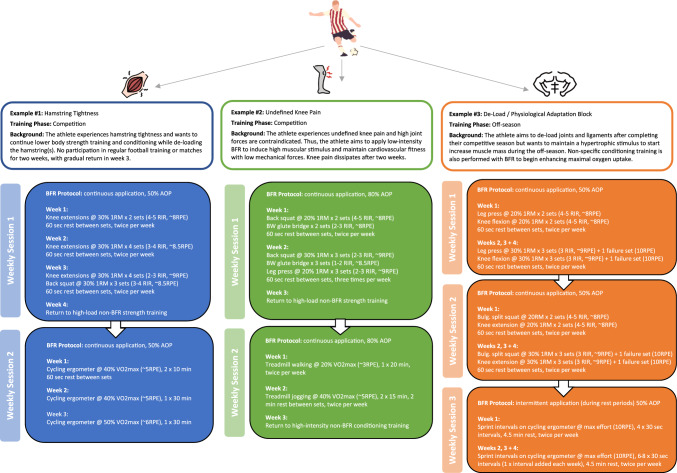
Blood flow-restricted exercise is currently used as a low-intensity time-efficient approach to reap many of the benefits of typical high-intensity training. Evidence continues to lend support to the notion that even highly trained individuals, such as athletes, still benefit from this mode of training. Both resistance and endurance exercise may be combined with blood flow restriction to provide a spectrum of adaptations in skeletal muscle, spanning from myofibrillar to mitochondrial adjustments. Such diverse adaptations would benefit both muscular strength and endurance qualities concurrently, which are demanded in athletic performance, most notably in team sports. Moreover, recent work indicates that when traditional high-load resistance training is supplemented with low-load, blood flow-restricted exercise, either in the same session or as a separate training block in a periodised programme, a synergistic and complementary effect on training adaptations may occur. Transient reductions in mechanical loading of tissues afforded by low-load, blood flow-restricted exercise may also serve a purpose during de-loading, tapering or rehabilitation of musculoskeletal injury. This narrative review aims to expand on the current scientific and practical understanding of how blood flow restriction methods may be applied by coaches and practitioners to enhance current athletic development models.
血流限制训练目前被用作一种低强度、省时的方法,以获得典型高强度训练的诸多益处。越来越多的证据支持这样一种观点,即即使是像运动员这样训练有素的人,仍然能从这种训练方式中受益。抗阻训练和耐力训练都可以与血流限制相结合,从而在骨骼肌中产生一系列适应性变化,从肌原纤维调整到线粒体调整。这种多样的适应性变化将同时有益于肌肉力量和耐力素质,而这些素质是运动表现所必需的,在团队运动中尤为明显。此外,最近的研究表明,当传统的高负荷抗阻训练在同一会话中或在周期性训练计划中作为单独的训练阶段,辅以低负荷的血流限制训练时,可能会对训练适应性产生协同和互补效应。低负荷、血流限制训练所带来的组织机械负荷的短暂降低,在肌肉骨骼损伤的减载、减量或康复过程中也可能起到作用。这篇叙述性综述旨在进一步阐述目前关于教练和从业者如何应用血流限制方法来改进当前运动发展模式的科学和实践理解。