School of Sport and Exercise Sciences, Liverpool John Moores University, Liverpool, UK.
Institute of Sport, Exercise and Health, University College London, London, UK.
Sports Med. 2020 Sep;50(9):1567-1580. doi: 10.1007/s40279-020-01307-7.
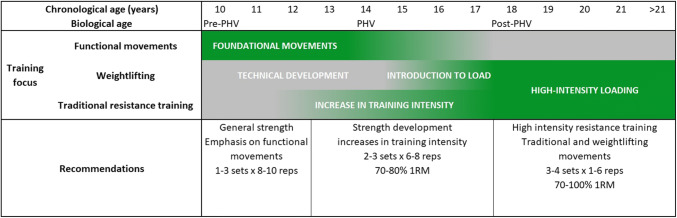
Generating high levels of muscular strength and power are important for success in sport and may have long-term implications for sporting careers in youth athletes. Importantly, maturation may confound the neuromuscular adaptations to resistance training when attempting to differentiate between training- vs. growth-induced strength and power gains; thus, potentially leading to erroneous conclusions regarding the efficacy of resistance training in youth athletes. The aim of this review was to critically appraise the literature concerning the efficacy of externally loaded free-weight resistance training on strength and power measures in youth athletes at different stages of maturity. Strength underpins power production; thus, developing strength through traditional resistance training methods can positively influence powerful sporting movements. In addition, weightlifting has the capacity to improve muscular power via explosive lower-body triple extension, which is essential for many sports. Despite the complexity of the techniques involved, it can be a safe and effective method to improve athletic qualities in young athletes, potentially more so than plyometric training. While low-load, high-velocity training can have a positive effect influence on high speed movements such as sprinting, the reduced intensity appears to be disadvantageous post peak-height velocity. Irrespective of age, well-coached progressive strength training adhering strictly to correct technique can then be periodised within a long-term athletic development program. It is important to primarily develop muscular strength, while concurrently refining the technical skill required for weightlifting. Physically mature athletes should undertake high-intensity resistance training to maximise neuromuscular adaptations, leading to positive changes in strength and power.
产生高水平的肌肉力量和爆发力对于运动成功至关重要,并且可能对青年运动员的运动生涯产生长期影响。重要的是,当试图区分训练引起的和生长引起的力量和爆发力增益时,成熟可能会使对阻力训练的神经肌肉适应复杂化;因此,这可能导致对青年运动员的阻力训练效果的错误结论。本综述的目的是批判性地评估有关外部加载自由重量阻力训练对不同成熟阶段的青年运动员的力量和爆发力测量的有效性的文献。力量是爆发力的基础;因此,通过传统的阻力训练方法发展力量可以积极影响有力的运动动作。此外,举重通过爆炸性的下肢三重伸展来提高肌肉力量,这对许多运动至关重要。尽管涉及的技术复杂,但它可以是一种安全有效的方法,可以提高年轻运动员的运动素质,可能比增强式训练更有效。虽然低负荷、高速度训练可以对短跑等高速运动产生积极影响,但强度降低似乎不利于峰值速度后的速度。无论年龄大小,只要严格遵循正确技术的精心指导的渐进式力量训练都可以在长期的运动发展计划中进行周期性训练。首先要发展肌肉力量,同时完善举重所需的技术技能,这一点很重要。身体成熟的运动员应进行高强度阻力训练,以最大限度地提高神经肌肉适应能力,从而使力量和爆发力发生积极变化。