Choi Jin-Ho, Lee Jong Mog, Kim Moon Soo, Lee Youngjoo, Suh Yang-Gun, Lee Sung Uk, Lee Doo Yeul, Oh Eun Sang, Kim Tae Hyun, Moon Sung Ho
Department of Thoracic Surgery, Research Institute and Hospital, National Cancer Center, Goyang 10408, Korea.
Department of Internal Medicine, Research Institute and Hospital, National Cancer Center, Goyang 10408, Korea.
Cancers (Basel). 2022 Apr 18;14(8):2033. doi: 10.3390/cancers14082033.
Proton beam therapy (PBT), as a neoadjuvant chemoradiotherapy (nCRT) modality, is expected to result in better outcomes than photon-based radiotherapy (RT) for esophageal cancer, particularly adenocarcinoma. This study reports the results of nCRT for locally advanced esophageal squamous cell carcinoma (ESCC) using both modalities.
We retrospectively reviewed the records of patients who underwent nCRT for ESCC between 2001 and 2020. A median of 41.4 Gy or cobalt gray equivalents of radiation was delivered using either photons or protons, with concurrent chemotherapy. Dosimetric and clinical parameters were compared between the two groups.
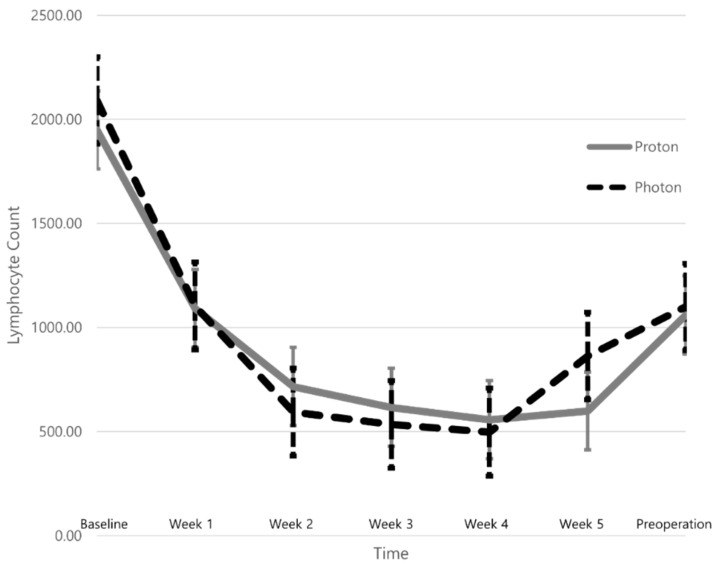
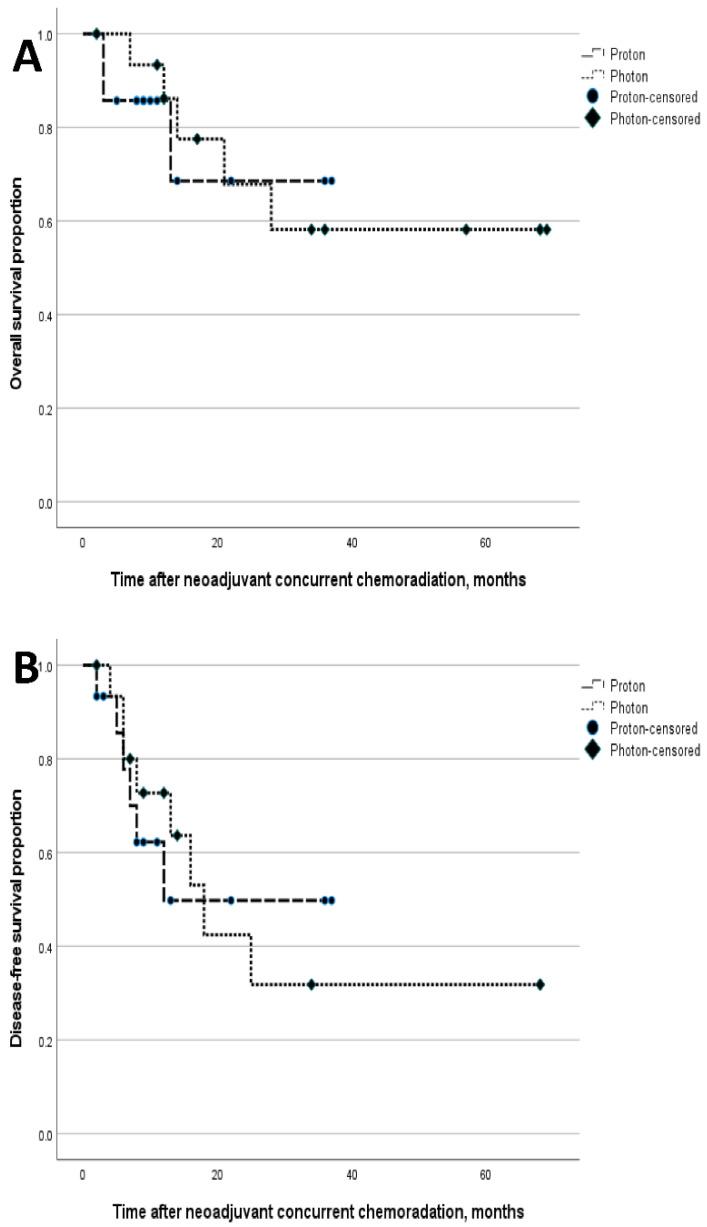
Of the 31 patients, the lungs and heart of the proton group ( = 15) were exposed to significantly less radiation compared to the photon group ( = 16). No significant differences in short-term postoperative outcomes or lymphocyte count were observed between the groups, and there were no significant differences between the photon and proton groups in 2-year overall survival (67.8% vs. 68.6%, = 0.867) or 2-year disease-free survival (33.3% vs. 34.5%, = 0.749), with a median follow-up of 17 months.
PBT provided a significant dosimetric benefit over photon-based RT during nCRT for ESCC; however, it did not improve clinical outcomes.
质子束治疗(PBT)作为一种新辅助放化疗(nCRT)方式,有望在食管癌尤其是腺癌的治疗中比基于光子的放射治疗(RT)取得更好的疗效。本研究报告了使用这两种方式对局部晚期食管鳞状细胞癌(ESCC)进行nCRT的结果。
我们回顾性分析了2001年至2020年间接受ESCC的nCRT患者的记录。使用光子或质子给予中位剂量为41.4 Gy或钴灰当量的辐射,并同时进行化疗。比较两组的剂量学和临床参数。
在31例患者中,质子组(n = 15)的肺和心脏所接受的辐射明显少于光子组(n = 16)。两组之间在短期术后结局或淋巴细胞计数方面未观察到显著差异,光子组和质子组在2年总生存率(67.8%对68.6%,P = 0.867)或2年无病生存率(33.3%对34.5%,P = 0.749)方面也无显著差异,中位随访时间为17个月。
在ESCC的nCRT期间,PBT比基于光子的RT具有显著的剂量学优势;然而,它并未改善临床结局。