Jaeger Herbert, Noheda Beatriz, van der Wiel Wilfred G
Bernoulli Institute, University of Groningen, 9700 AB, Groningen, The Netherlands.
Groningen Cognitive Systems and Materials Center (CogniGron), University of Groningen, 9700 AB, Groningen, The Netherlands.
Nat Commun. 2023 Aug 16;14(1):4911. doi: 10.1038/s41467-023-40533-1.
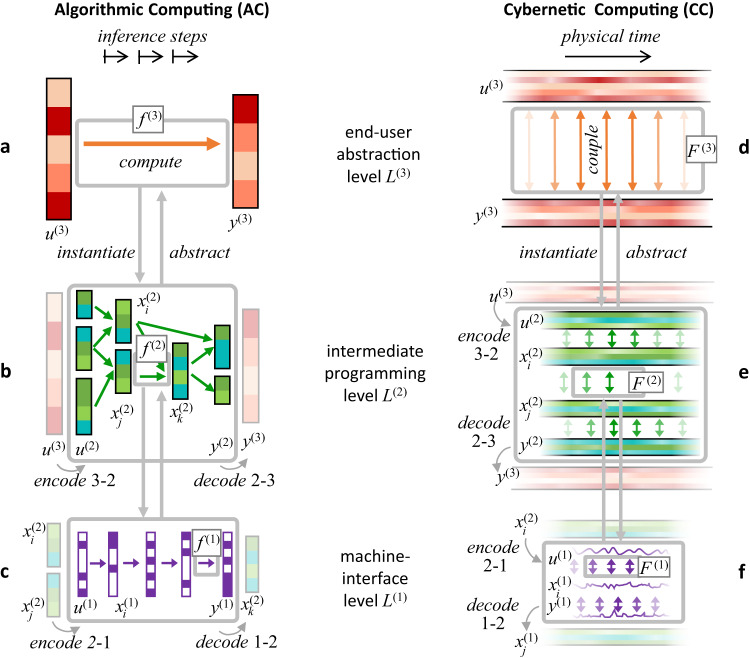
Approaching limitations of digital computing technologies have spurred research in neuromorphic and other unconventional approaches to computing. Here we argue that if we want to engineer unconventional computing systems in a systematic way, we need guidance from a formal theory that is different from the classical symbolic-algorithmic Turing machine theory. We propose a general strategy for developing such a theory, and within that general view, a specific approach that we call fluent computing. In contrast to Turing, who modeled computing processes from a top-down perspective as symbolic reasoning, we adopt the scientific paradigm of physics and model physical computing systems bottom-up by formalizing what can ultimately be measured in a physical computing system. This leads to an understanding of computing as the structuring of processes, while classical models of computing systems describe the processing of structures.
数字计算技术日益逼近的局限性激发了对神经形态计算及其他非传统计算方法的研究。在此,我们认为,如果要以系统的方式设计非传统计算系统,我们需要一种不同于经典符号算法图灵机理论的形式理论的指导。我们提出了一种发展此类理论的总体策略,并且在该总体框架内,提出了一种我们称之为流畅计算的具体方法。与图灵从自上而下的视角将计算过程建模为符号推理不同,我们采用物理学的科学范式,通过形式化物理计算系统中最终可测量的内容,自下而上地对物理计算系统进行建模。这使得我们将计算理解为过程的结构化,而传统计算系统模型描述的是结构的处理。