Department of Radiation Oncology, Department of Gynecology, Clinical Oncology School of Fujian Medical University, Fujian Cancer Hospital, Fuzhou, 350014, China.
Department of Radiation Oncology, First Hospital of Quanzhou Affiliated to Fujian Medical University, Quanzhou, 362000, China.
Sci Rep. 2023 Aug 16;13(1):13299. doi: 10.1038/s41598-023-39764-5.
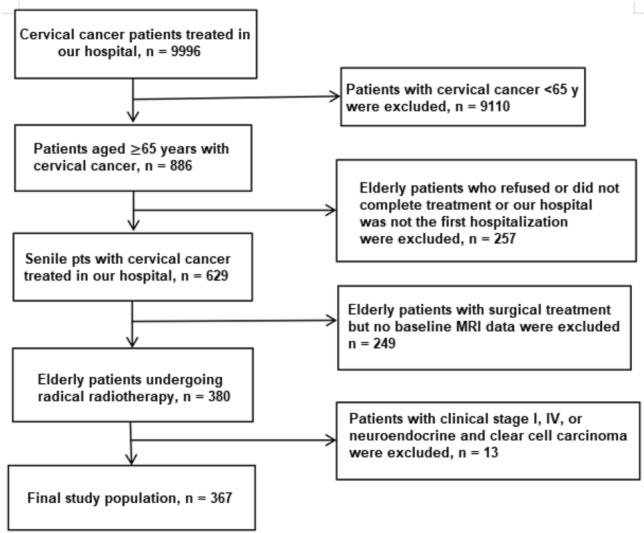
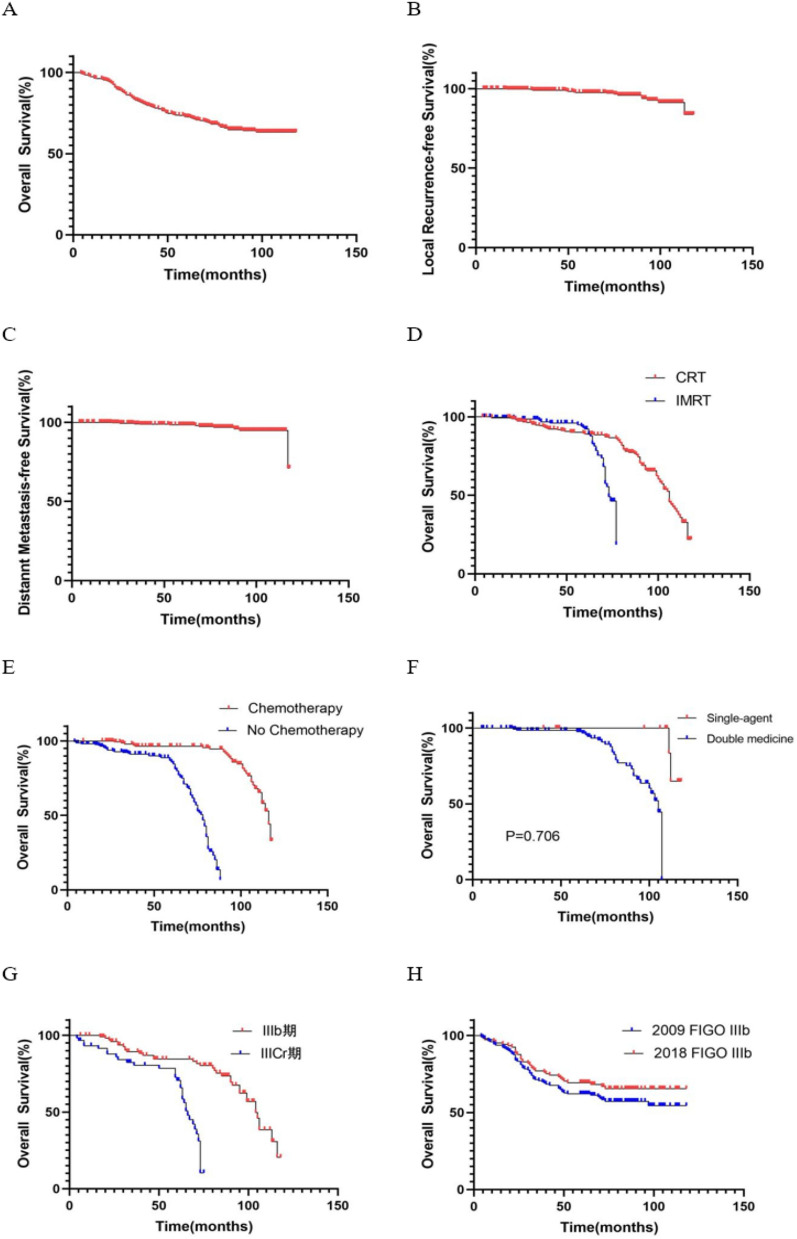
This retrospective study identified prognostic factors to help guide the clinical treatment of elderly patients (≥ 65 years) with cervical cancer who had undergone radiotherapy. A personalized model to predict 3- and 5-years survival was developed. A review was conducted of 367 elderly women with cervical cancer (staged II-III) who had undergone radiotherapy in our hospital between January 2012 and December 2016. The Cox proportional hazards regression model was used for survival analysis that considered age, hemoglobin, squamous cell carcinoma antigen, pathologic type, stage, pelvic lymph node metastasis status, and others. A nomogram was constructed to predict the survival rates. The median follow-up time was 71 months (4-118 months). The 3- (5-) years overall, progression-free, local recurrence-free, and distant metastasis-free survival rates were, respectively, 91.0% (84.4%), 92.3% (85.9%), 99.18% (99.01%), and 99.18% (97.82%). The following were significant independent prognostic factors for overall survival: tumor size, pre-treatment hemoglobin, chemotherapy, and pelvic lymph node metastasis. The C-index of the line chart was 0.699 (95% CI 0.652-0.746). The areas under the receiver operating characteristic curves for 3- and 5-years survival were 0.751 and 0.724. The nomogram was in good concordance with the actual survival rates. The independent prognostic factors for overall survival in elderly patients with cervical cancer after radiotherapy were: tumor size, pre-treatment hemoglobin, chemotherapy, and pelvic lymph node metastasis. The novel prognostic nomogram based on these factors showed good concordance with the actual survival rates and can be used to guide personalized clinical treatment.
本回顾性研究旨在确定预后因素,以帮助指导接受放疗的老年(≥65 岁)宫颈癌患者的临床治疗。建立了预测 3 年和 5 年生存率的个体化模型。对 2012 年 1 月至 2016 年 12 月在我院接受放疗的 367 例老年宫颈癌(Ⅱ-Ⅲ期)患者进行了回顾性分析。采用 Cox 比例风险回归模型进行生存分析,考虑年龄、血红蛋白、鳞状细胞癌抗原、病理类型、分期、盆腔淋巴结转移状态等因素。构建了一个列线图来预测生存率。中位随访时间为 71 个月(4-118 个月)。3-(5-)年总生存率、无进展生存率、局部无复发生存率和远处无转移生存率分别为 91.0%(84.4%)、92.3%(85.9%)、99.18%(99.01%)和 99.18%(97.82%)。总生存的独立预后因素有:肿瘤大小、治疗前血红蛋白、化疗和盆腔淋巴结转移。折线图的 C 指数为 0.699(95%CI 0.652-0.746)。3 年和 5 年生存的受试者工作特征曲线下面积分别为 0.751 和 0.724。列线图与实际生存率具有良好的一致性。放疗后老年宫颈癌患者的总生存的独立预后因素有:肿瘤大小、治疗前血红蛋白、化疗和盆腔淋巴结转移。基于这些因素的新型预后列线图与实际生存率具有良好的一致性,可以用于指导个体化的临床治疗。