Center for Quantum Spintronics, Department of Physics, Norwegian University of Science and Technology, 7491, Trondheim, Norway.
Jeremiah Horrocks Institute for Mathematics, Physics and Astronomy, University of Central Lancashire, Preston, PR1 2HE, UK.
Sci Rep. 2023 Aug 17;13(1):13404. doi: 10.1038/s41598-023-40575-x.
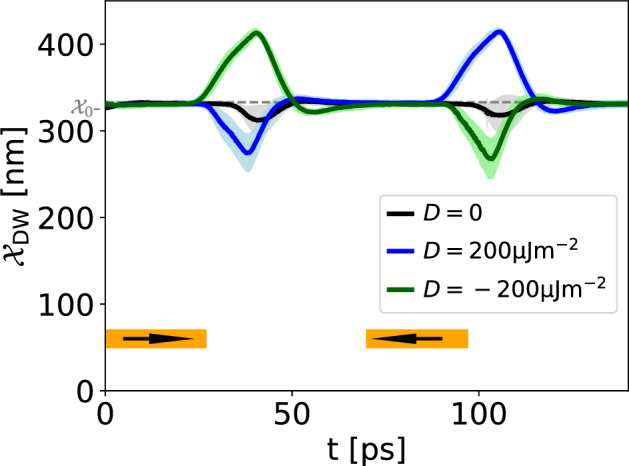
Brain-inspired neuromorphic computing is a promising path towards next generation analogue computers that are fundamentally different compared to the conventional von Neumann architecture. One model for neuromorphic computing that can mimic the human brain behavior are spiking neural networks (SNNs), of which one of the most successful is the leaky integrate-and-fire (LIF) model. Since conventional complementary metal-oxide-semiconductor (CMOS) devices are not meant for modelling neural networks and are energy inefficient in network applications, recently the focus shifted towards spintronic-based neural networks. In this work, using the advantage of antiferromagnetic insulators, we propose a non-volatile magnonic neuron that could be the building block of a LIF spiking neuronal network. In our proposal, an antiferromagnetic domain wall in the presence of a magnetic anisotropy gradient mimics a biological neuron with leaky, integrating, and firing properties. This single neuron is controlled by polarized antiferromagnetic magnons, activated by either a magnetic field pulse or a spin transfer torque mechanism, and has properties similar to biological neurons, namely latency, refraction, bursting and inhibition. We argue that this proposed single neuron, based on antiferromagnetic domain walls, is faster and has more functionalities compared to previously proposed neurons based on ferromagnetic systems.
脑启发的神经形态计算是下一代模拟计算机的有前途的途径,与传统的冯·诺依曼架构有根本的不同。一种可以模拟人脑行为的神经形态计算模型是尖峰神经网络 (SNN),其中最成功的模型之一是漏电积分和放电 (LIF) 模型。由于传统的互补金属氧化物半导体 (CMOS) 器件不适合用于模拟神经网络,并且在网络应用中效率低下,因此最近的重点转向基于自旋电子学的神经网络。在这项工作中,我们利用反铁磁绝缘体的优势,提出了一种非易失性磁振子神经元,它可以成为 LIF 尖峰神经元网络的基本组成部分。在我们的方案中,存在磁各向异性梯度的反铁磁畴壁模拟了具有漏、积分和放电特性的生物神经元。这个单神经元由极化的反铁磁磁振子控制,通过磁场脉冲或自旋转移扭矩机制激活,并且具有类似于生物神经元的特性,即潜伏期、折射、爆发和抑制。我们认为,与基于铁磁系统的先前提出的神经元相比,基于反铁磁畴壁的这种拟议的单神经元速度更快,功能更多。