Health Outcomes Division, College of Pharmacy, The University of Texas at Austin, Austin, TX, 78712, USA.
College of Nursing, University of Central Florida, Orlando, FL, USA.
Sci Rep. 2023 Aug 18;13(1):13491. doi: 10.1038/s41598-023-40552-4.
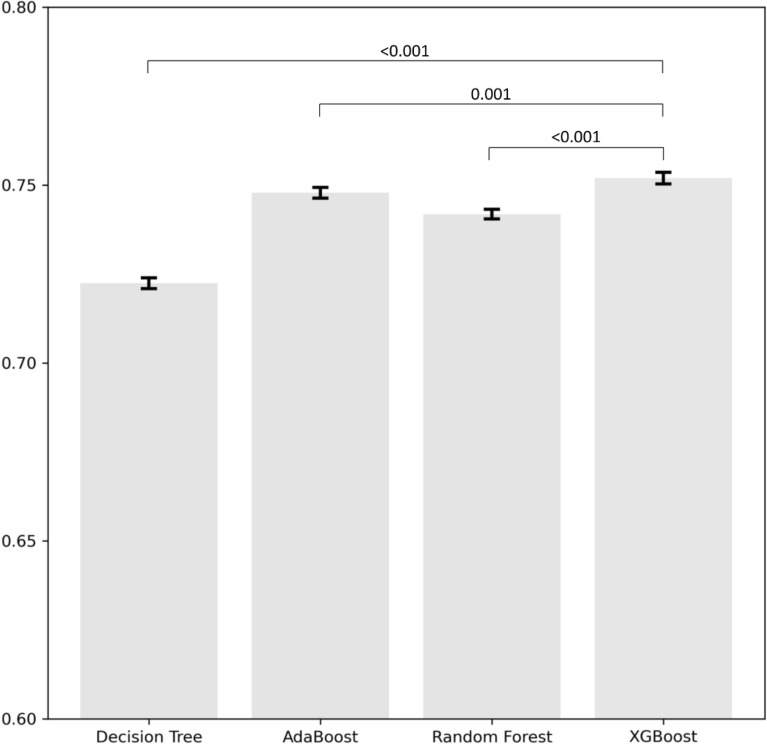
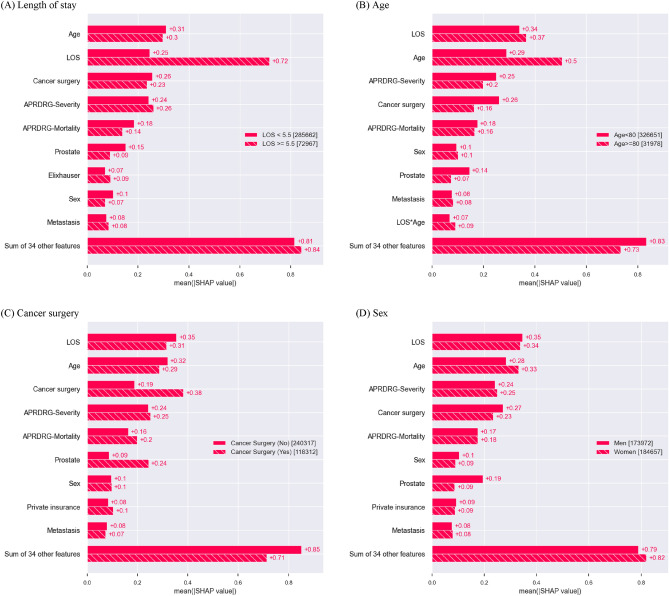
Cardiovascular disease (CVD) in cancer patients can affect the risk of unplanned readmissions, which have been reported to be costly and associated with worse mortality and prognosis. We aimed to demonstrate the feasibility of using machine learning techniques in predicting the risk of unplanned 180-day readmission attributable to CVD among hospitalized cancer patients using the 2017-2018 Nationwide Readmissions Database. We included hospitalized cancer patients, and the outcome was unplanned hospital readmission due to any CVD within 180 days after discharge. CVD included atrial fibrillation, coronary artery disease, heart failure, stroke, peripheral artery disease, cardiomegaly, and cardiomyopathy. Decision tree (DT), random forest, extreme gradient boost (XGBoost), and AdaBoost were implemented. Accuracy, precision, recall, F2 score, and receiver operating characteristic curve (AUC) were used to assess the model's performance. Among 358,629 hospitalized patients with cancer, 5.86% (n = 21,021) experienced unplanned readmission due to any CVD. The three ensemble algorithms outperformed the DT, with the XGBoost displaying the best performance. We found length of stay, age, and cancer surgery were important predictors of CVD-related unplanned hospitalization in cancer patients. Machine learning models can predict the risk of unplanned readmission due to CVD among hospitalized cancer patients.
心血管疾病(CVD)在癌症患者中可能会影响非计划性再入院的风险,据报道,这种风险代价高昂,并与死亡率和预后更差相关。我们旨在展示使用机器学习技术在预测因 CVD 导致的 180 天内非计划性再入院风险方面的可行性,这些患者数据来自 2017-2018 年全国再入院数据库。我们纳入了住院癌症患者,结局是出院后 180 天内因任何 CVD 导致的非计划性再入院。CVD 包括心房颤动、冠状动脉疾病、心力衰竭、中风、外周动脉疾病、心脏扩大和心肌病。我们实施了决策树(DT)、随机森林、极端梯度提升(XGBoost)和自适应增强(AdaBoost)。准确性、精度、召回率、F2 评分和接收者操作特征曲线(AUC)用于评估模型的性能。在 358629 名住院癌症患者中,有 5.86%(n=21021)因任何 CVD 而发生非计划性再入院。这三种集成算法的性能优于 DT,其中 XGBoost 表现最佳。我们发现住院时间、年龄和癌症手术是癌症患者 CVD 相关非计划性住院的重要预测因素。机器学习模型可以预测住院癌症患者因 CVD 导致的非计划性再入院风险。