Sun Changlong, Xu Xin, Gui Cenlin, Chen Fuzhou, Wang Yian, Chen Shengzhou, Shao Minhua, Wang Jiahai
School of Chemistry and Chemical Engineering, Guangzhou University, Guangzhou, 510006, People's Republic of China.
Department of Chemical and Biological Engineering, The Hong Kong University of Science and Technology, Clear Water Bay, Kowloon, Hong Kong, People's Republic of China.
Nanomicro Lett. 2023 Aug 18;15(1):202. doi: 10.1007/s40820-023-01175-6.
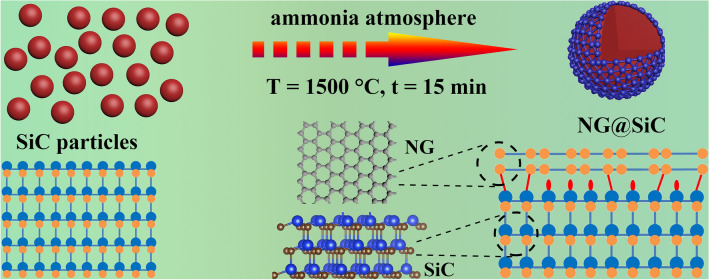
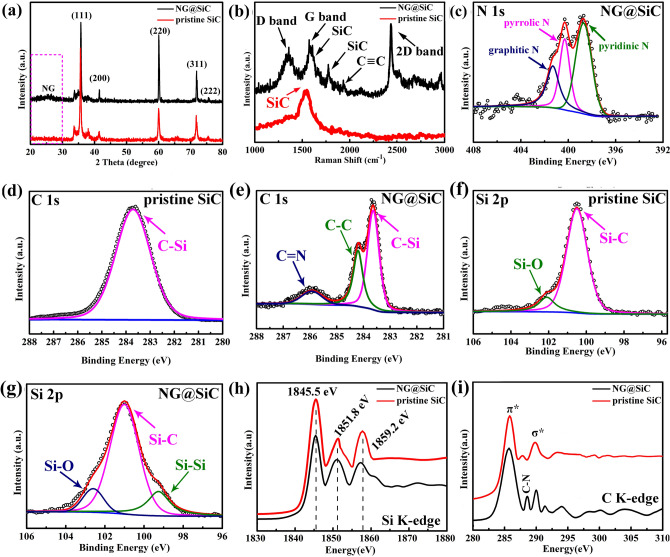
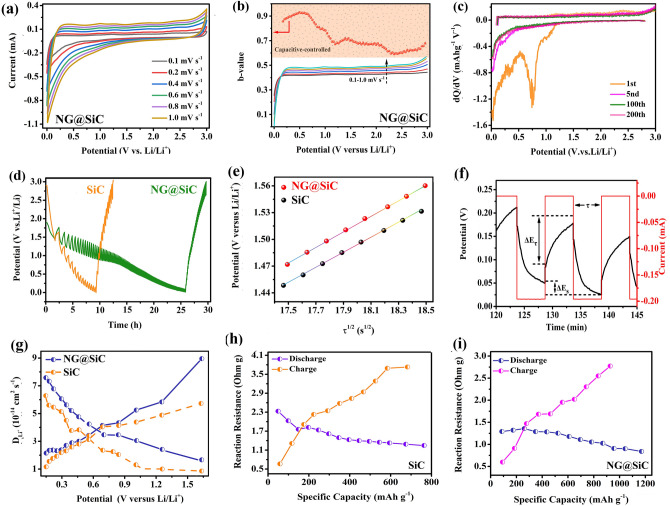
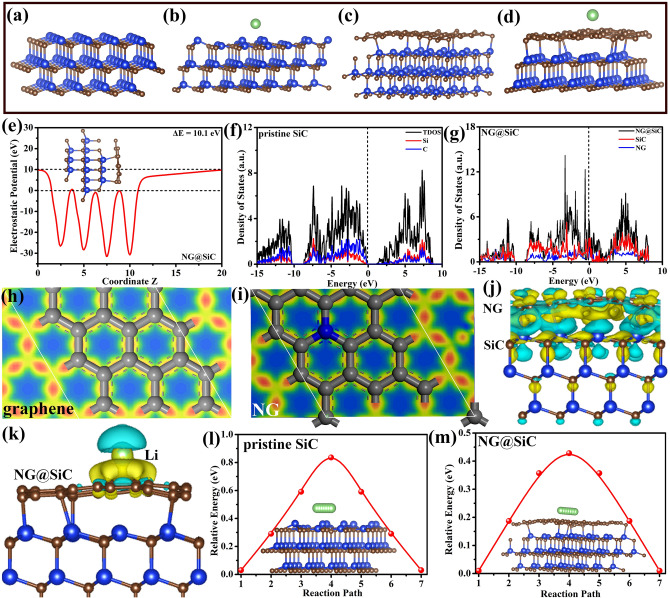
Tailoring the interfacial interaction in SiC-based anode materials is crucial to the accomplishment of higher energy capacities and longer cycle lives for lithium-ion storage. In this paper, atomic-scale tunable interfacial interaction is achieved by epitaxial growth of high-quality N doped graphene (NG) on SiC (NG@SiC). This well-designed NG@SiC heterojunction demonstrates an intrinsic electric field with intensive interfacial interaction, making it an ideal prototype to thoroughly understand the configurations of electron/ion bridges and the mechanisms of interatomic electron migration. Both density functional theory (DFT) analysis and electrochemical kinetic analysis reveal that these intriguing electron/ion bridges can control and tailor the interfacial interaction via the interfacial coupled chemical bonds, enhancing the interfacial charge transfer kinetics and preventing pulverization/aggregation. As a proof-of-concept study, this well-designed NG@SiC anode shows good reversible capacity (1197.5 mAh g after 200 cycles at 0.1 A g) and cycling durability with 76.6% capacity retention at 447.8 mAh g after 1000 cycles at 10.0 A g. As expected, the lithium-ion full cell (LiFePO/C//NG@SiC) shows superior rate capability and cycling stability. This interfacial interaction tailoring strategy via epitaxial growth method provides new opportunities for traditional SiC-based anodes to achieve high-performance lithium-ion storage and beyond.
调整碳化硅基负极材料中的界面相互作用对于实现更高的锂离子存储能量容量和更长的循环寿命至关重要。在本文中,通过在碳化硅(NG@SiC)上外延生长高质量的氮掺杂石墨烯(NG)实现了原子尺度上的可调界面相互作用。这种精心设计的NG@SiC异质结展现出具有强烈界面相互作用的内建电场,使其成为深入理解电子/离子桥构型和原子间电子迁移机制的理想原型。密度泛函理论(DFT)分析和电化学动力学分析均表明,这些有趣的电子/离子桥可通过界面耦合化学键控制和调整界面相互作用,增强界面电荷转移动力学并防止粉化/团聚。作为概念验证研究,这种精心设计的NG@SiC负极表现出良好的可逆容量(在0.1 A g下循环200次后为1197.5 mAh g)以及循环耐久性,在10.0 A g下循环1000次后,在447.8 mAh g时容量保持率为76.6%。正如预期的那样,锂离子全电池(LiFePO/C//NG@SiC)表现出优异的倍率性能和循环稳定性。这种通过外延生长方法进行的界面相互作用调控策略为传统碳化硅基负极实现高性能锂离子存储及其他应用提供了新机遇。