Centro de Investigação em Biodiversidade e Recursos Genéticos, CIBIO, InBIO Laboratório Associado, Universidade do Porto, Campus de Vairão, Vairão, 4485-661, Portugal.
Program in Genomics, Biodiversity and Land Planning, CIBIO, BIOPOLIS, Campus de Vairão, Vairão, 4485-661, Portugal.
BMC Microbiol. 2023 Aug 18;23(1):226. doi: 10.1186/s12866-023-02970-2.
While the human oral microbiome is known to play an important role in systemic health, its average composition and diversity patterns are still poorly understood. To gain better insights into the general composition of the microbiome on a global scale, the characterization of microbiomes from a broad range of populations, including non-industrialized societies, is needed. Here, we used the portion of non-human reads obtained through an expanded exome capture sequencing approach to characterize the saliva microbiomes of 52 individuals from eight ethnolinguistically diverse southern African populations from Angola (Kuvale, Kwepe, Himba, Tjimba, Kwisi, Twa, !Xun) and Zimbabwe (Tshwa), including foragers, food-producers, and peripatetic groups (low-status communities who provide services to their dominant neighbors).
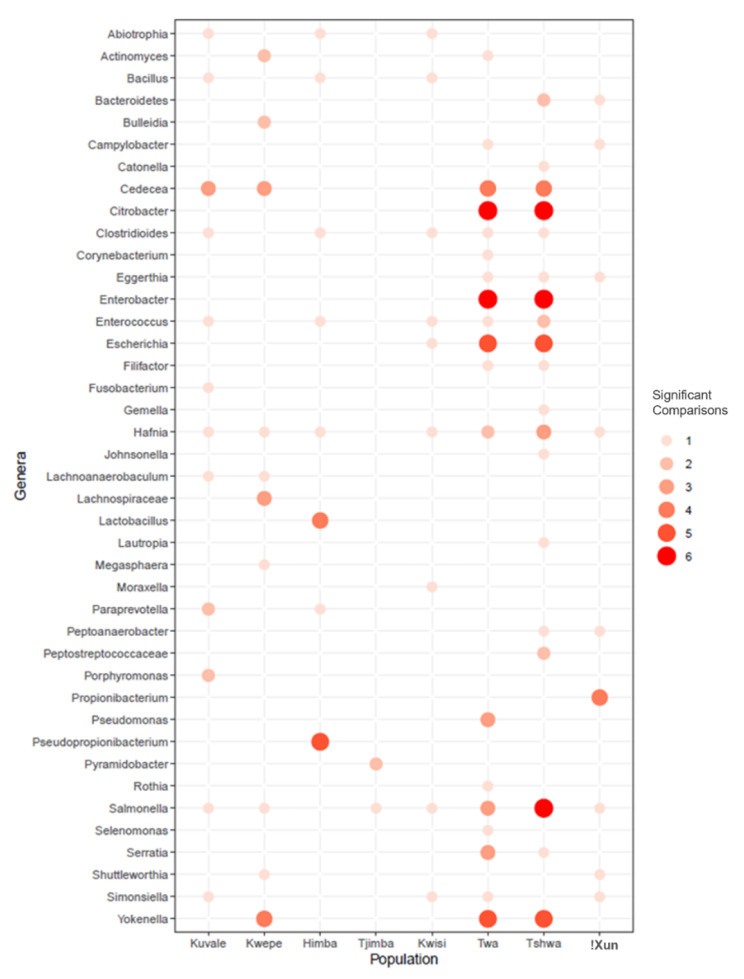
Our results indicate that neither host genetics nor livelihood seem to influence the oral microbiome profile, with Neisseria, Streptococcus, Prevotella, Rothia, and Porphyromonas being the five most frequent genera in southern African groups, in line with what has been shown for other human populations. However, we found that some Tshwa and Twa individuals display an enrichment of pathogenic genera from the Enterobacteriaceae family (i.e. Enterobacter, Citrobacter, Salmonella) of the Proteobacteria phylum, probably reflecting deficient sanitation and poor health conditions associated with social marginalization.
Taken together, our results suggest that socio-economic status, rather than ethnolinguistic affiliation or subsistence mode, is a key factor in shaping the salivary microbial profiles of human populations in southern Africa.
虽然人类口腔微生物组在全身健康中起着重要作用,但它的平均组成和多样性模式仍知之甚少。为了更深入地了解全球范围内微生物组的一般组成,需要对包括非工业化社会在内的广泛人群的微生物组进行特征描述。在这里,我们使用通过扩展外显子捕获测序方法获得的非人类reads 部分来描述来自安哥拉(Kuvale、Kwepe、Himba、Tjimba、Kwisi、Twa、!Xun)和津巴布韦(Tshwa)的 8 个具有不同语言和民族的南部非洲人群的 52 个人的唾液微生物组,包括觅食者、食物生产者和游牧群体(地位低下的社区为他们的主导邻居提供服务)。
我们的结果表明,宿主遗传学和生计似乎都不会影响口腔微生物组的特征,Neisseria、Streptococcus、Prevotella、Rothia 和 Porphyromonas 是南部非洲人群中最常见的五个属,这与其他人类人群的结果一致。然而,我们发现一些 Tshwa 和 Twa 个体的肠道杆菌科(即肠杆菌科、柠檬酸杆菌科、沙门氏菌)的致病性属富集,可能反映了卫生条件差和与社会边缘化相关的健康状况不佳。
总之,我们的研究结果表明,社会经济地位而不是语言和民族联系或生计模式是塑造南部非洲人群唾液微生物组特征的关键因素。