Impact Accelerator Unit, Versus Arthritis Primary Care Centre, School of Medicine, Keele University, Staffordshire, United Kingdom.
Department of Family Medicine and Population Health, University of Antwerpen, Antwerpen, Belgium.
Eur J Gen Pract. 2023 Dec;29(1):2243037. doi: 10.1080/13814788.2023.2243037.
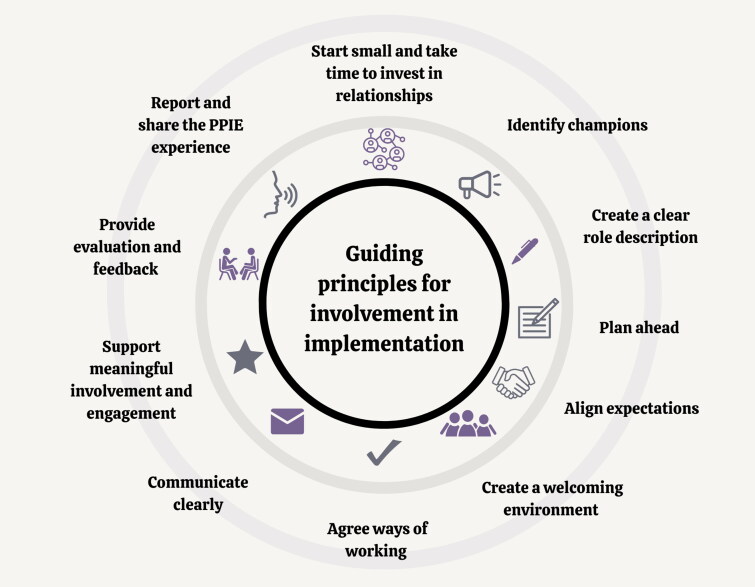
This final article in the four-part series focuses on the often neglected yet important role of the public in implementing research in General Practice and Primary Care more broadly. Experience in implementation of findings from research with public engagement in Primary Care has highlighted how partnership working with patients and the public is important in transitioning from 'what we know' from the evidence-base to 'what we do' in practice. Factors related to Primary Care research that make public engagement important are highlighted e.g. implementing complex interventions, implementing interventions that increase health equity, implementing interventions in countries with different primary healthcare system strengths. Involvement of patients and public can enhance the development of modelling and simulation included in studies on systems modelling for improving health services. We draw on the emerging evidence base to describe public engagement in implementation and offer some guiding principles for engaging with the public in the implementation in General Practice and Primary Care in general. Illustrative case studies are included to support others wishing to offer meaningful engagement in implementing research evidence.
这是四部分系列文章的最后一篇,重点关注公众在更广泛地实施全科医学和初级保健研究方面经常被忽视但却很重要的作用。在初级保健中通过公众参与实施研究结果的经验突出了与患者和公众合作的重要性,因为这有助于从证据基础上的“我们所知”过渡到实践中的“我们所做”。强调了与初级保健研究相关的使公众参与变得重要的因素,例如实施复杂干预措施、实施增加健康公平的干预措施、在具有不同初级卫生保健系统优势的国家实施干预措施。患者和公众的参与可以增强系统建模研究中建模和模拟的发展,从而改善卫生服务。我们借鉴新兴的证据基础来描述实施过程中的公众参与,并为一般意义上的全科医学和初级保健中的实施提供一些与公众进行合作的指导原则。本文还包括了一些说明性案例研究,以支持那些希望在实施研究证据方面进行有意义的参与的人。