Department of Intensive Care, Amsterdam University Medical Centers, Location AMC, Amsterdam, The Netherlands.
Department of Anesthesiology, Amsterdam University Medical Centers, Location AMC, Amsterdam, The Netherlands.
PLoS One. 2023 Aug 23;18(8):e0289412. doi: 10.1371/journal.pone.0289412. eCollection 2023.
INTELLiVENT-Adaptive Support Ventilation (ASV) is a closed-loop ventilation mode that uses capnography to adjust tidal volume (VT) and respiratory rate according to a user-set end-tidal CO2 (etCO2) target range. We compared sidestream versus mainstream capnography with this ventilation mode with respect to the quality of breathing in patients after cardiac surgery.
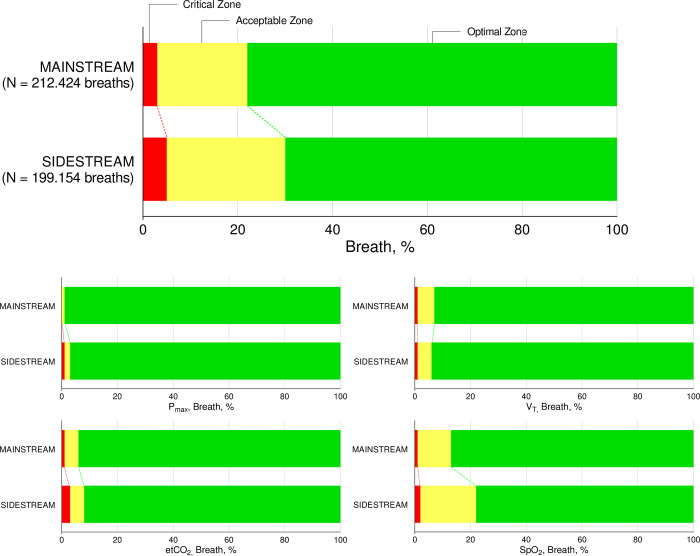
Single-center, single-blinded, non-inferiority, randomized clinical trial in adult patients scheduled for elective cardiac surgery that were expected to receive at least two hours of postoperative ventilation in the ICU. Patients were randomized 1:1 to closed-loop ventilation with sidestream or mainstream capnography. Each breath was classified into a zone based on the measured VT, maximum airway pressure, etCO2 and pulse oximetry. The primary outcome was the proportion of breaths spent in a predefined 'optimal' zone of ventilation during the first three hours of postoperative ventilation, with a non-inferiority margin for the difference in the proportions set at -20%. Secondary endpoints included the proportion of breaths in predefined 'acceptable' and 'critical' zones of ventilation, and the proportion of breaths with hypoxemia.
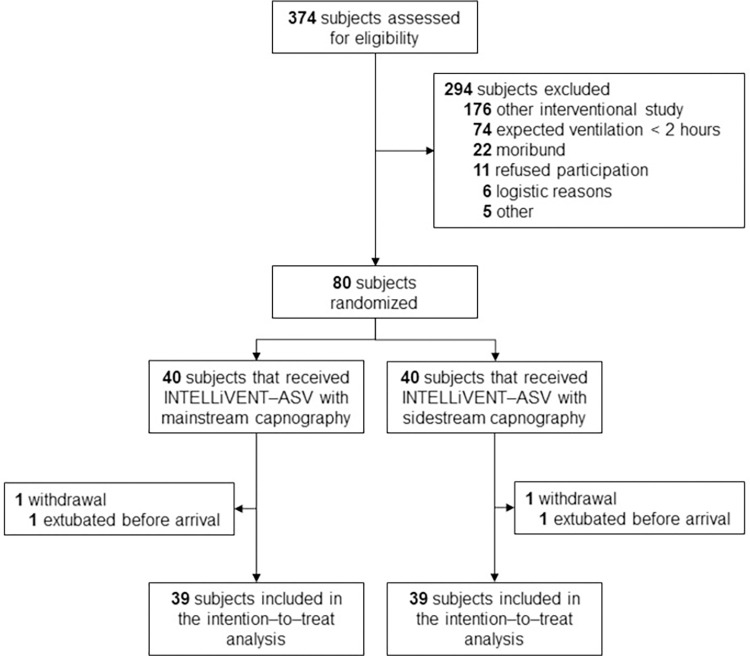
Of 80 randomized subjects, 78 were included in the intention-to-treat analysis. We could not confirm the non-inferiority of closed-loop ventilation using sidestream with respect to the proportion of breaths in the 'optimal' zone (mean ratio 0.87 [0.77 to ∞]; P = 0.116 for non-inferiority). The proportion of breaths with hypoxemia was higher in the sidestream capnography group versus the mainstream capnography group.
We could not confirm that INTELLiVENT-ASV using sidestream capnography is non-inferior to INTELLiVENT-ASV using mainstream capnography with respect to the quality of breathing in subjects receiving postoperative ventilation after cardiac surgery.
NCT04599491 (clinicaltrials.gov).
INTELLiVENT-自适应支持通气(ASV)是一种闭环通气模式,它使用呼气末二氧化碳(etCO2)监测来调整潮气量(VT)和呼吸频率,以达到用户设定的目标范围。我们比较了这种通气模式下,心外科手术后患者使用旁流与主流呼气末二氧化碳监测时的呼吸质量。
这是一项在成人患者中进行的单中心、单盲、非劣效性、随机临床试验,这些患者计划接受择期心脏手术,并预计在 ICU 中接受至少 2 小时的术后通气。患者以 1:1 的比例随机分配至接受旁流或主流呼气末二氧化碳监测的闭环通气。根据测量的 VT、最大气道压力、etCO2 和脉搏血氧饱和度,每一次呼吸被分类到一个区域。主要结局是在术后通气的前 3 小时内,预设的“最佳”通气区域内的呼吸比例,设定的差异非劣效性边界为-20%。次要终点包括预设的“可接受”和“关键”通气区域内的呼吸比例,以及低氧血症呼吸的比例。
在 80 名随机患者中,78 名患者纳入意向治疗分析。我们不能确认闭环通气使用旁流与主流相比,在“最佳”区域内的呼吸比例上具有非劣效性(平均比值 0.87 [0.77 至 ∞];非劣效性 P = 0.116)。旁流呼气末二氧化碳监测组的低氧血症呼吸比例高于主流呼气末二氧化碳监测组。
我们不能确认 INTELLiVENT-ASV 使用旁流呼气末二氧化碳监测在心脏手术后接受术后通气的患者的呼吸质量方面不劣于 INTELLiVENT-ASV 使用主流呼气末二氧化碳监测。
NCT04599491(clinicaltrials.gov)。