CINETic Center, National University of Theatre and Film "I.L. Caragiale" Bucharest, Bucharest, Romania.
Faculty of Psychology and Educational Sciences, Department of Applied Psychology and Psychotherapy, University of Bucharest, Bucharest, Romania.
Brain Topogr. 2024 May;37(3):357-368. doi: 10.1007/s10548-023-00999-0. Epub 2023 Aug 24.
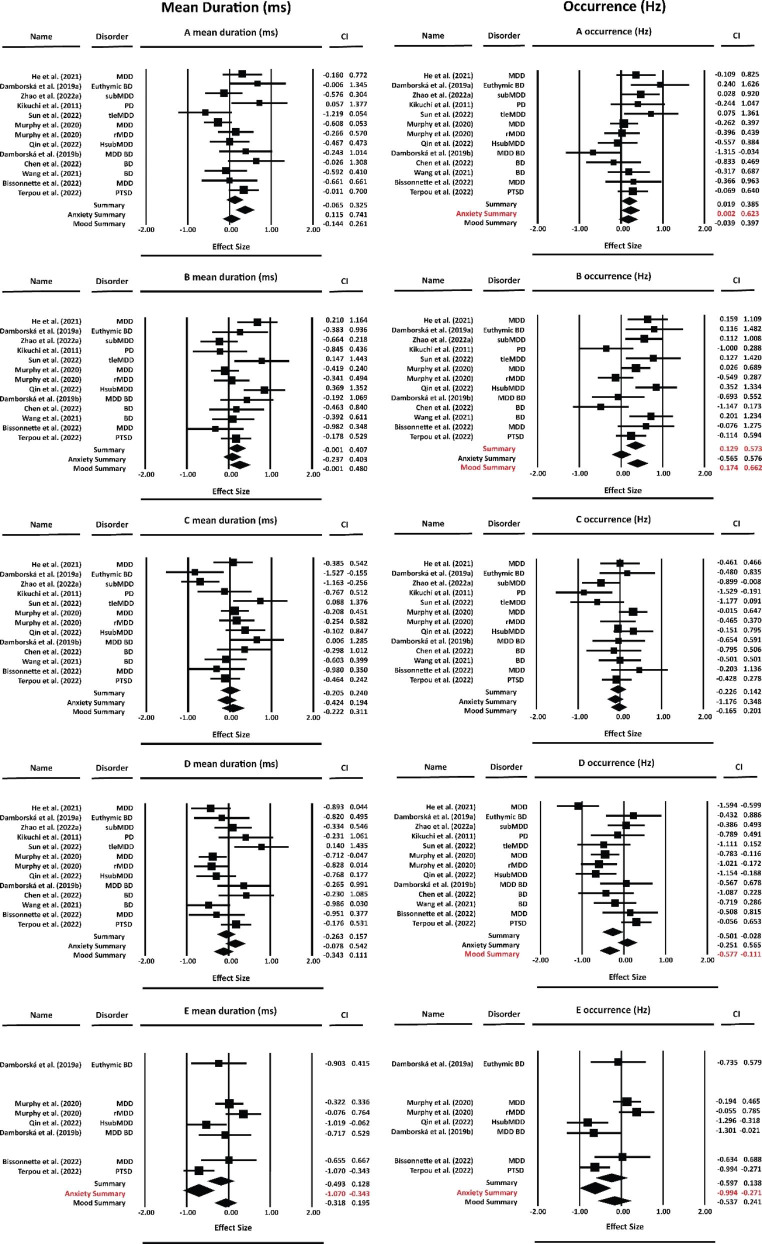
To reduce the psycho-social burden increasing attention has focused on brain abnormalities in the most prevalent and highly co-occurring neuropsychiatric disorders, such as mood and anxiety. However, high inter-study variability in these patients results in inconsistent and contradictory alterations in the fast temporal dynamics of large-scale networks as measured by EEG microstates. Thus, in this meta-analysis, we aim to investigate the consistency of these changes to better understand possible common neuro-dynamical mechanisms of these disorders.In the systematic search, twelve studies investigating EEG microstate changes in participants with mood and anxiety disorders and individuals with subclinical depression were included in this meta-analysis, adding up to 787 participants.The results suggest that EEG microstates consistently discriminate mood and anxiety impairments from the general population in patients and subclinical states. Specifically, we found a small significant effect size for B microstates in patients compared to healthy controls, with larger effect sizes for increased B presence in unmedicated patients with comorbidity. In a subgroup meta-analysis of ten mood disorder studies, microstate D showed a significant effect size for decreased presence. When investigating only the two anxiety disorder studies, we found a significantly small effect size for the increased microstate A and a medium effect size for decreased microstate E (one study). However, more studies are needed to elucidate whether these findings are diagnostic-specific markers.Results are discussed in relation to the functional meaning of microstates and possible contribution to an explanatory mechanism of overlapping symptomatology of mood and anxiety disorders.
为了减轻心理社会负担,人们越来越关注情绪和焦虑等最常见且高度共患的神经精神疾病中的大脑异常。然而,这些患者之间研究的高度变异性导致 EEG 微状态测量的大规模网络快速时间动态的不一致和矛盾变化。因此,在这项荟萃分析中,我们旨在研究这些变化的一致性,以更好地理解这些疾病可能存在的共同神经动力学机制。在系统搜索中,我们纳入了 12 项研究,这些研究调查了情绪和焦虑障碍患者以及亚临床抑郁个体的 EEG 微状态变化,共纳入了 787 名参与者。结果表明,EEG 微状态能够在患者和亚临床状态下将情绪和焦虑障碍与一般人群区分开来。具体来说,我们发现与健康对照组相比,患者的 B 微状态存在小而显著的效应量,合并症未用药患者的 B 微状态存在率增加,效应量更大。在对 10 项情绪障碍研究的亚组荟萃分析中,微状态 D 显示出存在率降低的显著效应量。当仅研究两项焦虑障碍研究时,我们发现微状态 A 的增加存在显著的小效应量,微状态 E 的减少存在中等效应量(一项研究)。然而,需要更多的研究来阐明这些发现是否是特定于诊断的标志物。结果与微状态的功能意义以及对情绪和焦虑障碍重叠症状的解释机制的可能贡献相关联进行了讨论。