Olivito Fabrizio, Jagdale Pravin, Oza Goldie
Department of Chemistry and Chemical Technologies, University of Calabria, Via P. Bucci, Cubo 12C, 87036 Cosenza, Italy.
Circular Carbon GmbH, Europaring 4, 94315 Straubing, Germany.
Toxics. 2023 Aug 13;11(8):698. doi: 10.3390/toxics11080698.
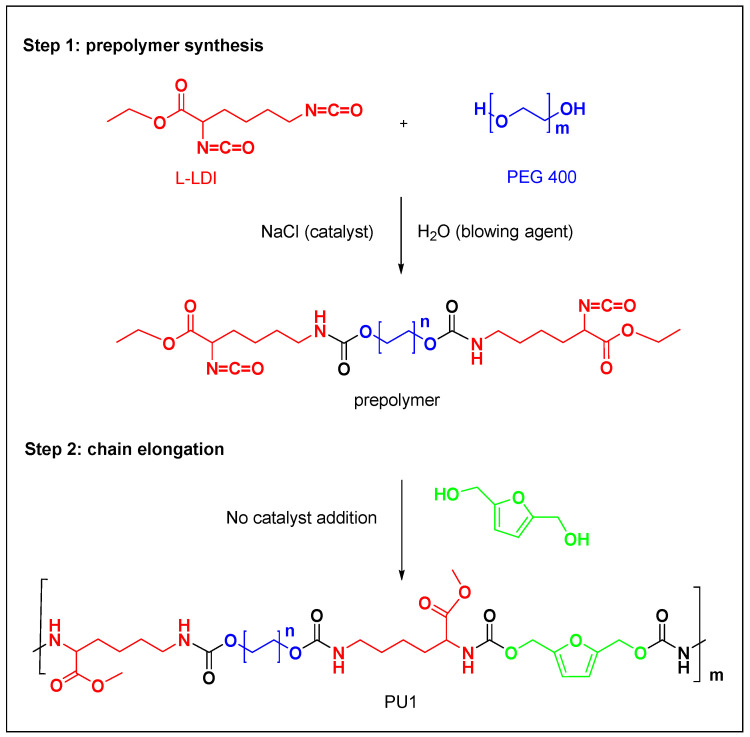
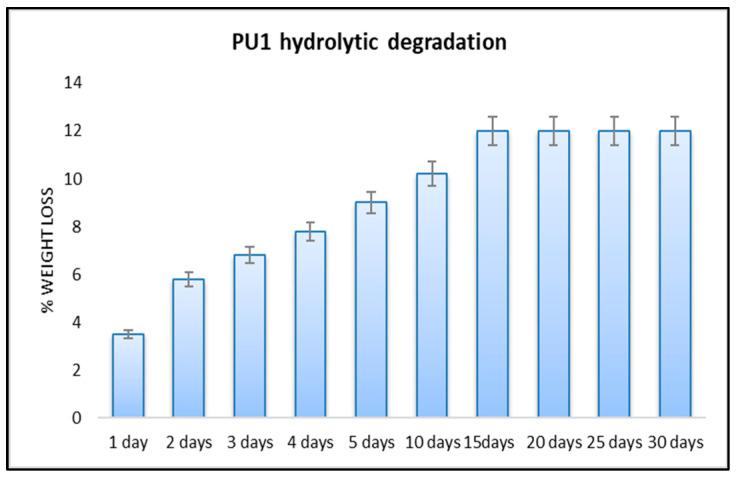
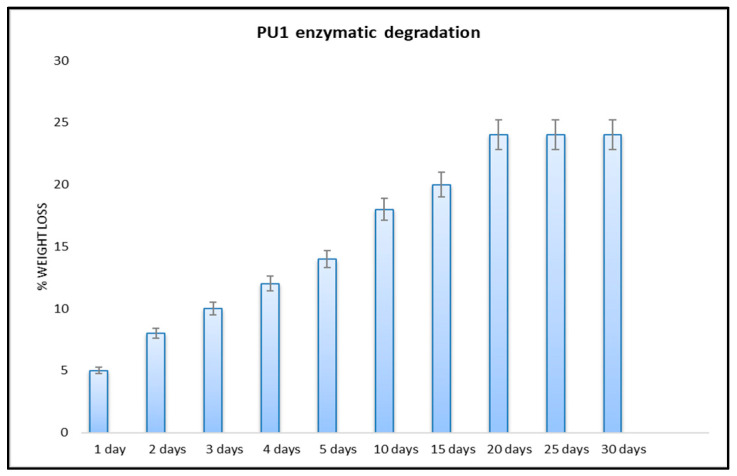
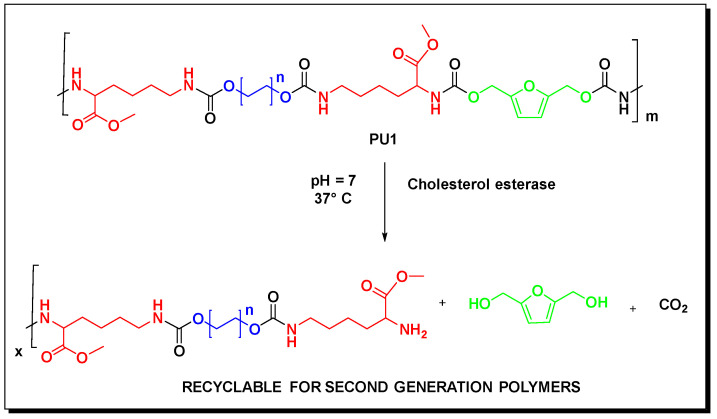
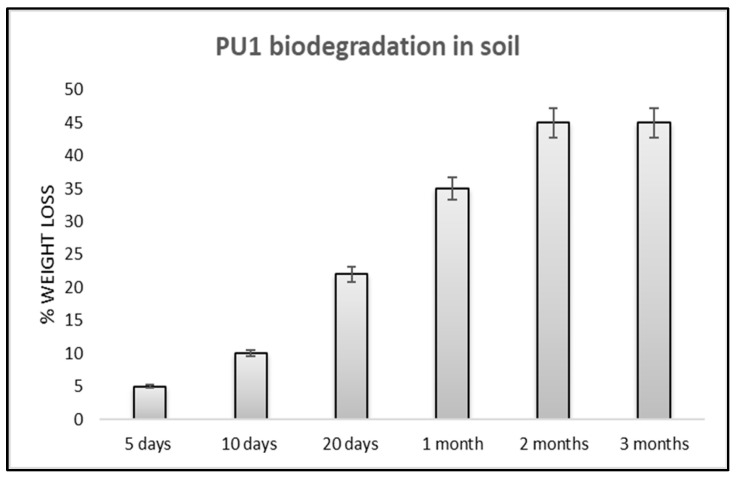
In this paper we produced a bio-based polyether-polyurethane foam PU1 through the prepolymer method. The prepolymer was obtained by the reaction of PEG 400 with -Lysine ethyl ester diisocyanate (L-LDI). The freshly prepared prepolymer was extended with 2,5-bis(hydroxymethyl)furan (BHMF) to produce the final polyurethane. The renewable chemical BHMF was produced through the chemical reduction of HMF by sodium borohydride. HMF was produced by a previously reported procedure from fructose using choline chloride and ytterbium triflate. To evaluate the degradation rate of the foam PU1, we tested the chemical stability by soaking it in a 10% sodium hydroxide solution. The weight loss was only 12% after 30 days. After that, we proved that enzymatic hydrolysis after 30 days using cholesterol esterase was more favoured than hydrolysis with NaOH, with a weight loss of 24%, probably due to the hydrophobic character of the PU1 and a better adhesion of the enzyme on the surface with respect to water. BHMF was proved to be of crucial importance for the enzymatic degradation assay at 37 °C in phosphate buffer solution, because it represents the breaking point inside the polyurethane chain. Soil burial degradation test was monitored for three months to evaluate whether the joint activity of sunlight, climate changes and microorganisms, including bacteria and fungi, could further increase the biodegradation. The unexpected weight loss after soil burial degradation test was 45% after three months. This paper highlights the potential of using sustainable resources to produce new biodegradable materials.
在本文中,我们通过预聚物法制备了一种生物基聚醚 - 聚氨酯泡沫PU1。预聚物是由聚乙二醇400(PEG 400)与赖氨酸乙酯二异氰酸酯(L - LDI)反应得到的。将新制备的预聚物与2,5 - 双(羟甲基)呋喃(BHMF)进行扩链反应,以制备最终的聚氨酯。可再生化学品BHMF是通过硼氢化钠对HMF进行化学还原制备的。HMF是通过先前报道的使用氯化胆碱和三氟甲磺酸镱从果糖制备的方法生产的。为了评估泡沫PU1的降解速率,我们将其浸泡在10%的氢氧化钠溶液中测试其化学稳定性。30天后重量损失仅为12%。之后,我们证明在30天后使用胆固醇酯酶进行酶水解比用NaOH水解更有利,重量损失为24%,这可能是由于PU1的疏水特性以及酶相对于水在表面的更好附着力。事实证明,BHMF对于在37°C的磷酸盐缓冲溶液中的酶降解测定至关重要,因为它代表了聚氨酯链内的断裂点。进行了为期三个月的土壤掩埋降解试验,以评估阳光、气候变化以及包括细菌和真菌在内的微生物的联合作用是否会进一步提高生物降解率。土壤掩埋降解试验三个月后的意外重量损失为45%。本文强调了利用可持续资源生产新型可生物降解材料的潜力。