Department of Urology and Institute of Urology, West China Hospital, Sichuan University, Chengdu, 610041, China.
West China School of Public Health and West China Fourth Hospital, Sichuan University, Chengdu, 610041, China.
BMC Public Health. 2023 Aug 25;23(1):1632. doi: 10.1186/s12889-023-16483-0.
Increasing body fat or decreasing muscle and bone mass were associated with worse health outcomes in the adult population. The effects of nickel exposure on body composition are not known. The aim of the current study was to investigate the relationship between urinary nickel levels and body compositions.
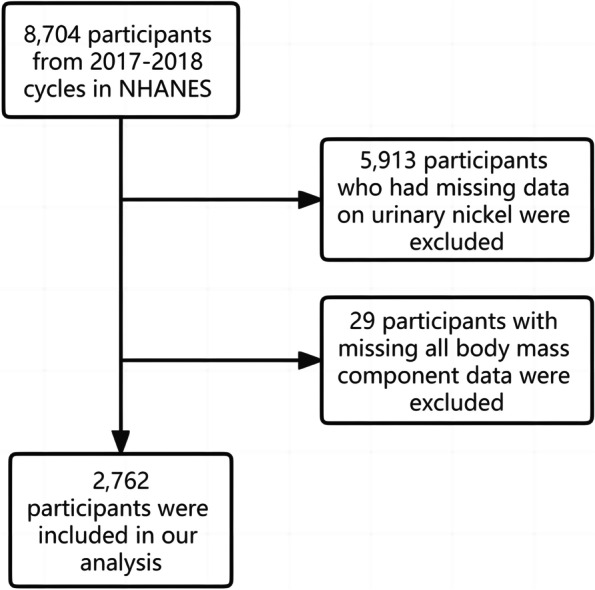
Two thousand seven hundred sixty-two participants were included in the analysis from the National Health and Nutrition Examination Surveys of 2017-2018 after excluding participants who have missing data on urinary nickel and those with missing all body mass component data. We used weighted generalized linear models to explore the relationship between urinary nickel and body mass components under interpolating missing covariable values. Simultaneously, sensitivity analyses and subgroup analysis were conducted to verify stability of analysis result. Curve fitting and saturation effect analysis were used to explore the possible nonlinear relationship between urine nickel and body compositions.
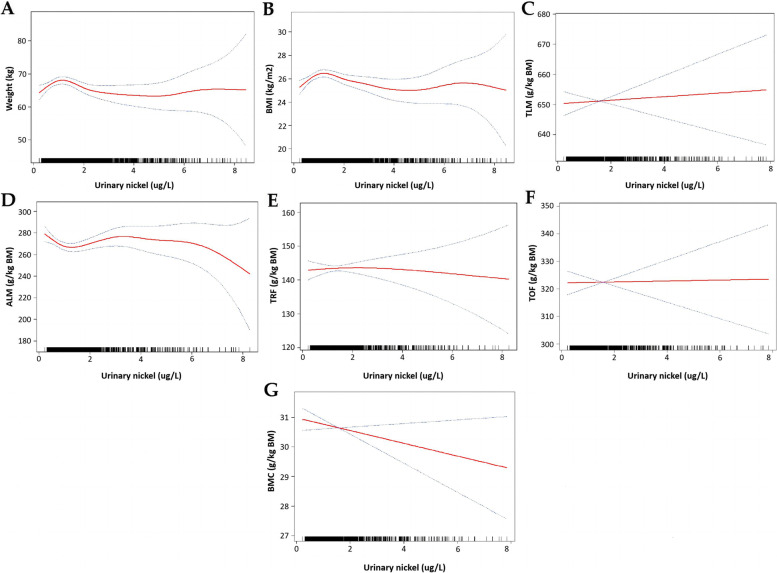
Among the 2,762 participants, the average urinary nickel level was 1.58 ug/L. The weighted generalized linear models, the sensitivity analyses and subgroup analyses found no significant linear relationship between urinary nickel and body compositions. For body weight, BMI, TLM, ALM, TRF, TOF and BMC, the urine nickel saturation effect values were 0.76, 0.74, 0.5, 0.67, 0.64, 0.48, and 0.45 ug/L, respectively. For each 1 ug/L rise in urinary nickel levels at levels below the turning point, body weight increases (β = 9.06, 95% CI = 2.75, 15.36, p = 0.01), BMI increases (β = 3.20, 95% CI = 1.36, 5.05, p = < 0.001), TLM decreases (β = -47.39, 95% CI = -97.38, 2.59, p = 0.06), ALM decreases (β = -37.25, 95% CI = -63.25, -11.24, p = 0.01), TRF increases (β = 20.68, 95% CI = 1.50, 39.86, p = 0.03), TOF increases (β = 57.92, 95% CI = -0.12, 115.95, p = 0.05), and BMC decreases (β = -6.84, 95% CI = -12.64, -1.04, p = 0.02).
In summary, our study demonstrated that a dose-response relationship exists between urinary nickel and body compositions, with a low inflection point level of urinary nickel for the saturation effect.
在成年人群体中,体脂肪增加或肌肉和骨量减少与健康状况恶化有关。镍暴露对身体成分的影响尚不清楚。本研究的目的是探讨尿镍水平与身体成分之间的关系。
在排除了尿镍数据缺失和所有身体成分数据缺失的参与者后,从 2017-2018 年全国健康与营养调查中纳入了 2762 名参与者进行分析。我们使用加权广义线性模型,在插补缺失协变量值的情况下,探讨尿镍与身体成分之间的关系。同时,进行敏感性分析和亚组分析以验证分析结果的稳定性。曲线拟合和饱和效应分析用于探索尿镍与身体成分之间可能存在的非线性关系。
在 2762 名参与者中,平均尿镍水平为 1.58 ug/L。加权广义线性模型、敏感性分析和亚组分析均未发现尿镍与身体成分之间存在显著的线性关系。对于体重、BMI、TLM、ALM、TRF、TOF 和 BMC,尿镍的饱和效应值分别为 0.76、0.74、0.5、0.67、0.64、0.48 和 0.45 ug/L。在转折点以下的每个尿镍水平升高 1 ug/L 时,体重增加(β=9.06,95%CI=2.75,15.36,p=0.01),BMI 增加(β=3.20,95%CI=1.36,5.05,p=0.001),TLM 减少(β=-47.39,95%CI=-97.38,2.59,p=0.06),ALM 减少(β=-37.25,95%CI=-63.25,-11.24,p=0.01),TRF 增加(β=20.68,95%CI=1.50,39.86,p=0.03),TOF 增加(β=57.92,95%CI=0.12,115.95,p=0.05),BMC 减少(β=-6.84,95%CI=-12.64,-1.04,p=0.02)。
总之,我们的研究表明,尿镍与身体成分之间存在剂量-反应关系,尿镍的低拐点水平存在饱和效应。