Santoro Luca, Zaccone Vincenzo, Falsetti Lorenzo, Ruggieri Vittorio, Danese Martina, Miro Chiara, Di Giorgio Angela, Nesci Antonio, D'Alessandro Alessia, Moroncini Gianluca, Santoliquido Angelo
Department of Cardiovascular and Thoracic Sciences, Fondazione Policlinico Universitario Agostino Gemelli IRCCS, 00168 Rome, Italy.
Department of Emergency Medicine, Internal and Sub-Intensive Medicine, Azienda Ospedaliero-Universitaria delle Marche, 60126 Ancona, Italy.
Biomedicines. 2023 Aug 9;11(8):2239. doi: 10.3390/biomedicines11082239.
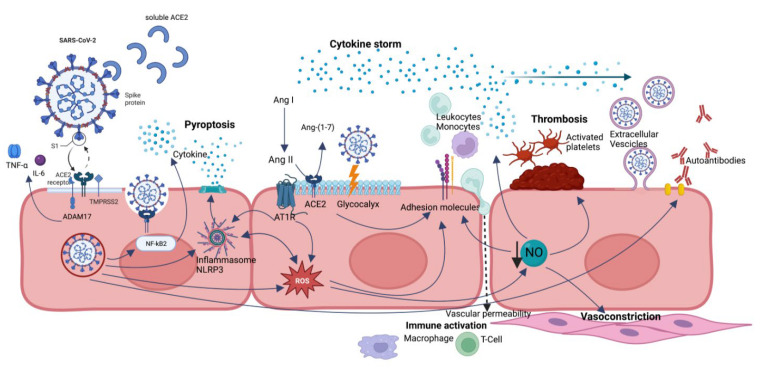
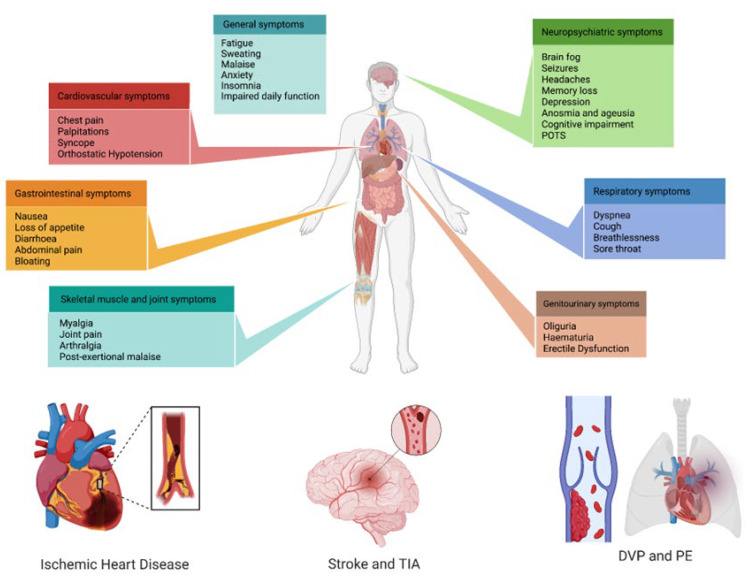
The global action against coronavirus disease 2019 (COVID-19), caused by SARS-CoV-2 infection, shed light on endothelial dysfunction. Although SARS-CoV-2 primarily affects the pulmonary system, multiple studies have documented pan-vascular involvement in COVID-19. The virus is able to penetrate the endothelial barrier, damaging it directly or indirectly and causing endotheliitis and multi-organ injury. Several mechanisms cooperate to development of endothelial dysfunction, including endothelial cell injury and pyroptosis, hyperinflammation and cytokine storm syndrome, oxidative stress and reduced nitric oxide bioavailability, glycocalyx disruption, hypercoagulability, and thrombosis. After acute-phase infection, some patients reported signs and symptoms of a systemic disorder known as long COVID, in which a broad range of cardiovascular (CV) disorders emerged. To date, the exact pathophysiology of long COVID remains unclear: in addition to the persistence of acute-phase infection mechanisms, specific pathways of CV damage have been postulated, such as persistent viral reservoirs in the heart or an autoimmune response to cardiac antigens through molecular mimicry. The aim of this review is to provide an overview of the main molecular patterns of enduring endothelial activation following SARS-CoV-2 infection and to offer the latest summary of CV complications in long COVID.
由严重急性呼吸综合征冠状病毒2型(SARS-CoV-2)感染引起的2019冠状病毒病(COVID-19)的全球应对行动,揭示了内皮功能障碍。尽管SARS-CoV-2主要影响肺部系统,但多项研究已证明COVID-19存在全身血管受累情况。该病毒能够穿透内皮屏障,直接或间接损害内皮屏障,导致内皮炎症和多器官损伤。多种机制共同作用导致内皮功能障碍,包括内皮细胞损伤和焦亡、过度炎症和细胞因子风暴综合征、氧化应激和一氧化氮生物利用度降低、糖萼破坏、高凝状态和血栓形成。在急性期感染后,一些患者报告出现了一种称为“长新冠”的全身性疾病的体征和症状,其中出现了多种心血管疾病。迄今为止,“长新冠”的确切病理生理学仍不清楚:除了急性期感染机制持续存在外,还推测了心血管损伤的特定途径,如心脏中持续存在的病毒储存库或通过分子模拟对心脏抗原的自身免疫反应。本综述的目的是概述SARS-CoV-2感染后持续内皮激活的主要分子模式,并提供“长新冠”中心血管并发症的最新总结。