Taketomi Takumi, Tsuruta Fuminori
PhD Program in Human Biology, School of Integrative and Global Majors, University of Tsukuba, Tsukuba 305-8577, Japan.
Master's and Doctoral Programs in Biology, Faculty of Life and Environmental Sciences, University of Tsukuba, Tsukuba 305-8577, Japan.
Biology (Basel). 2023 Aug 5;12(8):1091. doi: 10.3390/biology12081091.
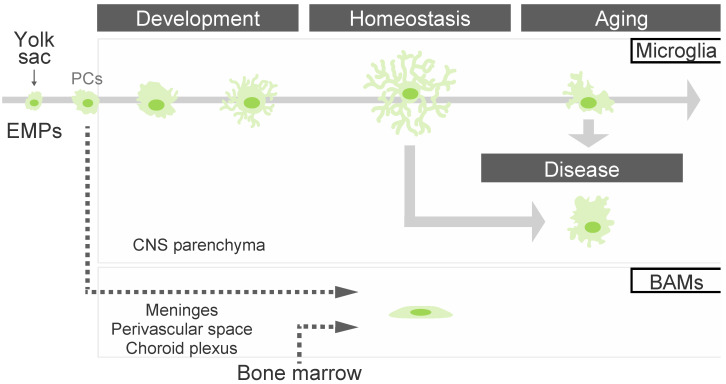
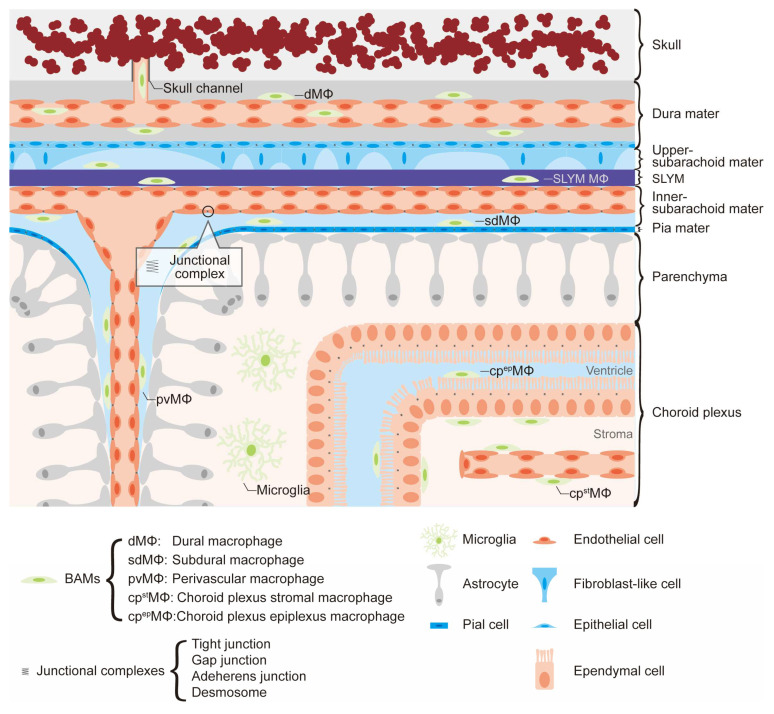
The central nervous system (CNS) plays a crucial role in regulating bodily functions by sensing and integrating environmental cues and maintaining proper physiological conditions. Recent research has revealed that CNS functions are closely coordinated with the immune system. As even minor disturbances of the immune system in the CNS can lead to various dysfunctions, diseases, or even death, it is highly specialized and segregated from that in peripheral regions. Microglia in the parenchyma and macrophages at the interface between the CNS and peripheral regions are essential immune cells in the CNS that monitor environmental changes. Recent omics analyses have revealed that these cells exhibit highly heterogeneous populations. In this review, we summarize the functions and diversity of microglia in the brain parenchyma and those of macrophages in the border regions, such as the meninges, perivascular spaces, and choroid plexus.
中枢神经系统(CNS)通过感知和整合环境线索以及维持适当的生理状况,在调节身体功能方面发挥着至关重要的作用。最近的研究表明,中枢神经系统的功能与免疫系统密切协调。由于中枢神经系统中免疫系统的哪怕是轻微紊乱都可能导致各种功能障碍、疾病甚至死亡,因此它高度专业化,与外周区域的免疫系统相隔离。实质中的小胶质细胞和中枢神经系统与外周区域之间界面处的巨噬细胞是中枢神经系统中监测环境变化的重要免疫细胞。最近的组学分析表明,这些细胞表现出高度异质性的群体。在这篇综述中,我们总结了脑实质中小胶质细胞以及脑膜、血管周围间隙和脉络丛等边界区域中巨噬细胞的功能和多样性。