Core Competence Metabolomics, Hilde-Mangold-Haus, University of Freiburg, 79104 Freiburg, Germany.
Institute of Organic Chemistry, University of Freiburg, 79104 Freiburg, Germany.
Biomolecules. 2023 Jul 26;13(8):1168. doi: 10.3390/biom13081168.
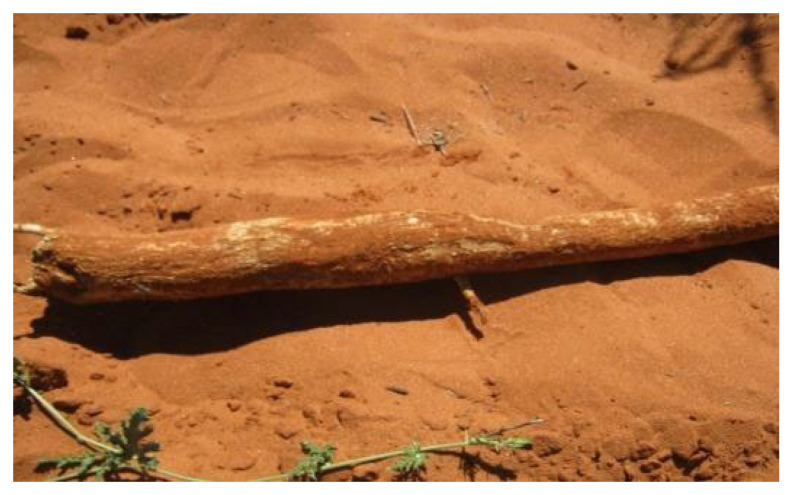
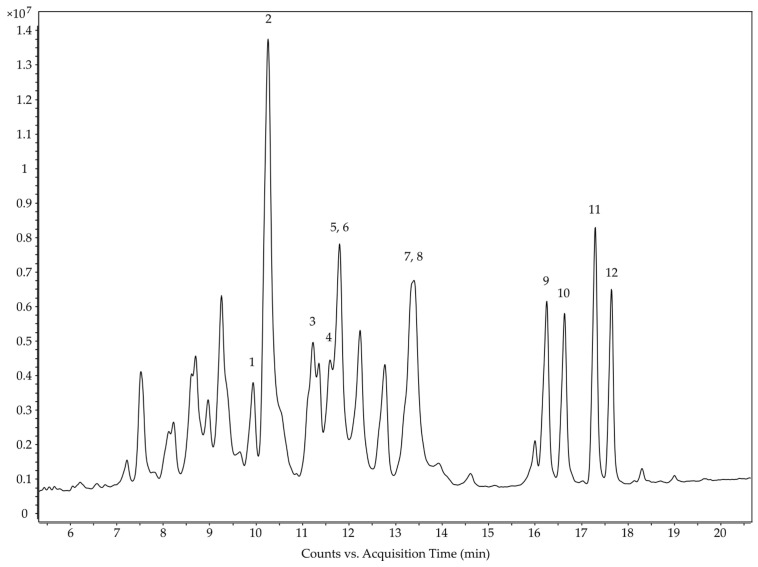
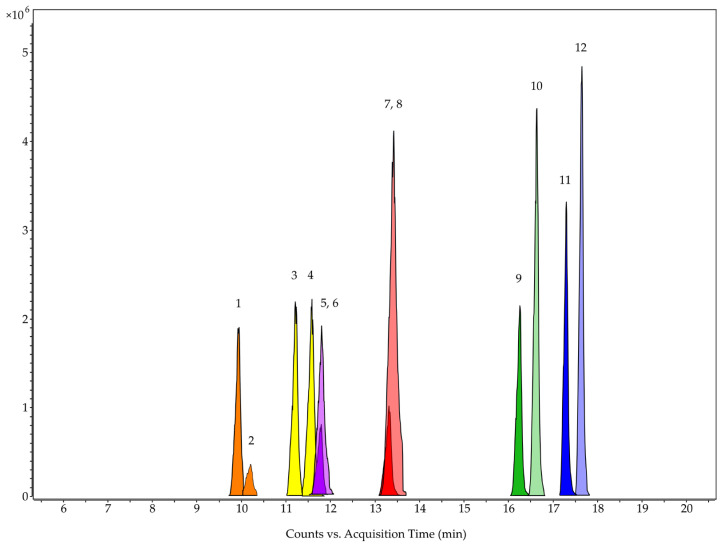
The vast pool of structurally and functionally distinct secondary metabolites (i.e., natural products (NPs)) is constantly being expanded, a process also driven by the rapid progress in the development of analytical techniques. Such NPs often show potent biological activities and are therefore prime candidates for drug development and medical applications. The ethyl acetate extract of the tuber of (), an African melon with edible fruits and seeds, shows in vitro immunomodulatory activity presumably elicited by cucurbitacins that are known major constituents of this plant. Further potentially immunomodulatory cucurbitacins or cucurbitacin derivatives were assumed to be in the tuber. Given the typically high content of cucurbitacins with similar physicochemical features but often distinct bioactivities, an efficient and reliable separation process is a prerequisite for their detailed characterization and assessment in terms of bioactivity. We therefore developed a detection method to screen and differentiate cucurbitacins via high-performance liquid chromatography/quadrupole-time-of-flight tandem mass spectrometry (HPLC-QTOF-MS/MS). In order to confirm the identification, the fragmentation patterns of two cucurbitacins and one 23,24-dihydrocucurbitacin were also investigated. Six characteristic fragments were identified and three of them were employed for the identification of cucurbitacins and 23,24-dihydrocucurbitacins in the extract. As a result, in addition to eight previously reported cucurbitacins from this plant four distinct 23,24-dihydrocucurbitacins (B, D, E, and I) were putatively identified and newly found in the ethyl acetate extract of the tuber of . The established methodology enables rapid and efficient LC-MS-based analysis and identification of cucurbitacins and 23,24-dihydrocucurbitacins in plant extracts.
()的块茎的乙酸乙酯提取物具有体外免疫调节活性,推测是由葫芦素引起的,葫芦素是这种植物的主要成分。进一步推测块茎中可能存在具有潜在免疫调节作用的葫芦素或葫芦素衍生物。鉴于通常葫芦素含量较高,具有相似的物理化学特征,但生物活性往往不同,因此,高效可靠的分离过程是对其进行详细表征和生物活性评估的前提。因此,我们开发了一种通过高效液相色谱/四极杆飞行时间串联质谱(HPLC-QTOF-MS/MS)进行筛选和区分葫芦素的检测方法。为了确认鉴定,还研究了两种葫芦素和一种 23,24-二氢葫芦素的碎裂模式。鉴定出 6 个特征片段,其中 3 个用于鉴定提取物中的葫芦素和 23,24-二氢葫芦素。结果,除了从该植物中先前报道的八种葫芦素外,还推测并在块茎的乙酸乙酯提取物中鉴定出四种不同的 23,24-二氢葫芦素(B、D、E 和 I)。所建立的方法学能够快速有效地进行基于 LC-MS 的葫芦素和 23,24-二氢葫芦素的分析和鉴定。