Jigoranu Raul-Alexandru, Roca Mihai, Costache Alexandru-Dan, Mitu Ovidiu, Oancea Alexandru-Florinel, Miftode Radu-Stefan, Haba Mihai Ștefan Cristian, Botnariu Eosefina Gina, Maștaleru Alexandra, Gavril Radu-Sebastian, Trandabat Bogdan-Andrei, Chirica Sabina Ioana, Haba Raluca Maria, Leon Maria Magdalena, Costache Irina-Iuliana, Mitu Florin
Department of Medical Specialties I, Faculty of Medicine, University of Medicine and Pharmacy "Grigore T. Popa", 700115 Iasi, Romania.
Department of Cardiology, "St. Spiridon" Emergency County Hospital, 700111 Iasi, Romania.
Life (Basel). 2023 Jul 27;13(8):1639. doi: 10.3390/life13081639.
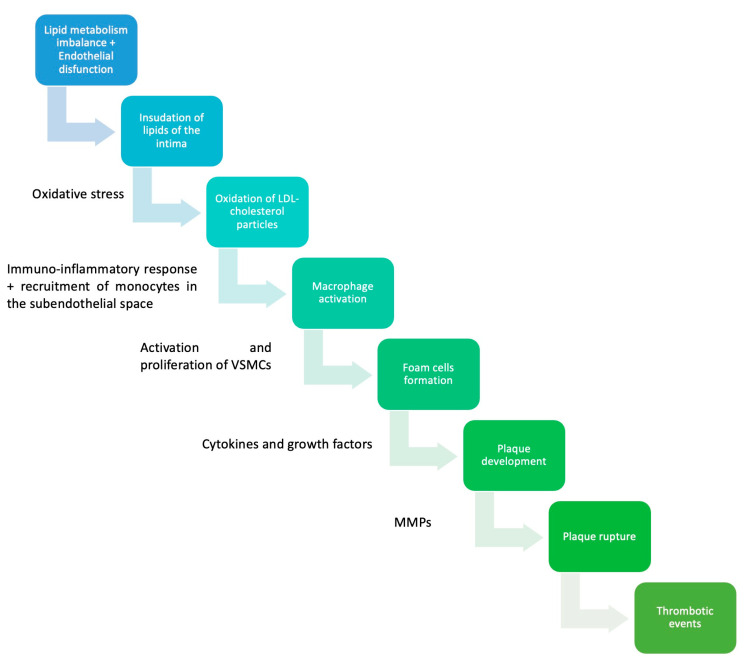
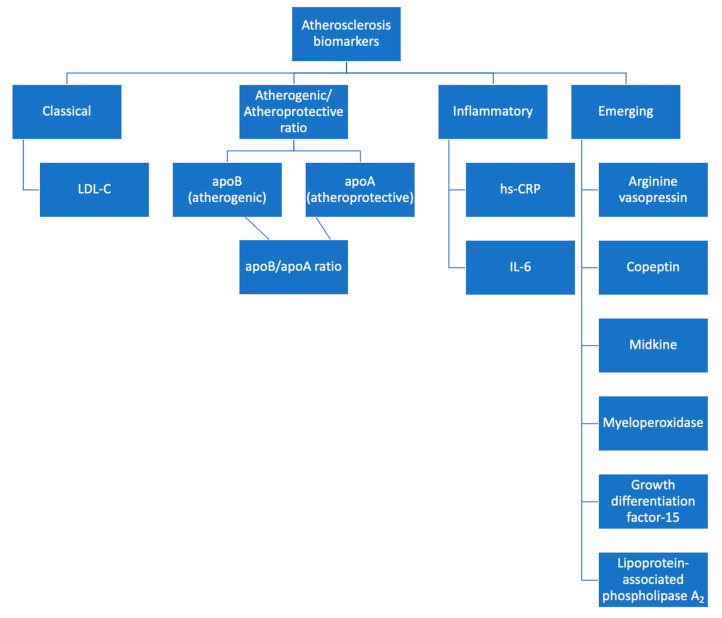
Atherosclerosis is a significant health concern with a growing incidence worldwide. It is directly linked to an increased cardiovascular risk and to major adverse cardiovascular events, such as acute coronary syndromes. In this review, we try to assess the potential diagnostic role of biomarkers in the early identification of patients susceptible to the development of atherosclerosis and other adverse cardiovascular events. We have collected publications concerning already established parameters, such as low-density lipoprotein cholesterol (LDL-C), as well as newer markers, e.g., apolipoprotein B (apoB) and the ratio between apoB and apoA. Additionally, given the inflammatory nature of the development of atherosclerosis, high-sensitivity c-reactive protein (hs-CRP) or interleukin-6 (IL-6) are also discussed. Additionally, newer publications on other emerging components linked to atherosclerosis were considered in the context of patient evaluation. Apart from the already in-use markers (e.g., LDL-C), emerging research highlights the potential of newer molecules in optimizing the diagnosis of atherosclerotic disease in earlier stages. After further studies, they might be fully implemented in the screening protocols.
动脉粥样硬化是一个重大的健康问题,在全球范围内发病率不断上升。它与心血管风险增加以及主要不良心血管事件直接相关,如急性冠脉综合征。在本综述中,我们试图评估生物标志物在早期识别易患动脉粥样硬化和其他不良心血管事件患者方面的潜在诊断作用。我们收集了有关已确立参数的出版物,如低密度脂蛋白胆固醇(LDL-C),以及较新的标志物,例如载脂蛋白B(apoB)和apoB与apoA的比值。此外,鉴于动脉粥样硬化发展的炎症性质,还讨论了高敏C反应蛋白(hs-CRP)或白细胞介素-6(IL-6)。此外,在患者评估的背景下,还考虑了有关与动脉粥样硬化相关的其他新兴成分的较新出版物。除了已在使用的标志物(如LDL-C)外,新出现的研究突出了新分子在优化动脉粥样硬化疾病早期诊断方面的潜力。经过进一步研究后,它们可能会全面应用于筛查方案中。