Department of Biology, Royal Museum for Central Africa, 3080 Tervuren, Belgium.
Laboratory of Aquatic Biology, KU Leuven, Campus Kortrijk, 8500 Kortrijk, Belgium.
FEMS Microbiol Ecol. 2023 Aug 22;99(9). doi: 10.1093/femsec/fiad101.
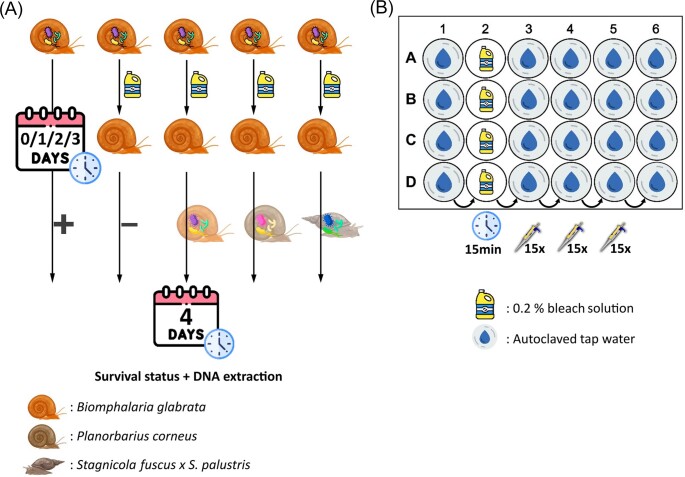
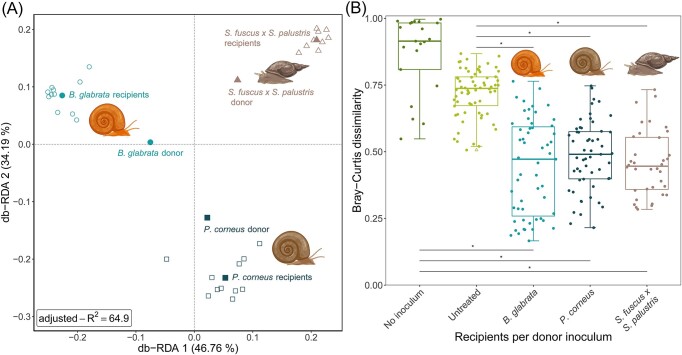
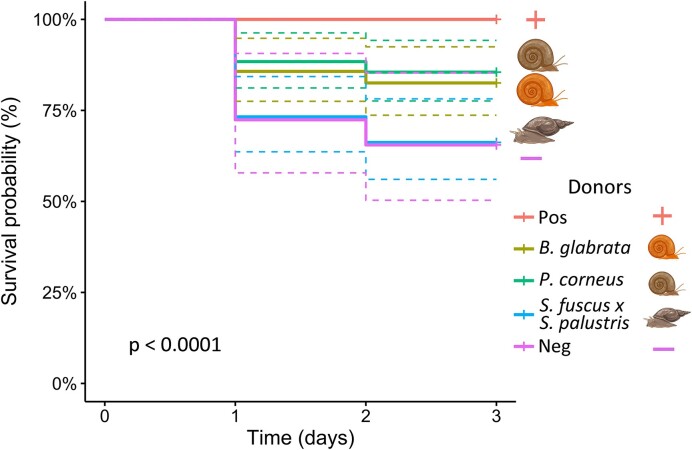
Microbial symbionts can affect host phenotypes and, thereby, ecosystem functioning. The microbiome is increasingly being recognized as an important player in the tripartite interaction between parasitic flatworms, snail intermediate hosts, and the snail microbiome. In order to better understand these interactions, transplant experiments are needed, which rely on the development of a reliable and reproducible protocol to obtain microbiome-disturbed snails. Here, we report on the first successful snail bacteriome transplants, which indicate that Biomphalaria glabrata can accrue novel bacterial assemblies depending on the available environmental bacteria obtained from donor snails. Moreover, the phylogenetic relatedness of the donor host significantly affected recipients' survival probability, corroborating the phylosymbiosis pattern in freshwater snails. The transplant technique described here, complemented by field-based studies, could facilitate future research endeavors to investigate the role of specific bacteria or bacterial communities in parasitic flatworm resistance of B. glabrata and might ultimately pave the way for microbiome-mediated control of snail-borne diseases.
微生物共生体可以影响宿主表型,从而影响生态系统功能。微生物组越来越被认为是寄生扁虫、蜗牛中间宿主和蜗牛微生物组之间三方相互作用的重要参与者。为了更好地理解这些相互作用,需要进行移植实验,这依赖于开发一种可靠且可重复的方案来获得微生物组受到干扰的蜗牛。在这里,我们报告了首次成功的蜗牛细菌组移植,这表明光滑双脐螺可以根据从供体蜗牛获得的可用环境细菌积累新的细菌组合。此外,供体宿主的系统发育相关性显著影响了受体的存活概率,证实了淡水蜗牛中的系统共生模式。这里描述的移植技术,结合基于现场的研究,可以促进未来的研究工作,以调查特定细菌或细菌群落在光滑双脐螺对寄生扁虫抗性中的作用,并最终为通过微生物组控制蜗牛传播的疾病铺平道路。