Høiseth Lars Øivind, Fjose Lars Olav, Hisdal Jonny, Comelon Marlin, Rosseland Leiv Arne, Lenz Harald
Department of Anaesthesia and Intensive Care Medicine, Division of Emergencies and Critical Care, Oslo University Hospital, Oslo, Norway.
Institute of Clinical Medicine, University of Oslo, Oslo, Norway.
BJA Open. 2023 Jun 28;7:100204. doi: 10.1016/j.bjao.2023.100204. eCollection 2023 Sep.
Methoxyflurane is approved for relief of moderate to severe pain in conscious adult trauma patients: it may be self-administrated and is well suited for use in austere environments. Trauma patients may sustain injuries causing occult haemorrhage compromising haemodynamic stability, and it is therefore important to elucidate whether methoxyflurane may adversely affect the haemodynamic response to hypovolaemia.
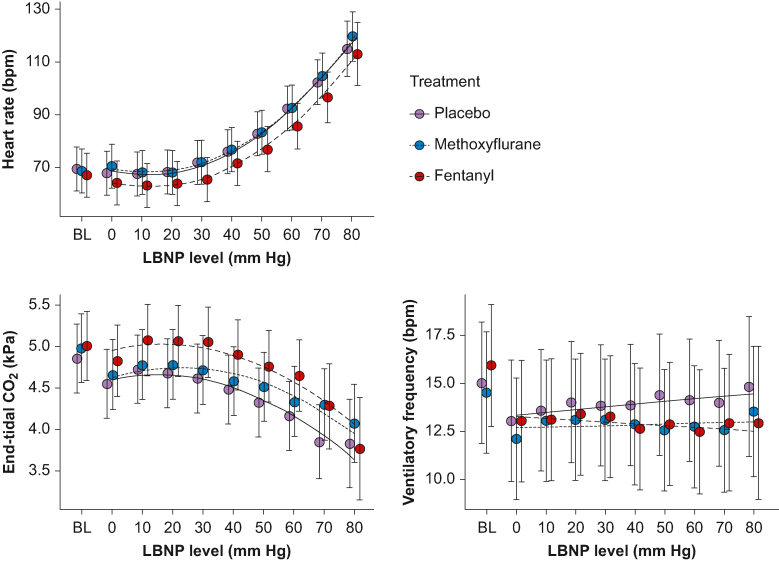
In this randomised, double-blinded, placebo-controlled, three-period crossover study, inhaled methoxyflurane 3 ml, i.v. fentanyl 25 μg, and placebo were administered to 15 healthy volunteers exposed to experimental hypovolaemia in the lower body negative pressure model. The primary endpoint was the effect of treatment on changes in cardiac output, while secondary endpoints were changes in stroke volume and mean arterial pressure and time to haemodynamic decompensation during lower body negative pressure.
There were no statistically significant effects of treatment on the changes in cardiac output, stroke volume, or mean arterial pressure during lower body negative pressure. The time to decompensation was longer for methoxyflurane compared with fentanyl (hazard ratio 1.9; 95% confidence interval 0.4-3.4; =0.010), whereas there was no significant difference to placebo (hazard ratio -1.3; 95% confidence interval -2.8 to 0.23; =0.117).
The present study does not indicate that methoxyflurane has significant adverse haemodynamic effects in conscious adults experiencing hypovolaemia.
ClinicalTrials.gov (NCT04641949) and EudraCT (2019-004144-29) https://www.clinicaltrialsregister.eu/ctr-search/trial/2019-004144-29/NO.
甲氧氟烷已被批准用于缓解清醒成年创伤患者的中度至重度疼痛:它可以自行给药,非常适合在艰苦环境中使用。创伤患者可能会遭受导致隐匿性出血的损伤,从而损害血流动力学稳定性,因此,阐明甲氧氟烷是否可能对低血容量时的血流动力学反应产生不利影响非常重要。
在这项随机、双盲、安慰剂对照、三阶段交叉研究中,对15名在下肢负压模型中经历实验性低血容量的健康志愿者给予3毫升吸入用甲氧氟烷、静脉注射25微克芬太尼和安慰剂。主要终点是治疗对心输出量变化的影响,次要终点是每搏输出量和平均动脉压的变化以及下肢负压期间血流动力学失代偿的时间。
在下肢负压期间,治疗对心输出量、每搏输出量或平均动脉压的变化没有统计学上的显著影响。与芬太尼相比,甲氧氟烷的失代偿时间更长(风险比1.9;95%置信区间0.4 - 3.4;P = 0.010),而与安慰剂相比没有显著差异(风险比 -1.3;95%置信区间 -2.8至0.23;P = 0.117)。
本研究并未表明甲氧氟烷对经历低血容量的清醒成年人有显著的不良血流动力学影响。
ClinicalTrials.gov(NCT04641949)和EudraCT(2019 - 004144 - 29)https://www.clinicaltrialsregister.eu/ctr-search/trial/2019-004144-29/NO.