Petit Camryn B, Diekfuss Jed A, Warren Shayla M, Barber Foss Kim D, Valencia Melanie, Thomas Staci M, Petushek Erich J, Karas Spero G, Hammond Kyle E, Pombo Mathew W, Labib Sameh A, Maughon Timothy S, Whitfield Bryan J, Myer Gregory D, Xerogeanes John W, Lamplot Joseph D
Emory Sports Performance And Research Center (SPARC), Flowery Branch, Georgia, U.S.A.
Emory Sports Medicine Center, Atlanta, Georgia, U.S.A.
Arthrosc Sports Med Rehabil. 2023 Jun 10;5(4):100741. doi: 10.1016/j.asmr.2023.04.024. eCollection 2023 Aug.
To characterize the secondary anterior cruciate ligament (ACL) injury rates after primary allograft anterior cruciate ligament reconstruction (ACLR) and to identify the age cut-score at which the risk of allograft failure decreases.
All patients who underwent primary ACLR within a single orthopaedic department between January 2005 and April 2020 were contacted at a minimum of 2 years post-ACLR to complete a survey regarding complications experienced post-surgery, activity level, and perceptions of knee health. Patients were excluded for incidence of previous ACLR (ipsilateral or contralateral) and/or age younger than 14 years. Relative proportions were calculated, binary regression analysis was performed, and receiver operating characteristic analysis was used to identify the threshold age for maximal sensitivity and specificity to predict high risk of allograft failure, defined as undergoing revision ACLR.
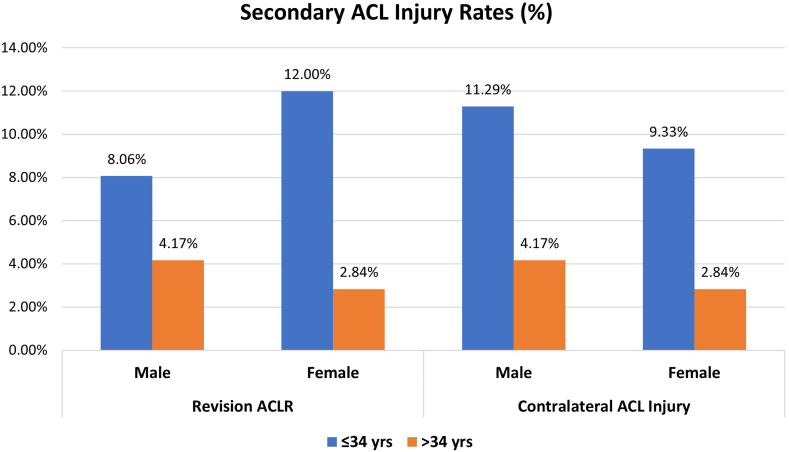
Of the 939 surveys completed, 398 patients underwent primary allograft ACLR (mean age 39.5 years; range 16.0-66.1 years; 54.3% female). The secondary ACL injury rate was 11.6% (5.8% ipsilateral revision ACLR, 5.8% contralateral ACL injury). Male and female patients had similar revision (5.5% male, 6.0% female, = .82) and contralateral ACL injury rates (6.6% male, 5.1% female, = .52). Receiver operating characteristic analysis indicated that age ≤34 years was threshold for differentiating high risk of allograft failure (area under the curve 0.65, 95% confidence interval 0.55-0.76; = .014). Patients aged ≤34 years had a greater secondary injury rate than patients >34 years (20.4% (10.2% revision ACLR, 10.2% contralateral ACL injury) versus 6.9% (3.5% revision ACLR, 3.5% contralateral ACL injury; < .001). Binary regression analysis demonstrated that decreasing age was associated with increased risk of graft failure (χ = 7.9, = .02.).
Allograft ACLR showed similar failure rates between sexes but displayed suboptimal graft failure outcomes in younger and active patients. By age 34 years, the increased revision risk for younger patients diminished.
Level IV, therapeutic case series.
描述初次同种异体前交叉韧带重建术(ACLR)后继发性前交叉韧带(ACL)损伤率,并确定同种异体移植失败风险降低的年龄分界点。
联系了2005年1月至2020年4月在单一骨科接受初次ACLR的所有患者,在ACLR后至少2年完成一项关于术后并发症、活动水平和膝关节健康认知的调查。排除既往有ACLR(同侧或对侧)病史和/或年龄小于14岁的患者。计算相对比例,进行二元回归分析,并采用受试者工作特征分析来确定预测同种异体移植失败高风险(定义为接受翻修ACLR)的最大敏感性和特异性的阈值年龄。
在完成的939份调查问卷中,398例患者接受了初次同种异体ACLR(平均年龄39.5岁;范围16.0 - 66.1岁;54.3%为女性)。继发性ACL损伤率为11.6%(5.8%为同侧翻修ACLR,5.8%为对侧ACL损伤)。男性和女性患者的翻修率(男性5.5%,女性6.0%,P = 0.82)和对侧ACL损伤率(男性6.6%,女性5.1%,P = 0.52)相似。受试者工作特征分析表明,年龄≤34岁是区分同种异体移植失败高风险的阈值(曲线下面积0.65,95%置信区间0.55 - 0.76;P = 0.014)。年龄≤34岁的患者继发性损伤率高于年龄>34岁的患者(20.4%(10.2%为翻修ACLR,10.2%为对侧ACL损伤)对6.9%(3.5%为翻修ACLR,3.5%为对侧ACL损伤;P < 0.001)。二元回归分析表明,年龄降低与移植失败风险增加相关(χ² = 7.9,P = 0.02)。
同种异体ACLR在性别之间显示出相似的失败率,但在年轻和活跃的患者中显示出次优的移植失败结果。到34岁时,年轻患者增加的翻修风险降低。
IV级,治疗性病例系列。