Mohamed Tasnim, Colciago Alessandra, Montagnani Marelli Marina, Moretti Roberta Manuela, Magnaghi Valerio
Department of Pharmacological and Biomolecular Sciences "Rodolfo Paoletti", University of Milan, Milan, Italy.
Front Cell Neurosci. 2023 Aug 14;17:1237479. doi: 10.3389/fncel.2023.1237479. eCollection 2023.
Protein kinase type C-ε (PKCε) plays an important role in the sensitization of primary afferent nociceptors, promoting mechanical hyperalgesia. In accordance, we showed that PKCε is present in sensory neurons of the peripheral nervous system (PNS), participating in the control of pain onset and chronification. Recently, it was found that PKCε is also implicated in the control of cell proliferation, promoting mitogenesis and metastatic invasion in some types of cancer. However, its role in the main glial cell of the PNS, the Schwann cells (SCs), was still not investigated.
Rat primary SCs culture were treated with different pharmacologic approaches, including the PKCε agonist dicyclopropyl-linoleic acid (DCP-LA) 500 nM, the human recombinant brain derived neurotrophic factor (BDNF) 1 nM and the TrkB receptor antagonist cyclotraxin B 10 nM. The proliferation (by cell count), the migration (by scratch test and Boyden assay) as well as some markers of SCs differentiation and epithelial-mesenchymal transition (EMT) process (by qRT-PCR and western blot) were analyzed.
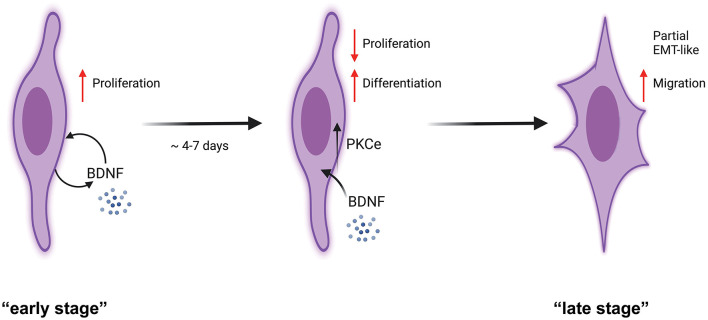
Overall, we found that PKCε is constitutively expressed in SCs, where it is likely involved in the switch from the proliferative toward the differentiated state. Indeed, we demonstrated that PKCε activation regulates SCs proliferation, increases their migration, and the expression of some markers (e.g., glycoprotein P0 and the transcription factor Krox20) of SCs differentiation. Through an autocrine mechanism, BDNF activates TrkB receptor, and controls SCs proliferation via PKCε. Importantly, PKCε activation likely promoted a partial EMT process in SCs.
PKCε mediates relevant actions in the neuronal and glial compartment of the PNS. In particular, we posit a novel function for PKCε in the transformation of SCs, assuming a role in the mechanisms controlling SCs' fate and plasticity.
蛋白激酶C-ε(PKCε)在初级传入伤害感受器的敏化过程中起重要作用,可促进机械性痛觉过敏。相应地,我们发现PKCε存在于外周神经系统(PNS)的感觉神经元中,参与疼痛发作和慢性化的控制。最近,人们发现PKCε也与细胞增殖的控制有关,在某些类型的癌症中促进有丝分裂和转移侵袭。然而,其在PNS的主要神经胶质细胞——雪旺细胞(SCs)中的作用仍未得到研究。
用不同的药理学方法处理大鼠原代SCs培养物,包括500 nM的PKCε激动剂二环丙基亚油酸(DCP-LA)、1 nM的人重组脑源性神经营养因子(BDNF)和10 nM的TrkB受体拮抗剂环曲毒素B。分析了增殖情况(通过细胞计数)、迁移情况(通过划痕试验和博伊登试验)以及SCs分化和上皮-间质转化(EMT)过程的一些标志物(通过qRT-PCR和蛋白质印迹法)。
总体而言,我们发现PKCε在SCs中组成性表达,可能参与从增殖状态向分化状态的转变。事实上,我们证明PKCε激活调节SCs增殖,增加其迁移以及SCs分化的一些标志物(例如糖蛋白P0和转录因子Krox20)的表达。通过自分泌机制,BDNF激活TrkB受体,并通过PKCε控制SCs增殖。重要的是,PKCε激活可能促进了SCs中的部分EMT过程。
PKCε在外周神经系统的神经元和神经胶质区室中介导相关作用。特别是,我们假定PKCε在SCs转化中具有新功能,在控制SCs命运和可塑性的机制中发挥作用。