Coucke Quinten, Parveen Nagma, Fernández Guillermo Solís, Qian Chen, Hofkens Johan, Debyser Zeger, Hendrix Jelle
Molecular Imaging and Photonics Division, Department of Chemistry, KU Leuven, Leuven, Belgium.
Department of Chemistry, Indian Institute of Technology Kanpur, Kanpur, India.
Biophys Rep (N Y). 2023 Aug 9;3(3):100122. doi: 10.1016/j.bpr.2023.100122. eCollection 2023 Sep 13.
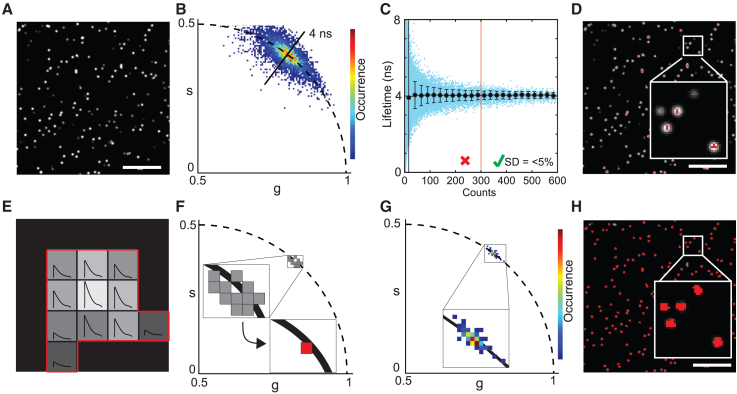
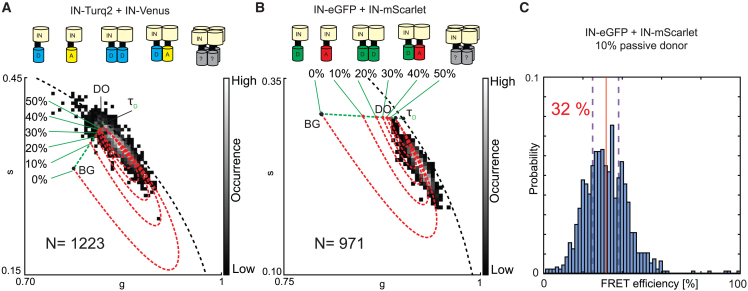
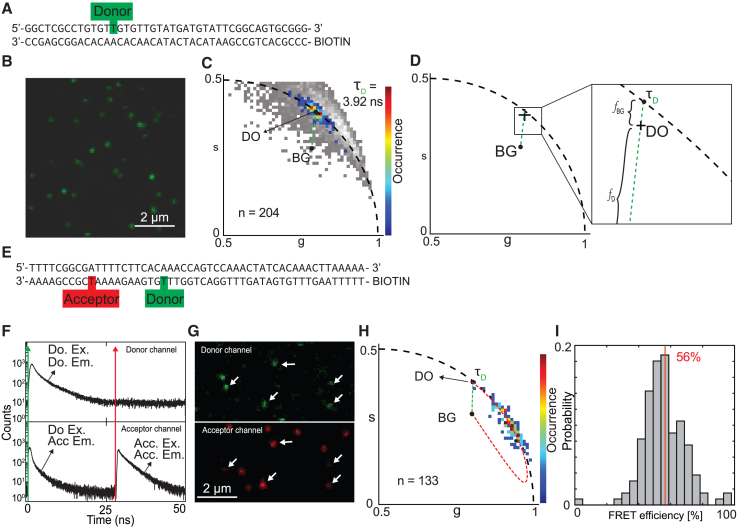
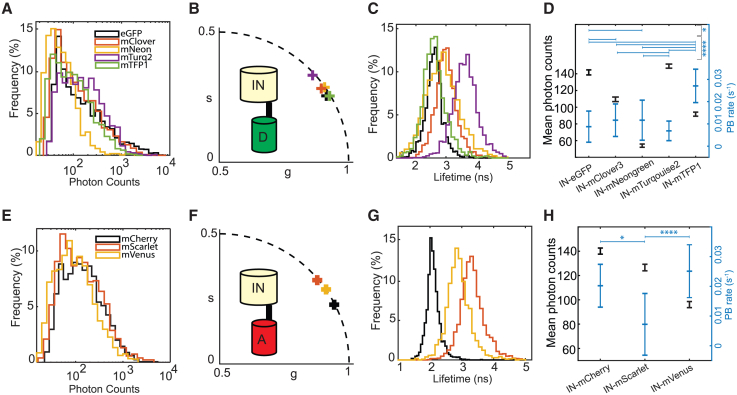
Fluorescence lifetime imaging microscopy (FLIM) is a popular modality to create additional contrast in fluorescence images. By carefully analyzing pixel-based nanosecond lifetime patterns, FLIM allows studying complex molecular populations. At the single-molecule or single-particle level, however, image series often suffer from low signal intensities per pixel, rendering it difficult to quantitatively disentangle different lifetime species, such as during Förster resonance energy transfer (FRET) analysis in the presence of a significant donor-only fraction. In this article we investigate whether an object localization strategy and the phasor approach to FLIM have beneficial effects when carrying out FRET analyses of single particles. Using simulations, we first showed that an average of ∼300 photons, spread over the different pixels encompassing single fluorescing particles and without background, is enough to determine a correct phasor signature (SD < 5% for a 4-ns lifetime). For immobilized single- or double-labeled dsDNA molecules, we next validated that particle-based phasor-FLIM-FRET readily allows estimating fluorescence lifetimes and FRET from single molecules. Thirdly, we applied particle-based phasor-FLIM-FRET to investigate protein-protein interactions in subdiffraction HIV-1 viral particles. To do this, we first quantitatively compared the fluorescence brightness, lifetime, and photostability of different popular fluorescent protein-based FRET probes when genetically fused to the HIV-1 integrase enzyme in viral particles, and conclude that eGFP, mTurquoise2, and mScarlet perform best. Finally, for viral particles coexpressing FRET-donor/acceptor-labeled IN, we determined the absolute FRET efficiency of IN oligomers. Available in a convenient open-source graphical user interface, we believe that particle-based phasor-FLIM-FRET is a promising tool to provide detailed insights in samples suffering from low overall signal intensities.
荧光寿命成像显微镜(FLIM)是一种在荧光图像中产生额外对比度的常用方法。通过仔细分析基于像素的纳秒级寿命模式,FLIM能够研究复杂的分子群体。然而,在单分子或单粒子水平上,图像序列通常每个像素的信号强度较低,这使得在存在大量仅为供体部分的情况下,例如在福斯特共振能量转移(FRET)分析期间,难以定量区分不同的寿命种类。在本文中,我们研究了在对单粒子进行FRET分析时,目标定位策略和FLIM的相量方法是否具有有益效果。通过模拟,我们首先表明,平均约300个光子分布在包含单个荧光粒子且无背景的不同像素上,足以确定正确的相量特征(对于4纳秒的寿命,标准差<5%)。接下来,对于固定的单标记或双标记双链DNA分子,我们验证了基于粒子的相量-FLIM-FRET能够轻松地从单分子估计荧光寿命和FRET。第三,我们应用基于粒子的相量-FLIM-FRET来研究亚衍射HIV-1病毒粒子中的蛋白质-蛋白质相互作用。为此,我们首先定量比较了不同常用的基于荧光蛋白的FRET探针在基因融合到病毒粒子中的HIV-1整合酶时的荧光亮度、寿命和光稳定性,并得出结论,eGFP、mTurquoise2和mScarlet表现最佳。最后,对于共表达FRET供体/受体标记的整合酶的病毒粒子,我们确定了整合酶寡聚体的绝对FRET效率。由于有方便的开源图形用户界面,我们相信基于粒子的相量-FLIM-FRET是一种有前途的工具,能够为整体信号强度较低的样品提供详细的见解。