Department of Electrical and Computer Engineering, Jack Baskin School of Engineering, University of California, Santa Cruz, Santa Cruz, CA, 95064, USA.
Department of Mechanical Engineering, Massachusetts Institute of Technology, Cambridge, MA, 02139, USA.
Nat Commun. 2023 Sep 4;14(1):5364. doi: 10.1038/s41467-023-40870-1.
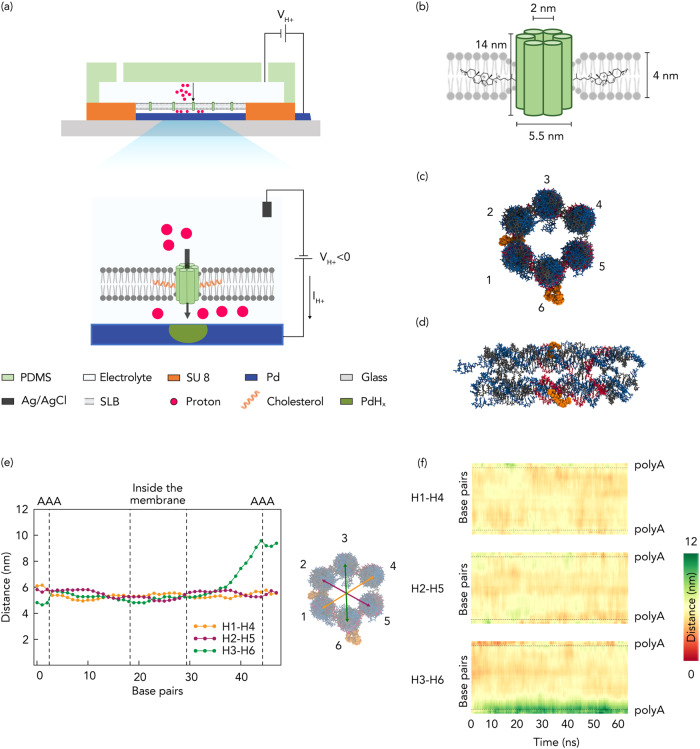
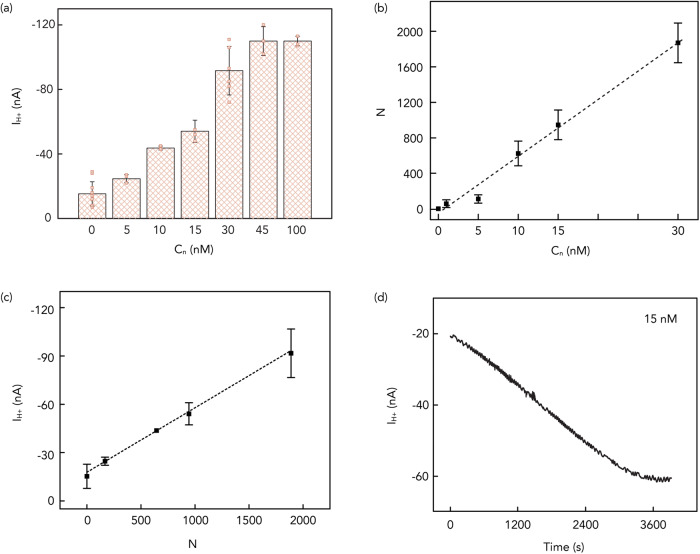
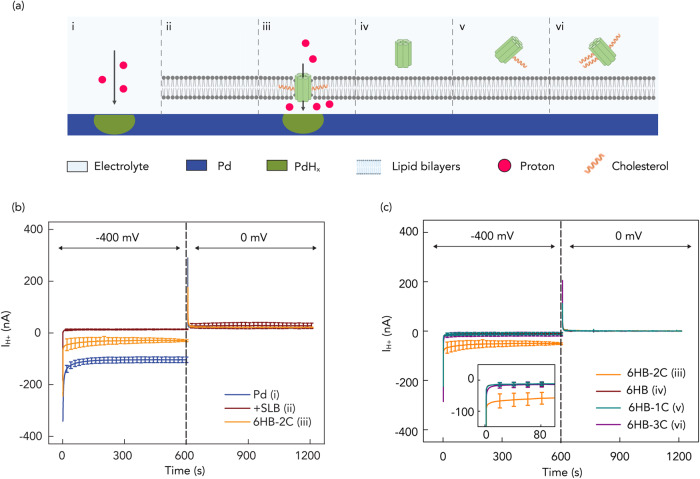
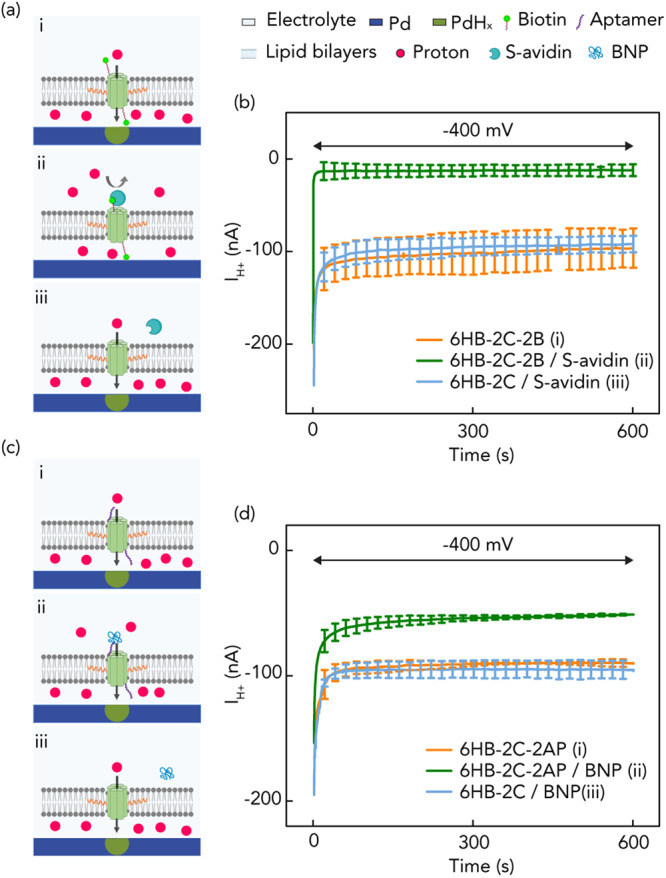
Biological membrane channels mediate information exchange between cells and facilitate molecular recognition. While tuning the shape and function of membrane channels for precision molecular sensing via de-novo routes is complex, an even more significant challenge is interfacing membrane channels with electronic devices for signal readout, which results in low efficiency of information transfer - one of the major barriers to the continued development of high-performance bioelectronic devices. To this end, we integrate membrane spanning DNA nanopores with bioprotonic contacts to create programmable, modular, and efficient artificial ion-channel interfaces. Here we show that cholesterol modified DNA nanopores spontaneously and with remarkable affinity span the lipid bilayer formed over the planar bio-protonic electrode surface and mediate proton transport across the bilayer. Using the ability to easily modify DNA nanostructures, we illustrate that this bioprotonic device can be programmed for electronic recognition of biomolecular signals such as presence of Streptavidin and the cardiac biomarker B-type natriuretic peptide, without modifying the biomolecules. We anticipate this robust interface will allow facile electronic measurement and quantification of biomolecules in a multiplexed manner.
生物膜通道介导细胞间的信息交换,并促进分子识别。虽然通过从头开始的方法来调整膜通道的形状和功能以实现精确的分子传感非常复杂,但更具挑战性的是将膜通道与电子设备接口用于信号读出,这导致信息传输效率低下——这是高性能生物电子设备持续发展的主要障碍之一。为此,我们将跨膜 DNA 纳米孔与生物质子接触相结合,以创建可编程、模块化和高效的人工离子通道接口。在这里,我们表明胆固醇修饰的 DNA 纳米孔自发地以显著的亲和力跨越在平面生物质子电极表面上形成的脂质双层,并介导质子穿过双层的传输。利用易于修饰 DNA 结构的能力,我们说明了这种生物质子器件可以被编程用于电子识别生物分子信号,例如存在链霉亲和素和心脏生物标志物 B 型利钠肽,而无需修饰生物分子。我们预计这种稳健的接口将允许以多重方式轻松进行生物分子的电子测量和定量。