Jukic Ivan, Prnjak Katarina, McGuigan Michael R, Helms Eric R
Sport Performance Research Institute New Zealand (SPRINZ), Auckland University of Technology, Auckland, New Zealand.
School of Engineering, Computer and Mathematical Sciences, Auckland University of Technology, Auckland, New Zealand.
Sports Med Open. 2023 Sep 5;9(1):80. doi: 10.1186/s40798-023-00626-z.
This study aimed to quantify the potential variability in the volume of work completed after reaching different velocity loss (VL) thresholds and determine the effects of sex, training status and history, as well as psychological traits on the reliability and magnitude of the amount of work completed after reaching different VL thresholds using different loads in the back-squat exercise.
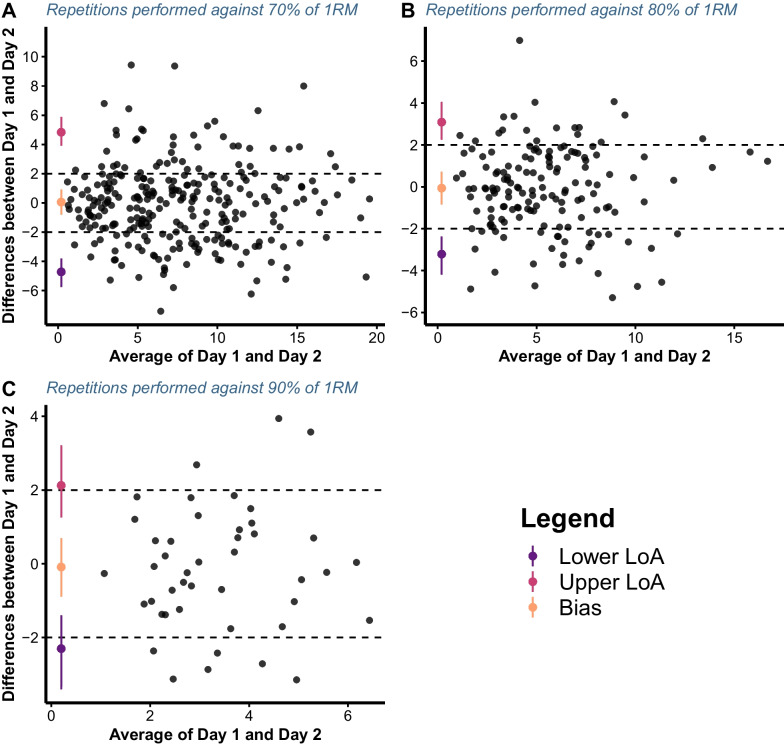
Forty-six resistance-trained people (15 females and 31 males; 18 to 40 years of age) with a wide range of strength levels, training experience, and different training practices were recruited and performed a one-repetition maximum (1RM) test, and two repetitions to failure (RTF) tests 72 h apart. RTF tests were performed with 70, 80, and 90% of 1RM with 10 min of rest between sets. The Bland-Altman analysis for multiple observations per participant and equivalence tests were used to quantify the variability in the volume of work completed after reaching different VL thresholds, whereas linear and generalised mixed-effects models were used to examine the effects of different moderators on the stability and magnitude of the amount of work completed after reaching different VL thresholds.
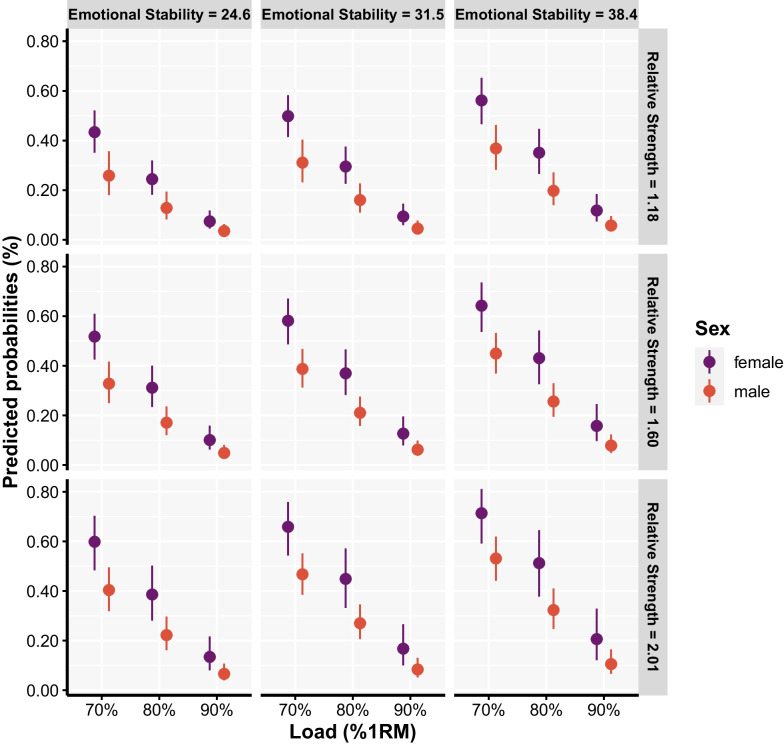
The findings of the present study question the utility of using VL thresholds to prescribe resistance training (RT) volume as the agreement in the amount of work completed across two consecutive testing sessions was not acceptable. Regardless of the load used, females completed more repetitions than males across VL thresholds, while males performed repetitions at higher velocities. In addition, individuals with higher levels of emotional stability also tended to perform more repetitions across VL thresholds. Finally, sex, choice of load, strength levels and training practices, as well as emotional stability affected the linearity of the repetition-velocity relationship and when sets terminated.
Using the same VL thresholds for all individuals, while assuming generalisability of the stimuli applied, would likely lead to variable acute physiological responses to RT and divergent neuromuscular adaptations over long term. Therefore, VL monitoring practices could be improved by considering sex, training status, history, and psychological traits of individuals due to their effects on the variability in responses to different VL thresholds.
本研究旨在量化达到不同速度损失(VL)阈值后完成的工作量的潜在变异性,并确定性别、训练状态和训练经历以及心理特质对使用不同负荷进行深蹲练习时达到不同VL阈值后完成的工作量的可靠性和大小的影响。
招募了46名阻力训练者(15名女性和31名男性;年龄在18至40岁之间),他们的力量水平、训练经验和训练方式各不相同,进行了一次重复最大值(1RM)测试,以及两次间隔72小时的重复至力竭(RTF)测试。RTF测试采用1RM的70%、80%和90%进行,每组之间休息10分钟。使用针对每位参与者多次观察的Bland-Altman分析和等效性测试来量化达到不同VL阈值后完成的工作量的变异性,而线性和广义混合效应模型则用于检验不同调节因素对达到不同VL阈值后完成的工作量的稳定性和大小的影响。
本研究的结果对使用VL阈值来规定阻力训练(RT)量的实用性提出了质疑,因为连续两次测试 session 中完成的工作量的一致性不可接受。无论使用何种负荷,在各个VL阈值下,女性完成的重复次数都比男性多,而男性以更高的速度进行重复。此外,情绪稳定性较高的个体在各个VL阈值下也往往能完成更多的重复次数。最后,性别、负荷选择、力量水平和训练方式以及情绪稳定性影响了重复次数与速度关系的线性以及组何时结束。
对所有个体使用相同的VL阈值,同时假设所应用刺激的可推广性,可能会导致对RT的急性生理反应可变,以及长期不同的神经肌肉适应。因此,由于个体的性别、训练状态、训练经历和心理特质会影响对不同VL阈值反应的变异性,考虑这些因素可以改进VL监测方法。