• 文献检索
  • 文档翻译
  • 深度研究
  • 学术资讯
  • Suppr Zotero 插件Zotero 插件
  • 邀请有礼
  • 套餐&价格
  • 历史记录
应用&插件
Suppr Zotero 插件Zotero 插件浏览器插件Mac 客户端Windows 客户端微信小程序
定价
高级版会员购买积分包购买API积分包
服务
文献检索文档翻译深度研究API 文档MCP 服务
关于我们
关于 Suppr公司介绍联系我们用户协议隐私条款
关注我们

Suppr 超能文献

核心技术专利:CN118964589B侵权必究
粤ICP备2023148730 号-1Suppr @ 2026

文献检索

告别复杂PubMed语法,用中文像聊天一样搜索,搜遍4000万医学文献。AI智能推荐,让科研检索更轻松。

立即免费搜索

文件翻译

保留排版,准确专业,支持PDF/Word/PPT等文件格式,支持 12+语言互译。

免费翻译文档

深度研究

AI帮你快速写综述,25分钟生成高质量综述,智能提取关键信息,辅助科研写作。

立即免费体验

前瞻性、多中心验证基于深度学习的心脏骤停风险管理系统,以预测普通病房收治患者院内心脏骤停或非计划转入重症监护病房的风险。

Prospective, multicenter validation of the deep learning-based cardiac arrest risk management system for predicting in-hospital cardiac arrest or unplanned intensive care unit transfer in patients admitted to general wards.

机构信息

VUNO, Seoul, Republic of Korea.

Division of Critical Care Medicine, Department of Hospital Medicine, Inha College of Medicine, Incheon, Republic of Korea.

出版信息

Crit Care. 2023 Sep 5;27(1):346. doi: 10.1186/s13054-023-04609-0.

DOI:10.1186/s13054-023-04609-0
PMID:37670324
原文链接:https://pmc.ncbi.nlm.nih.gov/articles/PMC10481524/
Abstract

BACKGROUND

Retrospective studies have demonstrated that the deep learning-based cardiac arrest risk management system (DeepCARS™) is superior to the conventional methods in predicting in-hospital cardiac arrest (IHCA). This prospective study aimed to investigate the predictive accuracy of the DeepCARS™ for IHCA or unplanned intensive care unit transfer (UIT) among general ward patients, compared with that of conventional methods in real-world practice.

METHODS

This prospective, multicenter cohort study was conducted at four teaching hospitals in South Korea. All adult patients admitted to general wards during the 3-month study period were included. The primary outcome was predictive accuracy for the occurrence of IHCA or UIT within 24 h of the alarm being triggered. Area under the receiver operating characteristic curve (AUROC) values were used to compare the DeepCARS™ with the modified early warning score (MEWS), national early warning Score (NEWS), and single-parameter track-and-trigger systems.

RESULTS

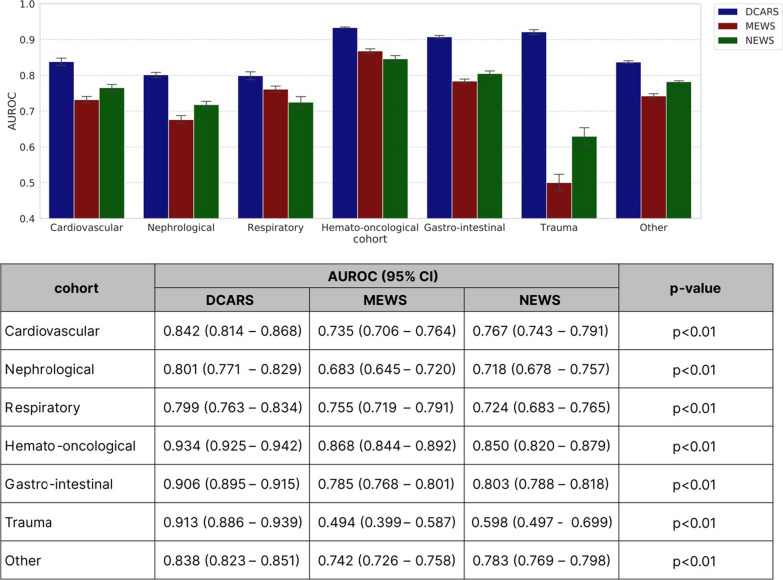
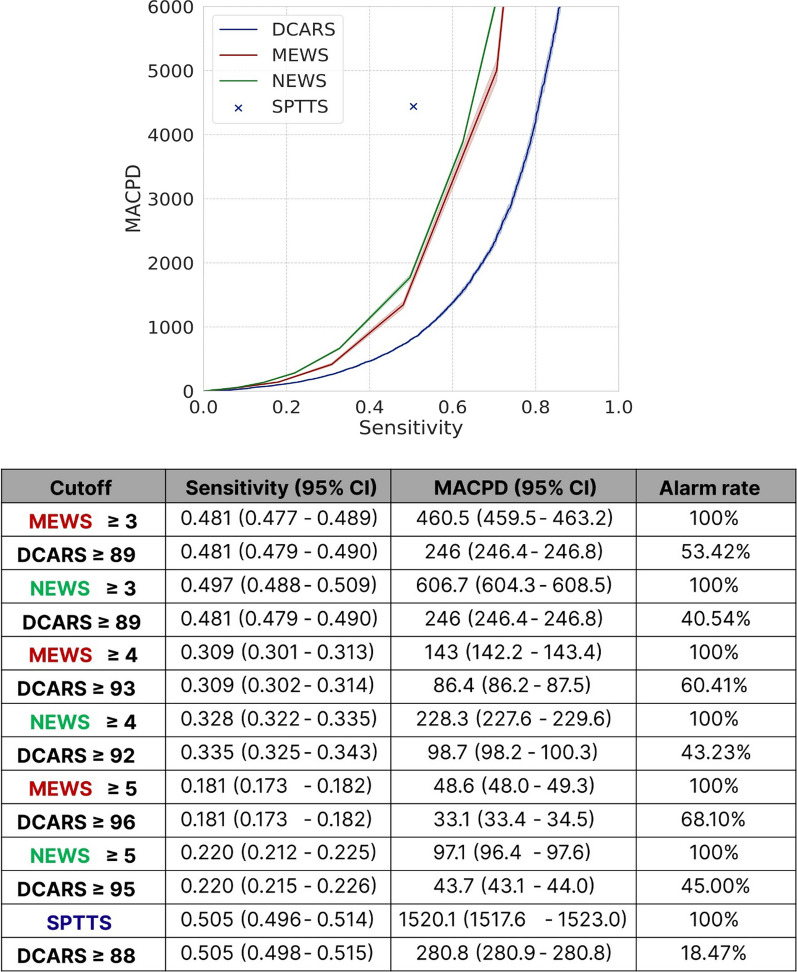
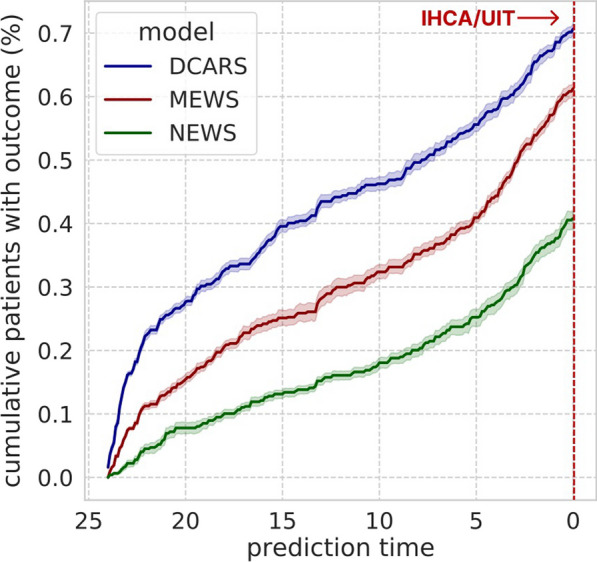
Among 55,083 patients, the incidence rates of IHCA and UIT were 0.90 and 6.44 per 1,000 admissions, respectively. In terms of the composite outcome, the AUROC for the DeepCARS™ was superior to those for the MEWS and NEWS (0.869 vs. 0.756/0.767). At the same sensitivity level of the cutoff values, the mean alarm counts per day per 1,000 beds were significantly reduced for the DeepCARS™, and the rate of appropriate alarms was higher when using the DeepCARS™ than when using conventional systems.

CONCLUSION

The DeepCARS™ predicts IHCA and UIT more accurately and efficiently than conventional methods. Thus, the DeepCARS™ may be an effective screening tool for detecting clinical deterioration in real-world clinical practice. Trial registration This study was registered at ClinicalTrials.gov ( NCT04951973 ) on June 30, 2021.

摘要

背景

回顾性研究表明,基于深度学习的心脏骤停风险管理系统(DeepCARS™)在预测院内心脏骤停(IHCA)方面优于传统方法。本前瞻性研究旨在比较 DeepCARS™ 与常规方法在真实世界实践中的预测准确性,以预测普通病房患者发生 IHCA 或非计划性重症监护病房转科(UIT)的可能性。

方法

这是一项在韩国四家教学医院进行的前瞻性、多中心队列研究。研究期间的 3 个月内,所有入住普通病房的成年患者均被纳入研究。主要结局是预测警报触发后 24 小时内发生 IHCA 或 UIT 的准确性。受试者工作特征曲线下面积(AUROC)值用于比较 DeepCARS™ 与改良早期预警评分(MEWS)、国家早期预警评分(NEWS)和单参数跟踪和触发系统。

结果

在 55083 名患者中,IHCA 和 UIT 的发生率分别为每 1000 例住院患者 0.90 和 6.44 例。就复合结局而言,DeepCARS™ 的 AUROC 优于 MEWS 和 NEWS(0.869 比 0.756/0.767)。在相同的截断值灵敏度水平下,DeepCARS™ 的平均每日报警次数/千张床位显著减少,并且使用 DeepCARS™ 的适当报警率高于使用传统系统。

结论

DeepCARS™ 比传统方法更准确、更有效地预测 IHCA 和 UIT。因此,DeepCARS™ 可能是一种有效的筛查工具,可用于在真实世界的临床实践中检测临床恶化。

试验注册

本研究于 2021 年 6 月 30 日在 ClinicalTrials.gov(NCT04951973)注册。

https://cdn.ncbi.nlm.nih.gov/pmc/blobs/dbf2/10481524/bfda221be53d/13054_2023_4609_Fig5_HTML.jpg
https://cdn.ncbi.nlm.nih.gov/pmc/blobs/dbf2/10481524/8c5f60c1bcc0/13054_2023_4609_Fig1_HTML.jpg
https://cdn.ncbi.nlm.nih.gov/pmc/blobs/dbf2/10481524/ed5fb24f0785/13054_2023_4609_Fig2_HTML.jpg
https://cdn.ncbi.nlm.nih.gov/pmc/blobs/dbf2/10481524/1637d18e568e/13054_2023_4609_Fig3_HTML.jpg
https://cdn.ncbi.nlm.nih.gov/pmc/blobs/dbf2/10481524/217848eb2ec3/13054_2023_4609_Fig4_HTML.jpg
https://cdn.ncbi.nlm.nih.gov/pmc/blobs/dbf2/10481524/bfda221be53d/13054_2023_4609_Fig5_HTML.jpg
https://cdn.ncbi.nlm.nih.gov/pmc/blobs/dbf2/10481524/8c5f60c1bcc0/13054_2023_4609_Fig1_HTML.jpg
https://cdn.ncbi.nlm.nih.gov/pmc/blobs/dbf2/10481524/ed5fb24f0785/13054_2023_4609_Fig2_HTML.jpg
https://cdn.ncbi.nlm.nih.gov/pmc/blobs/dbf2/10481524/1637d18e568e/13054_2023_4609_Fig3_HTML.jpg
https://cdn.ncbi.nlm.nih.gov/pmc/blobs/dbf2/10481524/217848eb2ec3/13054_2023_4609_Fig4_HTML.jpg
https://cdn.ncbi.nlm.nih.gov/pmc/blobs/dbf2/10481524/bfda221be53d/13054_2023_4609_Fig5_HTML.jpg

相似文献

1
Prospective, multicenter validation of the deep learning-based cardiac arrest risk management system for predicting in-hospital cardiac arrest or unplanned intensive care unit transfer in patients admitted to general wards.前瞻性、多中心验证基于深度学习的心脏骤停风险管理系统,以预测普通病房收治患者院内心脏骤停或非计划转入重症监护病房的风险。
Crit Care. 2023 Sep 5;27(1):346. doi: 10.1186/s13054-023-04609-0.
2
External Validation of Deep Learning-Based Cardiac Arrest Risk Management System for Predicting In-Hospital Cardiac Arrest in Patients Admitted to General Wards Based on Rapid Response System Operating and Nonoperating Periods: A Single-Center Study.基于快速反应系统运行和非运行期的普通病房住院患者院内心搏骤停的深度学习为基础的心脏骤停风险管理系统的外部验证:一项单中心研究。
Crit Care Med. 2024 Mar 1;52(3):e110-e120. doi: 10.1097/CCM.0000000000006137. Epub 2023 Dec 20.
3
A multicentre validation study of the deep learning-based early warning score for predicting in-hospital cardiac arrest in patients admitted to general wards.一项基于深度学习的早期预警评分对普通病房入院患者院内心脏骤停预测的多中心验证研究。
Resuscitation. 2021 Apr 22;163:78-85. doi: 10.1016/j.resuscitation.2021.04.013.
4
Quick Sequential Organ Failure Assessment Score and the Modified Early Warning Score for Predicting Clinical Deterioration in General Ward Patients Regardless of Suspected Infection.快速序贯器官衰竭评估评分与改良早期预警评分在非感染疑似患者普通病房患者临床恶化预测中的应用
J Korean Med Sci. 2022 Apr 25;37(16):e122. doi: 10.3346/jkms.2022.37.e122.
5
Detecting Patient Deterioration Using Artificial Intelligence in a Rapid Response System.使用快速反应系统中的人工智能检测患者病情恶化。
Crit Care Med. 2020 Apr;48(4):e285-e289. doi: 10.1097/CCM.0000000000004236.
6
Deep Learning-Based Early Warning Score for Predicting Clinical Deterioration in General Ward Cancer Patients.基于深度学习的普通病房癌症患者临床恶化预测预警评分
Cancers (Basel). 2023 Oct 26;15(21):5145. doi: 10.3390/cancers15215145.
7
An Algorithm Based on Deep Learning for Predicting In-Hospital Cardiac Arrest.基于深度学习的院内心脏骤停预测算法。
J Am Heart Assoc. 2018 Jun 26;7(13):e008678. doi: 10.1161/JAHA.118.008678.
8
Incidence of in-hospital cardiac arrest at general wards before and after implementation of an early warning score.综合病房实施早期预警评分前后院内心搏骤停的发生率。
BMC Emerg Med. 2021 Jul 7;21(1):79. doi: 10.1186/s12873-021-00469-5.
9
Multicenter validation of a deep-learning-based pediatric early-warning system for prediction of deterioration events.基于深度学习的儿科早期预警系统对病情恶化事件预测的多中心验证
Acute Crit Care. 2022 Nov;37(4):654-666. doi: 10.4266/acc.2022.00976. Epub 2022 Oct 26.
10
Derivation of a cardiac arrest prediction model using ward vital signs*.基于病房生命体征的心脏骤停预测模型的推导*。
Crit Care Med. 2012 Jul;40(7):2102-8. doi: 10.1097/CCM.0b013e318250aa5a.

引用本文的文献

1
Conceptual framework for prediction models of patient deterioration based on nursing documentation patterns: reproducibility and generalizability with a large number of hospitals across the United States.基于护理记录模式的患者病情恶化预测模型的概念框架:在美国众多医院中的可重复性和普遍性
J Biomed Inform. 2025 Jul 27;169:104887. doi: 10.1016/j.jbi.2025.104887.
2
Artificial intelligence in resuscitation: a scoping review.复苏中的人工智能:一项范围综述。
Resusc Plus. 2025 May 3;24:100973. doi: 10.1016/j.resplu.2025.100973. eCollection 2025 Jul.
3
Using weak signals to predict spontaneous breathing trial success: a machine learning approach.

本文引用的文献

1
Improved inpatient deterioration detection in general wards by using time-series vital signs.利用时间序列生命体征提高普通病房住院患者恶化检测率。
Sci Rep. 2022 Jul 13;12(1):11901. doi: 10.1038/s41598-022-16195-2.
2
A multicentre validation study of the deep learning-based early warning score for predicting in-hospital cardiac arrest in patients admitted to general wards.一项基于深度学习的早期预警评分对普通病房入院患者院内心脏骤停预测的多中心验证研究。
Resuscitation. 2021 Apr 22;163:78-85. doi: 10.1016/j.resuscitation.2021.04.013.
3
Predicting Intensive Care Transfers and Other Unforeseen Events: Analytic Model Validation Study and Comparison to Existing Methods.
利用微弱信号预测自主呼吸试验的成功:一种机器学习方法。
Intensive Care Med Exp. 2025 Mar 18;13(1):34. doi: 10.1186/s40635-025-00724-0.
4
Transforming rapid response team through artificial intelligence.通过人工智能改造快速反应小组。
Acute Crit Care. 2025 Feb;40(1):136-137. doi: 10.4266/acc.000425. Epub 2025 Feb 28.
5
Multicenter validation of a machine learning model to predict intensive care unit readmission within 48 hours after discharge.用于预测出院后48小时内重症监护病房再入院的机器学习模型的多中心验证
EClinicalMedicine. 2025 Feb 13;81:103112. doi: 10.1016/j.eclinm.2025.103112. eCollection 2025 Mar.
6
Resident and nurse attitudes toward a rapid response team in a tertiary hospital in South Korea.韩国一家三级医院住院医师和护士对快速反应小组的态度。
Acute Crit Care. 2025 Feb;40(1):29-37. doi: 10.4266/acc.004272. Epub 2025 Feb 12.
7
Enhancing Clinical Cardiac Care: Predicting In-Hospital Cardiac Arrest With Machine Learning.加强临床心脏护理:利用机器学习预测院内心脏骤停。
Ann Lab Med. 2025 Mar 1;45(2):117-120. doi: 10.3343/alm.2024.0696. Epub 2025 Jan 8.
8
Prospective Human Validation of Artificial Intelligence Interventions in Cardiology: A Scoping Review.人工智能干预在心脏病学中的前瞻性人体验证:一项范围综述。
JACC Adv. 2024 Aug 28;3(9):101202. doi: 10.1016/j.jacadv.2024.101202. eCollection 2024 Sep.
9
[Data-driven intensive care: a lack of comprehensive datasets].[数据驱动的重症监护:缺乏综合数据集]
Med Klin Intensivmed Notfmed. 2024 Jun;119(5):352-357. doi: 10.1007/s00063-024-01141-z. Epub 2024 Apr 26.
10
Considerations for Developing Diagnostic Artificial Intelligence: Towards Real-World Application of an Asthma Detection Model.开发诊断性人工智能的考量:迈向哮喘检测模型的实际应用
Allergy Asthma Immunol Res. 2024 Jan;16(1):6-8. doi: 10.4168/aair.2024.16.1.6.
预测重症监护病房转运及其他意外事件:分析模型验证研究及与现有方法的比较
JMIR Med Inform. 2021 Apr 21;9(4):e25066. doi: 10.2196/25066.
4
Using machine learning to improve the accuracy of patient deterioration predictions: Mayo Clinic Early Warning Score (MC-EWS).利用机器学习提高患者恶化预测的准确性:梅奥诊所早期预警评分(MC-EWS)。
J Am Med Inform Assoc. 2021 Jun 12;28(6):1207-1215. doi: 10.1093/jamia/ocaa347.
5
Predicting In-Hospital Mortality at Admission to the Medical Ward: A Big-Data Machine Learning Model.预测内科病房入院时的院内死亡率:一种大数据机器学习模型。
Am J Med. 2021 Feb;134(2):227-234.e4. doi: 10.1016/j.amjmed.2020.07.014. Epub 2020 Aug 15.
6
Role of the Rapid Response System in End-of-Life Care Decisions.快速反应系统在临终关怀决策中的作用。
Am J Hosp Palliat Care. 2020 Nov;37(11):943-949. doi: 10.1177/1049909120927372. Epub 2020 May 26.
7
Comparison of Early Warning Scoring Systems for Hospitalized Patients With and Without Infection at Risk for In-Hospital Mortality and Transfer to the Intensive Care Unit.比较有感染风险的住院患者和无感染风险的住院患者的预警评分系统,以预测住院死亡率和转入重症监护病房的情况。
JAMA Netw Open. 2020 May 1;3(5):e205191. doi: 10.1001/jamanetworkopen.2020.5191.
8
Quality metrics for the evaluation of Rapid Response Systems: Proceedings from the third international consensus conference on Rapid Response Systems.快速反应系统评价的质量指标:第三届快速反应系统国际共识会议纪要。
Resuscitation. 2019 Aug;141:1-12. doi: 10.1016/j.resuscitation.2019.05.012. Epub 2019 May 23.
9
Unplanned ICU Transfers from Inpatient Units: Examining the Prevalence and Preventability of Adverse Events Associated with ICU Transfer in Pediatrics.来自住院病房的非计划性重症监护病房(ICU)转运:探讨儿科ICU转运相关不良事件的发生率及可预防性。
J Pediatr Intensive Care. 2016 Mar;5(1):21-27. doi: 10.1055/s-0035-1568150. Epub 2015 Nov 21.
10
In-Hospital Cardiac Arrest: A Review.院内心搏骤停:综述。
JAMA. 2019 Mar 26;321(12):1200-1210. doi: 10.1001/jama.2019.1696.