Purtle Jonathan, Moucheraud Corrina, Yang Lawrence H, Shelley Donna
Department of Public Health Policy & Management, Global Center for Implementation Science, New York University School of Global Public Health, 708 Broadway, New York, NY, 10003, USA.
Department of Social and Behavioral Sciences, Global Center for Implementation Science, New York University School of Global Public Health, Global Mental Health and Stigma Program, 708 Broadway, New York, NY, 10003, USA.
Implement Sci Commun. 2023 Sep 12;4(1):111. doi: 10.1186/s43058-023-00497-1.
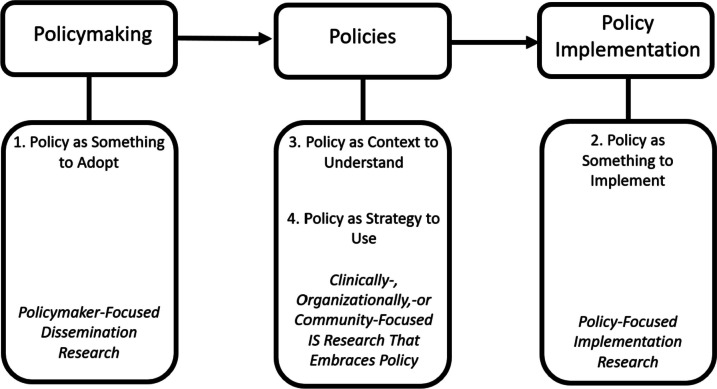
Policy is receiving increasing attention in the field of implementation science. However, there remains a lack of clear, concise guidance about how policy can be conceptualized in implementation science research. Building on Curran's article "Implementation science made too simple"-which defines "the thing" as the intervention, practice, or innovation in need of implementation support-we offer a typology of four very basic ways to conceptualize policy in implementation science research. We provide examples of studies that have conceptualized policy in these different ways and connect aspects of the typology to established frameworks in the field. The typology simplifies and refines related typologies in the field. Four very basic ways to think about policy in implementation science research. 1) Policy as something to adopt: an evidence-supported policy proposal is conceptualized as "the thing" and the goal of research is to understand how policymaking processes can be modified to increase adoption, and thus reach, of the evidence-supported policy. Policy-focused dissemination research is well-suited to achieve this goal. 2) Policy as something to implement: a policy, evidence-supported or not, is conceptualized as "the thing" and the goal of research is to generate knowledge about how policy rollout (or policy de-implementation) can be optimized to maximize benefits for population health and health equity. Policy-focused implementation research is well-suited to achieve this goal. 3) Policy as context to understand: an evidence-supported intervention is "the thing" and policies are conceptualized as a fixed determinant of implementation outcomes. The goal of research is to understand the mechanisms through which policies affect implementation of the evidence-supported intervention. 4) Policy as strategy to use: an evidence-supported intervention is "the thing" and policy is conceptualized as a strategy to affect implementation outcomes. The goal of research is to understand, and ideally test, how policy strategies affect implementation outcomes related to the evidence-supported intervention.
Policy can be conceptualized in multiple, non-mutually exclusive ways in implementation science. Clear conceptualizations of these distinctions are important to advancing the field of policy-focused implementation science and promoting the integration of policy into the field more broadly.
政策在实施科学领域正受到越来越多的关注。然而,对于如何在实施科学研究中对政策进行概念化,仍然缺乏清晰、简洁的指导。基于柯伦的文章《实施科学过于简单化》(该文章将“事物”定义为需要实施支持的干预措施、实践或创新),我们提供了在实施科学研究中对政策进行概念化的四种非常基本方式的类型学。我们给出了以这些不同方式对政策进行概念化的研究示例,并将类型学的各个方面与该领域已有的框架联系起来。这种类型学简化并完善了该领域相关的类型学。在实施科学研究中思考政策的四种非常基本的方式。1)政策作为要采纳的事物:一项有证据支持的政策提议被概念化为“事物”,研究的目标是了解如何修改政策制定过程以增加对有证据支持的政策的采纳,从而使其得以推行。以政策为重点的传播研究非常适合实现这一目标。2)政策作为要实施的事物:一项政策,无论是否有证据支持,都被概念化为“事物”,研究的目标是生成关于如何优化政策推出(或政策废除)以最大限度地提高对人群健康和健康公平性的益处的知识。以政策为重点的实施研究非常适合实现这一目标。3)政策作为理解的背景:一项有证据支持的干预措施是“事物”,政策被概念化为实施结果的固定决定因素。研究的目标是了解政策影响有证据支持的干预措施实施的机制。4)政策作为要使用的策略:一项有证据支持的干预措施是“事物”,政策被概念化为影响实施结果的策略。研究的目标是了解(并理想情况下进行测试)政策策略如何影响与有证据支持的干预措施相关的实施结果。
在实施科学中,政策可以通过多种并非相互排斥的方式进行概念化。对这些区别进行清晰的概念化对于推进以政策为重点的实施科学领域以及更广泛地促进政策融入该领域很重要。