SDG #03 Group - Good Health and Well-being, Landmark University, Ipetu Road, PMB 1001, Omu-Aran, 251101, Nigeria.
Department of Biochemistry, Landmark University, Ipetu Road, PMB 1001, Omu-Aran, 251101, Nigeria.
BMC Complement Med Ther. 2023 Sep 16;23(1):324. doi: 10.1186/s12906-023-04131-4.
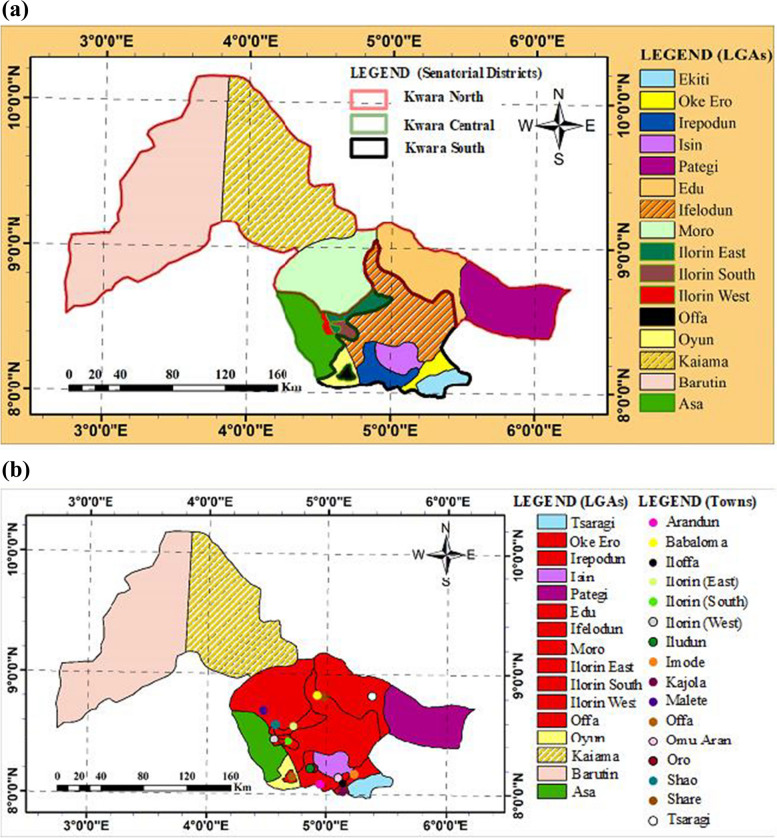
Folk medicine is crucial to healthcare delivery in the underdeveloped countries. It is frequently used as a primary treatment option or as a complementary therapy for malaria. Malaria is a deadly disease which greatly threatens global public health, claiming incredible number of lives yearly. The study was aimed at documenting the medicinal plants used for malaria treatment in folk medicine in Kwara State, Nigeria.
Ethnobotanical information was collected from selected consenting registered traditional medicine practitioners (TMPs) through oral face-to-face interviews using in-depth, semi-structured interview guide. The ethnobotanical data were analysed, and descriptive statistical methods were used to compile them.
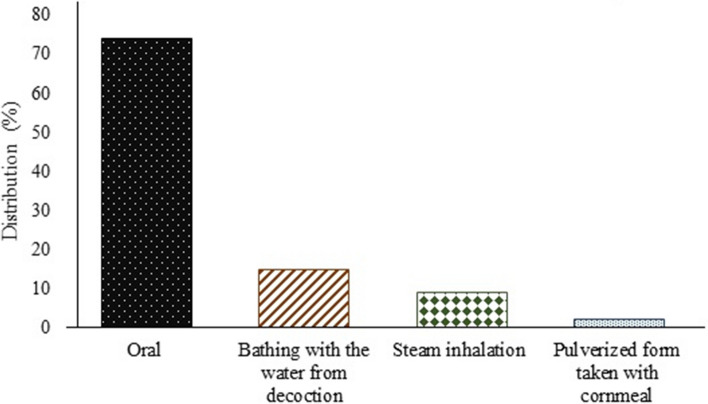
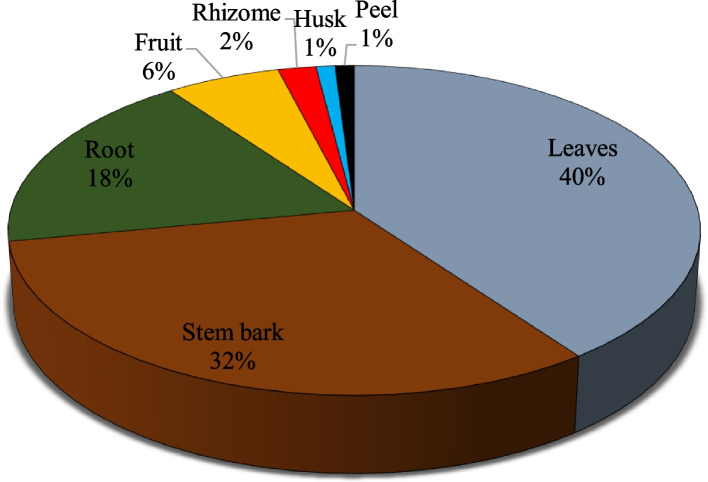
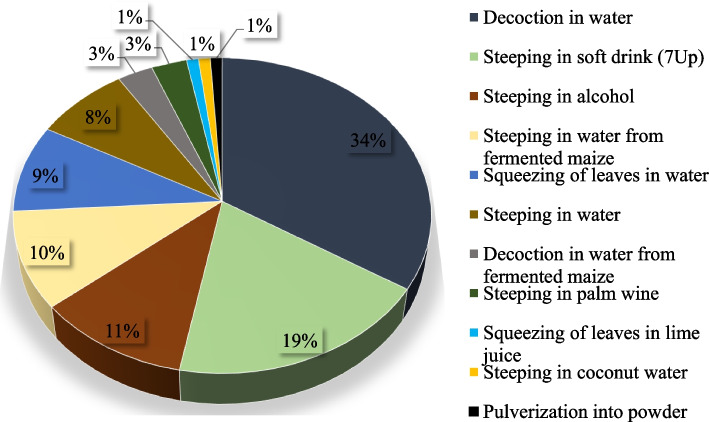
Sixty-two indigenous medicinal plants, including 13 new plants, used for malaria treatment were identified in this study. The TMPs preferred decoction in aqueous solvent (34%) and steeping in decaffeinated soft drink (19%) for herbal preparations. Oral administration (74%) was the main route of administration, while leaves (40%) and stem barks (32%) were the most dominant plant parts used in herbal preparations. The most cited families were Fabaceae (15%) and Rutaceae (6%), while Mangifera indica (77.14%), Enantia chlorantha (65.71%), Alstonia boonei (57.14%) followed by Cymbopogon citratus (54.29%) were the most used plants. Besides, the antimalarial activities of many of the plants recorded and their isolated phytocompounds have been demonstrated. Furthermore, the conservation status of 4 identified plants were Vulnerable.
The study showed strong ethnobotanical knowledge shared by the TMPs in the State and provides preliminary information that could be explored for the discovery of more potent antimalarial compounds.
民间医学在欠发达国家的医疗保健中至关重要。它经常被用作主要治疗方法或疟疾的补充疗法。疟疾是一种致命疾病,每年都会夺走大量生命,严重威胁着全球公共健康。本研究旨在记录尼日利亚夸拉州民间医学中用于治疗疟疾的药用植物。
通过面对面的口头访谈,从选定的同意的注册传统医学从业者(TMP)那里收集民族植物学信息,使用深入的半结构化访谈指南。对民族植物学数据进行分析,并使用描述性统计方法对其进行编译。
本研究确定了 62 种用于治疗疟疾的土着药用植物,包括 13 种新植物。TMP 更喜欢用水溶剂(34%)和脱咖啡因软饮料(19%)煎煮草药制剂。口服(74%)是主要的给药途径,而叶片(40%)和茎皮(32%)是草药制剂中最常用的植物部位。引用最多的科是豆科(15%)和芸香科(6%),而芒果(77.14%)、恩坦亚·chlorantha(65.71%)、Alstonia boonei(57.14%)紧随其后的是香茅(54.29%)是最常用的植物。此外,记录了许多植物的抗疟活性及其分离的植物化合物。此外,还确定了 4 种植物的保护状况为脆弱。
该研究表明,该州的 TMP 具有很强的民族植物学知识,并提供了初步信息,可用于发现更有效的抗疟化合物。