Yelkuvan Evrim Meriç, Erdemli Özge, Yilmaz Bengi, Aktürk Ömer
Department of Bioengineering, Faculty of Engineering and Architecture, Kırıkkale University, Kırıkkale, Turkey.
Department of Molecular Biology and Genetics, Faculty of Science and Letters, Başkent University, Ankara, Turkey.
Turk J Chem. 2022 Oct 8;47(1):101-115. doi: 10.55730/1300-0527.3521. eCollection 2023.
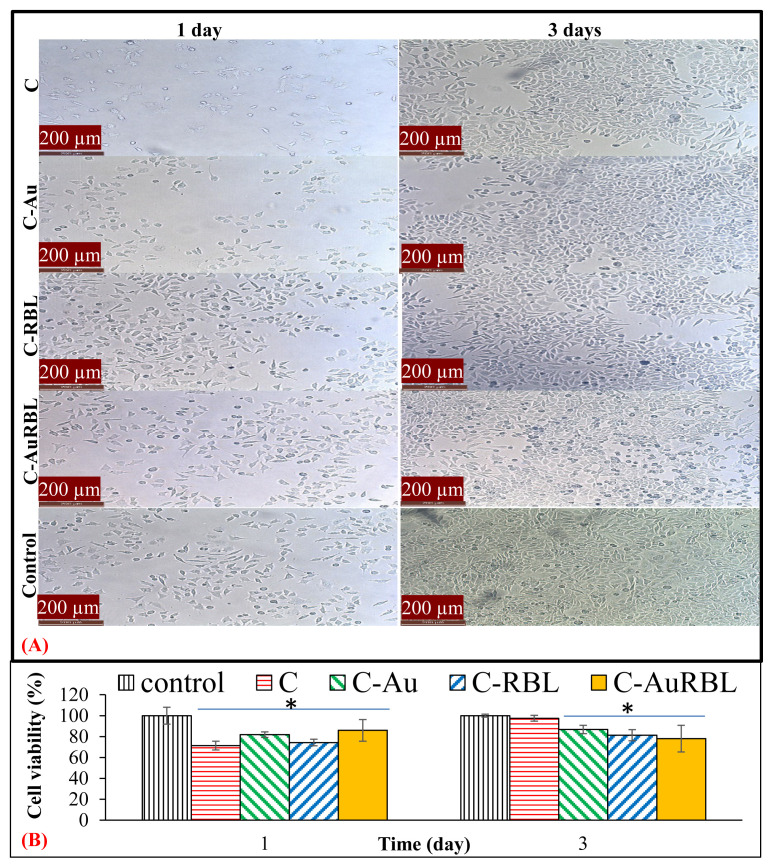
Collagen type I is the main structural unit in skin tissue and is therefore used preferentially in skin tissue scaffolds. However, collagen-based 3D scaffolds have weak aqueous stability and degradation profiles in their uncross-linked states and chemical cross-linking reagents arise toxicity concerns, which generally restrict the spectrum of their biomedical applicability. Here, the research goal is to photochemically cross-link collagen type I with rose bengal (RB) when subjected to green laser light and to investigate the effect of silk sericin-capped gold nanoparticles (S-AuNP) when incorporated into scaffolds on the cross-linking process and thus on the scaffold properties. All the collagen scaffolds, that is plain collagen (C), collagen/S-AuNP (C-Au), cross-linked collagen (C-RBL), and cross-linked collagen/S-AuNP (C-AuRBL) were characterized for their potential as skin tissue scaffolds. C-AuRBL group had the best thermal stability, resistance to enzymatic degradation, and more uniform pore size distribution. None of the groups had cytotoxicity (cell viability > 70%) regarding the microscopic observations and MTT cell viability assays for L929 fibroblasts. L929 fibroblasts and primary adult human epidermal keratinocytes (HEKa) were also separately seeded on C-AuRBL scaffolds and according to microscopy results, they could support the stimulation of adhesion, morphological changes, and spreading of both cells, thereby encouraging the usage of this fabrication strategy for prospective skin tissue scaffolds.
I型胶原蛋白是皮肤组织中的主要结构单元,因此优先用于皮肤组织支架。然而,基于胶原蛋白的3D支架在未交联状态下具有较弱的水稳定性和降解特性,并且化学交联试剂存在毒性问题,这通常限制了它们在生物医学应用中的范围。在此,研究目标是在绿色激光照射下用孟加拉玫瑰红(RB)对I型胶原蛋白进行光化学交联,并研究将丝胶蛋白包覆的金纳米颗粒(S-AuNP)掺入支架时对交联过程以及支架性能的影响。对所有胶原蛋白支架,即普通胶原蛋白(C)、胶原蛋白/S-AuNP(C-Au)、交联胶原蛋白(C-RBL)和交联胶原蛋白/S-AuNP(C-AuRBL)作为皮肤组织支架的潜力进行了表征。C-AuRBL组具有最佳的热稳定性、抗酶降解性和更均匀的孔径分布。就L929成纤维细胞的显微镜观察和MTT细胞活力测定而言,所有组均无细胞毒性(细胞活力>70%)。L929成纤维细胞和原代成人表皮角质形成细胞(HEKa)也分别接种在C-AuRBL支架上,根据显微镜结果,它们能够支持两种细胞的黏附、形态变化和铺展刺激,从而鼓励将这种制造策略用于未来的皮肤组织支架。