Department of Radiology, Korea University Anam Hospital, Seoul, Korea.
AI Center, Korea University Anam Hospital, Seoul, Korea.
J Korean Med Sci. 2023 Sep 18;38(37):e306. doi: 10.3346/jkms.2023.38.e306.
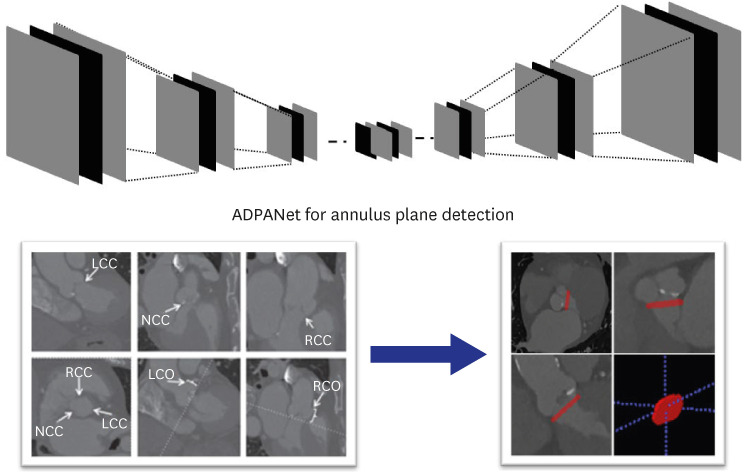
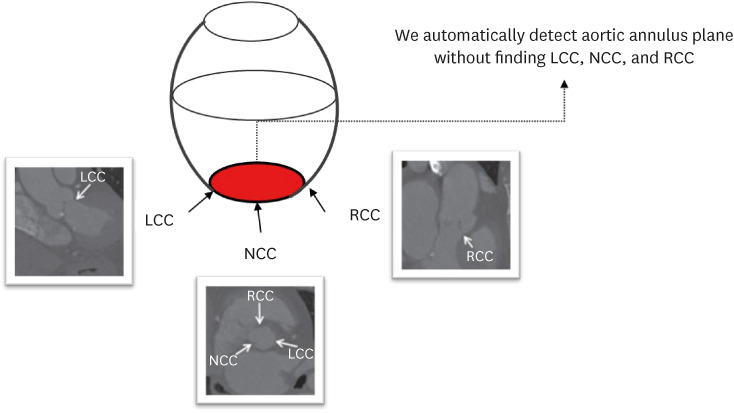
To propose a deep learning architecture for automatically detecting the complex structure of the aortic annulus plane using cardiac computed tomography (CT) for transcatheter aortic valve replacement (TAVR).
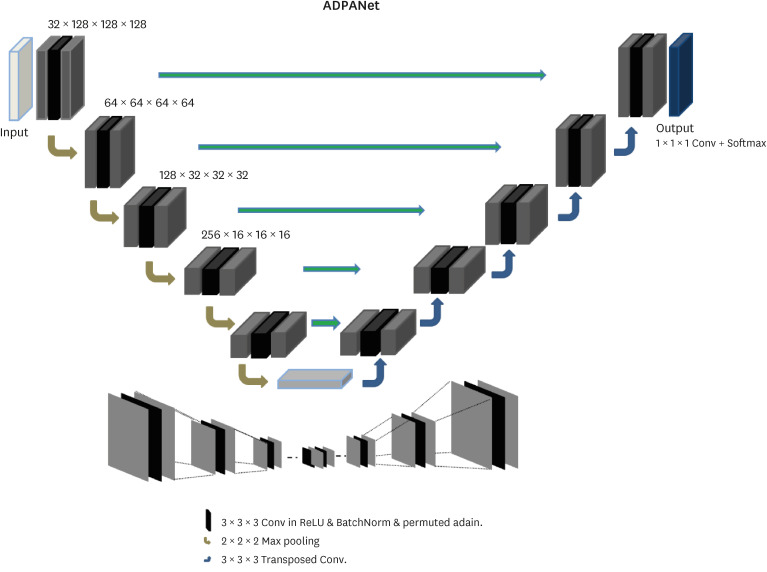
This study retrospectively reviewed consecutive patients who underwent TAVR between January 2017 and July 2020 at a tertiary medical center. Annulus Detection Permuted AdaIN network (ADPANet) based on a three-dimensional (3D) U-net architecture was developed to detect and localize the aortic annulus plane using cardiac CT. Patients (N = 72) who underwent TAVR between January 2017 and July 2020 at a tertiary medical center were enrolled. Ground truth using a limited dataset was delineated manually by three cardiac radiologists. Training, tuning, and testing sets (70:10:20) were used to build the deep learning model. The performance of ADPANet for detecting the aortic annulus plane was analyzed using the root mean square error (RMSE) and dice similarity coefficient (DSC).
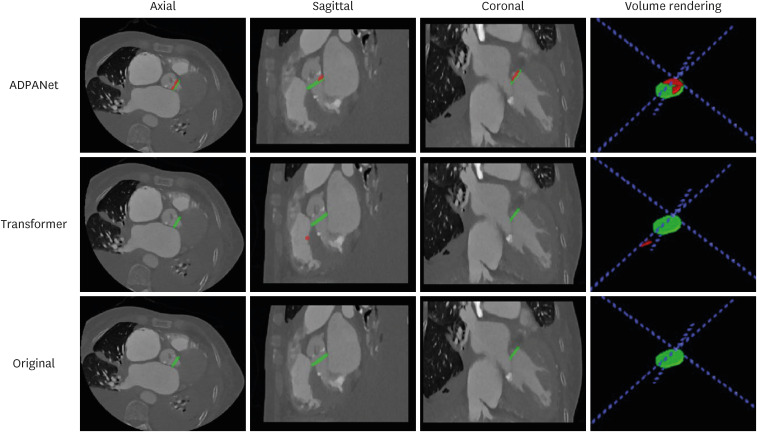
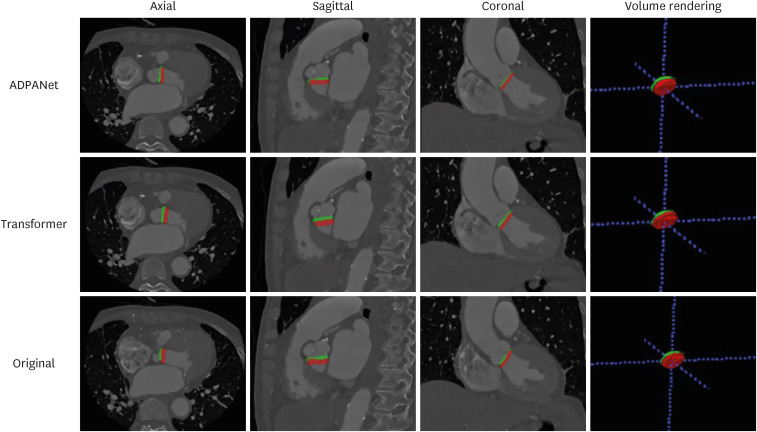
In this study, the total dataset consisted of 72 selected scans from patients who underwent TAVR. The RMSE and DSC values for the aortic annulus plane using ADPANet were 55.078 ± 35.794 and 0.496 ± 0.217, respectively.
Our deep learning framework was feasible to detect the 3D complex structure of the aortic annulus plane using cardiac CT for TAVR. The performance of our algorithms was higher than other convolutional neural networks.
提出一种深度学习架构,用于使用心脏 CT 自动检测经导管主动脉瓣置换术(TAVR)的主动脉瓣环平面的复杂结构。
本研究回顾性分析了 2017 年 1 月至 2020 年 7 月在一家三级医疗中心接受 TAVR 的连续患者。基于三维(3D)U-net 架构的瓣环检测排列自适应网络(ADPANet)用于使用心脏 CT 检测和定位主动脉瓣环平面。纳入 2017 年 1 月至 2020 年 7 月在一家三级医疗中心接受 TAVR 的患者(N=72)。使用有限数据集的真实情况由三位心脏放射科医生手动描绘。使用深度学习模型构建训练、调整和测试集(70:10:20)。使用均方根误差(RMSE)和骰子相似系数(DSC)分析 ADPANet 检测主动脉瓣环平面的性能。
在这项研究中,总数据集由接受 TAVR 的患者的 72 个选定扫描组成。使用 ADPANet 的主动脉瓣环平面的 RMSE 和 DSC 值分别为 55.078±35.794 和 0.496±0.217。
我们的深度学习框架能够使用心脏 CT 检测 TAVR 中主动脉瓣环平面的 3D 复杂结构。我们算法的性能优于其他卷积神经网络。