Majewska Joanna, Miernikiewicz Paulina, Szymczak Aleksander, Kaźmierczak Zuzanna, Goszczyński Tomasz M, Owczarek Barbara, Rybicka Izabela, Ciekot Jarosław, Dąbrowska Krystyna
Hirszfeld Institute of Immunology and Experimental Therapy, Polish Academy of Sciences , Wrocław, Poland.
Research and Development Center, Regional Specialist Hospital in Wrocław , Wrocław, Poland.
Microbiol Spectr. 2023 Sep 19;11(5):e0011523. doi: 10.1128/spectrum.00115-23.
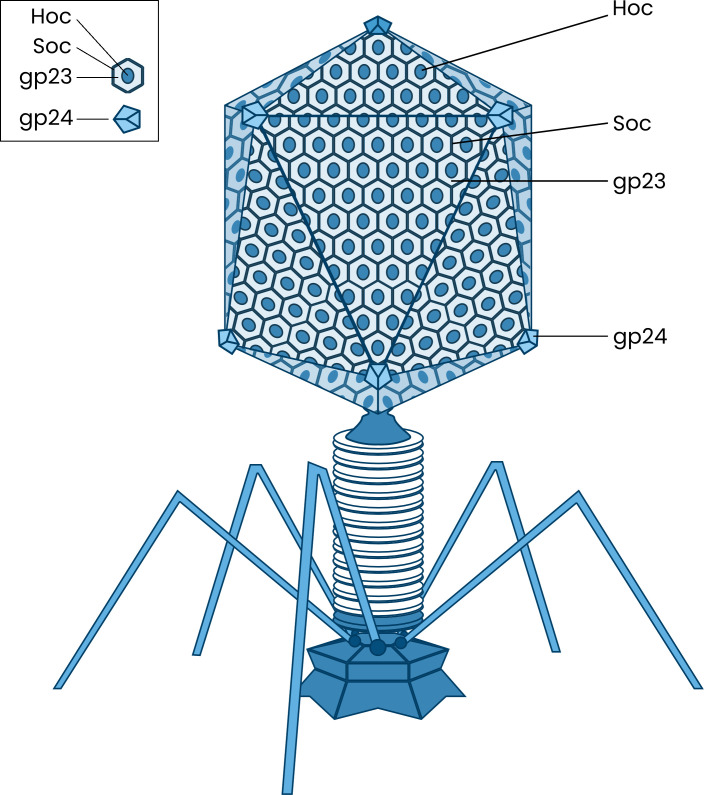
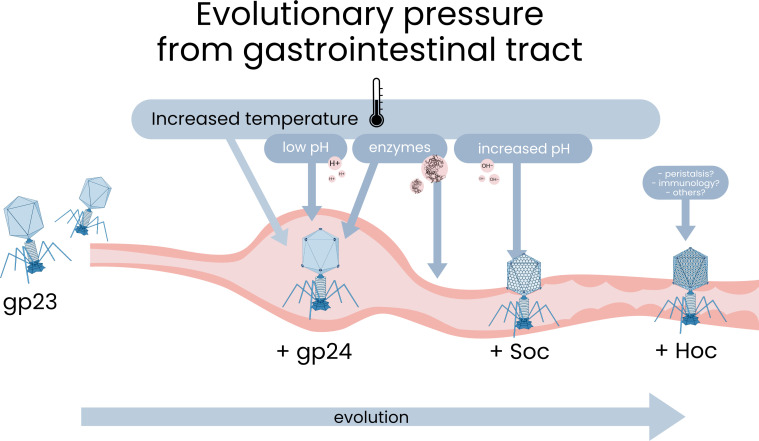
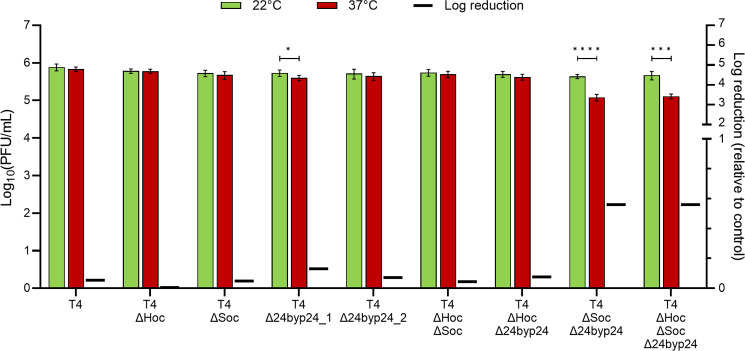
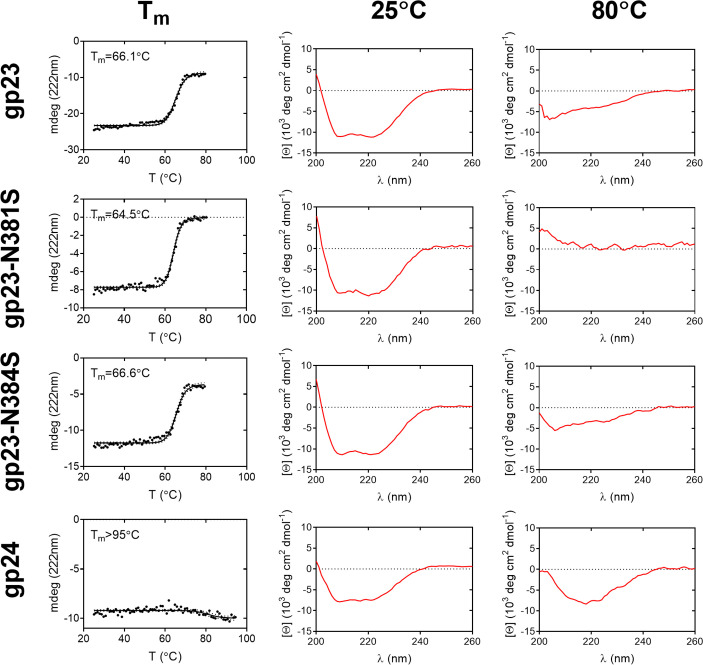
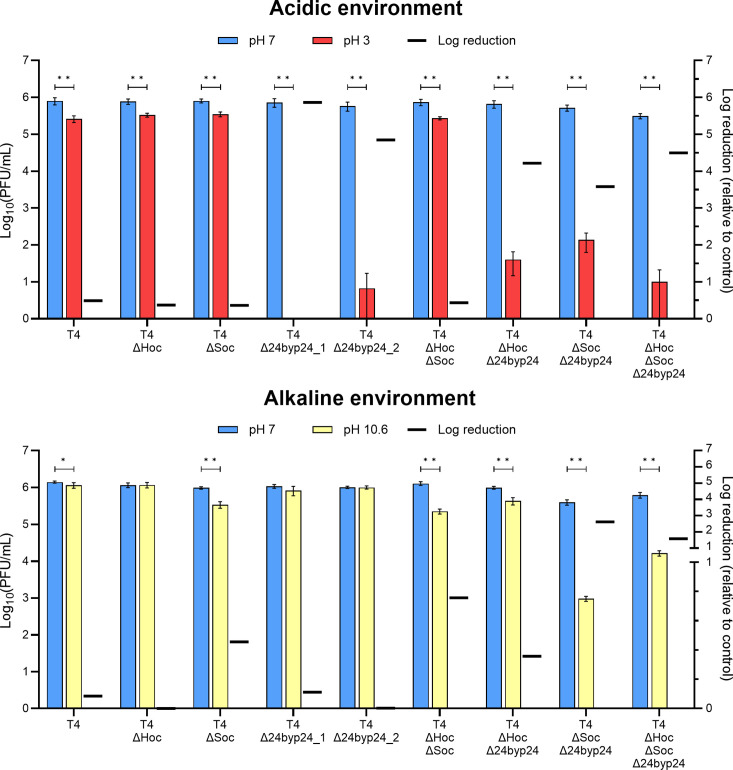
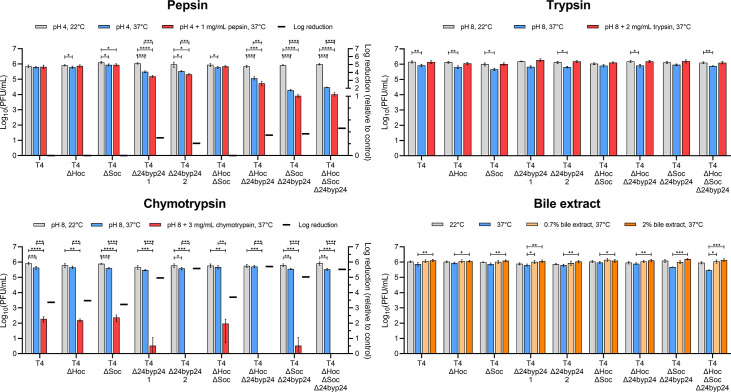
Bacteriophages colonize animal and human bodies, propagating on sensitive bacteria that are symbionts, commensals, or pathogens of animals and humans. T4-like phages are dependent on abundant symbionts such as , commonly present in animal and human gastrointestinal (GI) tracts. Bacteriophage T4 is one of the most complex viruses, and its intricate structure, particularly the capsid head protecting the phage genome, likely contributes substantially to the overall phage fitness in diverse environments. We investigated how individual head proteins-gp24, Hoc, and Soc-affect T4 phage survival under pressure from non-bacterial factors. We constructed a panel of T4 phage variants defective in these structural proteins: T4∆Soc, T4∆24byp24, T4∆Hoc∆Soc, T4∆Hoc∆24byp24, T4∆Soc∆24byp24, and T4∆Hoc∆Soc∆24byp24 (byp = bypass). These variants were investigated for their sensitivity to selected environmental conditions relevant to the microenvironment of the GI tract, including pH, temperature, and digestive enzymes. The simple and "primitive" structure of the phage capsid (∆24byp24) was significantly less stable at low pH and more sensitive to inactivation by digestive enzymes, and the simultaneous lack of gp24 and Soc resulted in a notable decrease in phage activity at 37°C. Gp24 was also found to be highly resistant to thermal and chemical denaturation. Thus, gp24, which was acquired relatively late in evolution, seems to play a key role in T4 withstanding environmental conditions, including those related to the animal/human GI tract, and Soc is a molecular glue that enhances this protective effect. IMPORTANCE Bacteriophages are important components of animal and human microbiota, particularly in the gastrointestinal tract, where they dominate the viral community and contribute to shaping microbial balance. However, interactions with bacterial hosts are not the only element of the equation in phage survival-phages inhabiting the GI tract are constantly exposed to increased temperature, pH fluctuations, or digestive enzymes, which raises the question of whether and how the complex structure of phage capsids contributes to their persistence in the specific microenvironment of human/animal bodies. Here we address this phage-centric perspective, identifying the role of individual head proteins in T4 phage survival in GI tract conditions. The selection pressure driving the evolution of T4-like phages could have come from the external environment that affects phage virions with increased temperature and variable pH; it is possible that in the local microenvironment along the GI tract, the phage benefits from stability-protecting proteins.
噬菌体定殖于动物和人体,在作为动物和人类共生菌、共栖菌或病原体的敏感细菌上繁殖。T4样噬菌体依赖于丰富的共生菌,如通常存在于动物和人类胃肠道(GI)中的共生菌。噬菌体T4是最复杂的病毒之一,其复杂的结构,特别是保护噬菌体基因组的衣壳头部,可能对其在不同环境中的整体适应性有很大贡献。我们研究了单个头部蛋白——gp24、Hoc和Soc——在非细菌因素压力下如何影响T4噬菌体的存活。我们构建了一组在这些结构蛋白上有缺陷的T4噬菌体变体:T4∆Soc、T4∆24byp24、T4∆Hoc∆Soc、T4∆Hoc∆24byp24、T4∆Soc∆24byp24和T4∆Hoc∆Soc∆24byp24(byp=旁路)。研究了这些变体对与胃肠道微环境相关的选定环境条件的敏感性,包括pH值、温度和消化酶。噬菌体衣壳(∆24byp24)的简单和“原始”结构在低pH值下稳定性显著降低,对消化酶失活更敏感,同时缺乏gp24和Soc导致噬菌体在37°C时活性显著下降。还发现gp24对热变性和化学变性具有高度抗性。因此,在进化过程中相对较晚获得的gp24似乎在T4噬菌体耐受环境条件(包括与动物/人类胃肠道相关的条件)中起关键作用,而Soc是一种增强这种保护作用的分子胶水。重要性噬菌体是动物和人类微生物群中的重要组成部分,特别是在胃肠道中,它们在病毒群落中占主导地位,并有助于塑造微生物平衡。然而,与细菌宿主的相互作用并不是噬菌体存活等式中的唯一因素——栖息在胃肠道中的噬菌体不断暴露于温度升高、pH值波动或消化酶中,这就提出了一个问题,即噬菌体衣壳的复杂结构是否以及如何有助于它们在人类/动物身体的特定微环境中持续存在。在这里,我们从以噬菌体为中心的角度解决这个问题,确定单个头部蛋白在T4噬菌体在胃肠道条件下存活中的作用。驱动T4样噬菌体进化的选择压力可能来自外部环境,该环境通过升高温度和改变pH值影响噬菌体病毒体;有可能在胃肠道沿线的局部微环境中,噬菌体受益于稳定保护蛋白。