Dharmasri Poorna A, Levy Aaron D, Blanpied Thomas A
Department of Physiology, University of Maryland School of Medicine, Baltimore, Maryland 21201.
Program in Neuroscience, University of Maryland School of Medicine, Baltimore, Maryland 21201.
bioRxiv. 2023 Sep 7:2023.09.06.556279. doi: 10.1101/2023.09.06.556279.
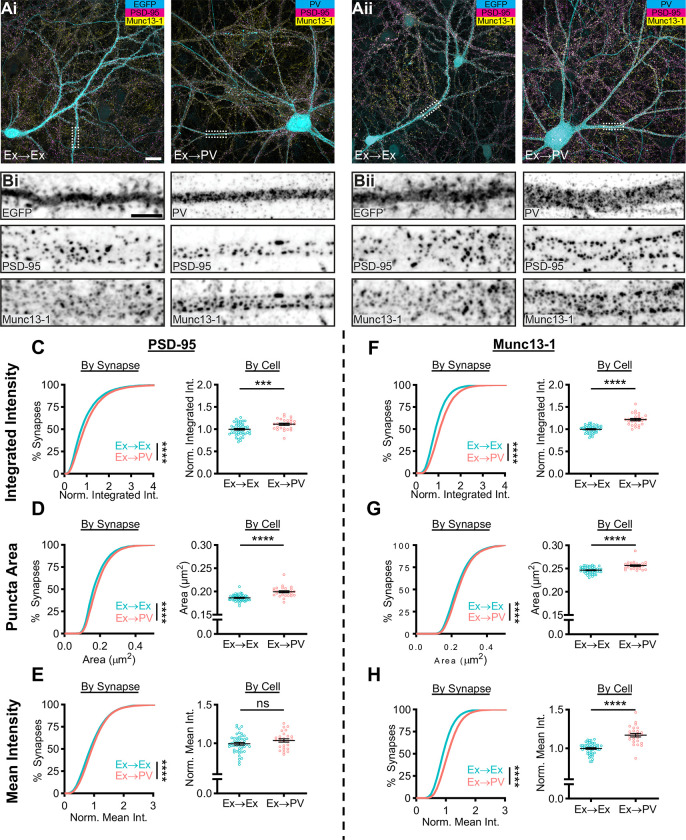
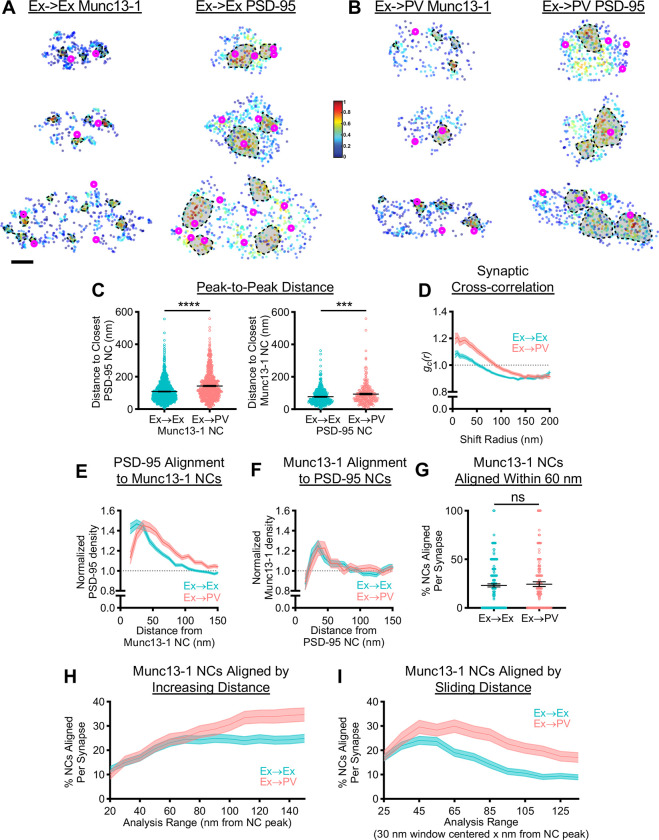
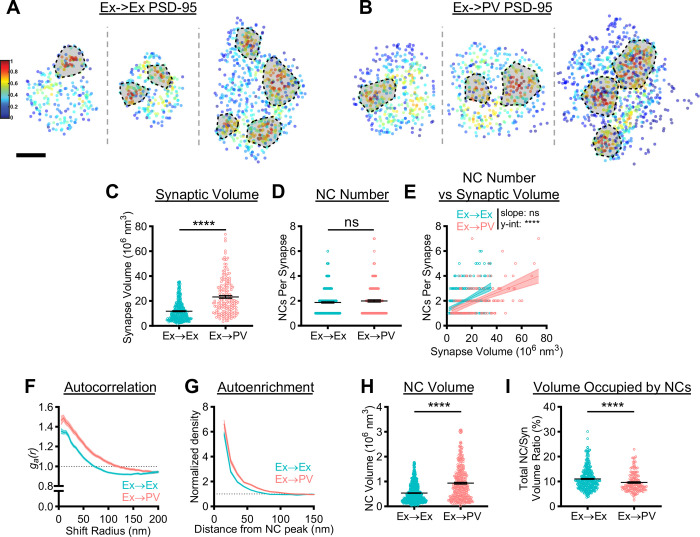
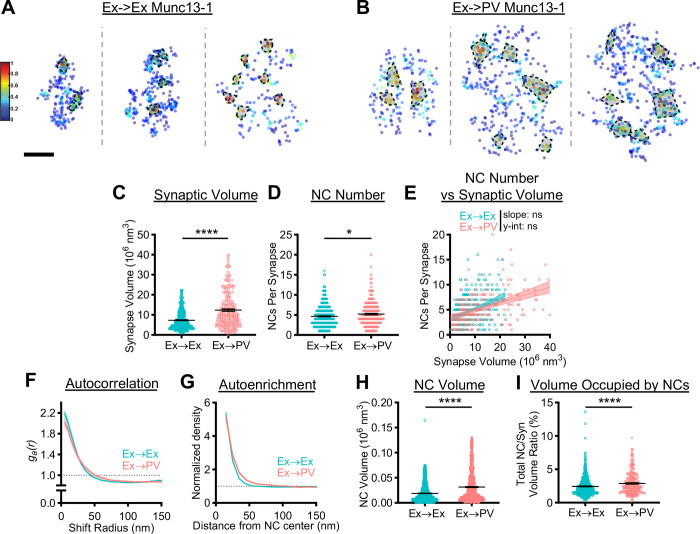
A key feature of excitatory synapses is the existence of subsynaptic protein nanoclusters whose precise alignment across the cleft in a trans-synaptic nanocolumn influences the strength of synaptic transmission. However, whether nanocolumn properties vary between excitatory synapses functioning in different cellular contexts is unknown. We used a combination of confocal and DNA-PAINT super-resolution microscopy to directly compare the organization of shared scaffold proteins at two important excitatory synapses - those forming onto excitatory principal neurons (Ex→Ex synapses) and those forming onto parvalbumin-expressing interneurons (Ex→PV synapses). As in Ex→Ex synapses, we find that in Ex→PV synapses presynaptic Munc13-1 and postsynaptic PSD-95 both form nanoclusters that demonstrate alignment, underscoring synaptic nanostructure and the trans-synaptic nanocolumn as conserved organizational principles of excitatory synapses. Despite the general conservation of these features, we observed specific differences in the characteristics of pre- and postsynaptic Ex→PV nanostructure. Ex→PV synapses contained larger PSDs with fewer PSD-95 NCs when accounting for size than Ex→Ex synapses. Furthermore, the PSD-95 NCs were larger and denser. The identity of the postsynaptic cell also had a retrograde impact on Munc13-1 organization, as Ex→PV synapses hosted larger Munc13-1 puncta that contained less dense but larger and more numerous Munc13-1 NCs. Moreover, we measured the spatial variability of transsynaptic alignment in these synapse types, revealing protein alignment in Ex→PV synapses over a distinct range of distances compared to Ex→Ex synapses. We conclude that while general principles of nanostructure and alignment are shared, cell-specific elements of nanodomain organization likely contribute to functional diversity of excitatory synapses. Understanding the rules of synapse nanodomain assembly, which themselves are cell-type specific, will be essential for illuminating brain network dynamics.
兴奋性突触的一个关键特征是存在突触下蛋白纳米簇,其在跨突触纳米柱中精确排列在突触间隙上会影响突触传递的强度。然而,在不同细胞环境中发挥作用的兴奋性突触之间,纳米柱特性是否存在差异尚不清楚。我们结合共聚焦显微镜和DNA-PAINT超分辨率显微镜,直接比较了两种重要兴奋性突触中共享支架蛋白的组织情况——那些形成于兴奋性主神经元上的突触(Ex→Ex突触)和那些形成于表达小白蛋白的中间神经元上的突触(Ex→PV突触)。与Ex→Ex突触一样,我们发现在Ex→PV突触中,突触前的Munc13-1和突触后的PSD-95都形成了显示对齐的纳米簇,突出了突触纳米结构和跨突触纳米柱是兴奋性突触保守的组织原则。尽管这些特征总体上是保守的,但我们观察到突触前和突触后Ex→PV纳米结构的特征存在特定差异。考虑到大小,Ex→PV突触比Ex→Ex突触含有更大的突触后致密物(PSD),且PSD-95纳米簇更少。此外,PSD-95纳米簇更大且更密集。突触后细胞的身份也对Munc13-1的组织有逆行影响,因为Ex→PV突触中存在更大的Munc13-1点状结构,其包含密度较低但更大且更多的Munc13-1纳米簇。此外,我们测量了这些突触类型中跨突触对齐的空间变异性,发现与Ex→Ex突触相比,Ex→PV突触中蛋白质在不同距离范围内对齐。我们得出结论,虽然纳米结构和对齐的一般原则是共享的,但纳米域组织的细胞特异性元素可能有助于兴奋性突触的功能多样性。理解突触纳米域组装的规则(这些规则本身是细胞类型特异性的)对于阐明脑网络动力学至关重要。