Division of Clinical Pharmacology and Toxicology, Hospital for Sick Children, Toronto, ON, Canada.
Department of Pediatrics, University of California San Diego, San Diego, CA, USA.
Clin Pharmacokinet. 2023 Nov;62(11):1611-1619. doi: 10.1007/s40262-023-01307-6. Epub 2023 Sep 21.
Knowledge about exposure to cannabidiol (CBD) in breastfed infants can provide an improved understanding of potential risk. The aim was to predict CBD exposure in breastfed infants from mothers taking CBD and CBD-containing products.
Cannabidiol concentrations in milk previously attained from data collected through an existing human milk research biorepository were used to simulate infant doses and identify subgroups. A developed pediatric physiologically based pharmacokinetic model produced virtual breastfed infants administered the simulated CBD doses. Predicted breastfed infant exposures and upper area under the curve ratios were compared to the lowest therapeutic dose for approved indications in children.
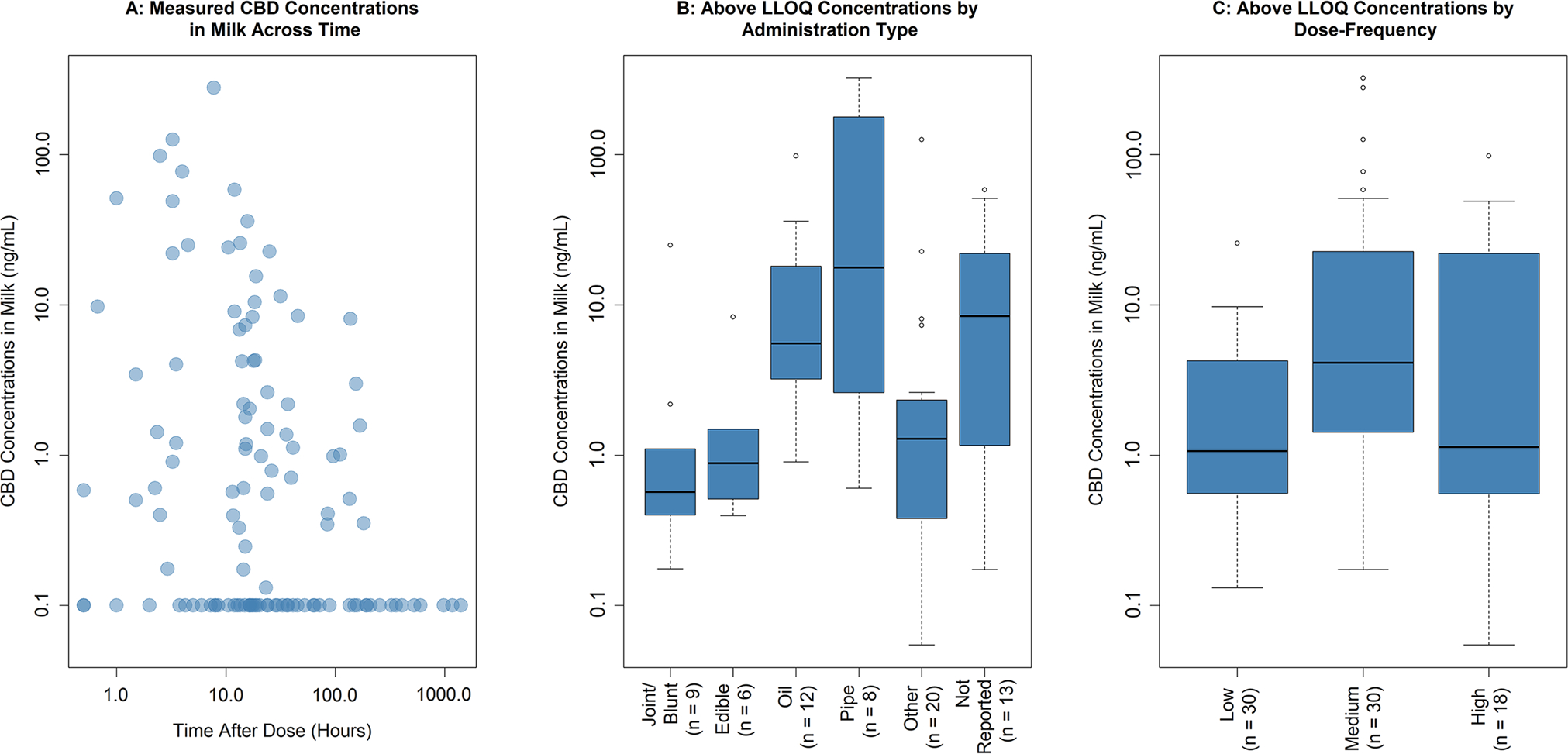
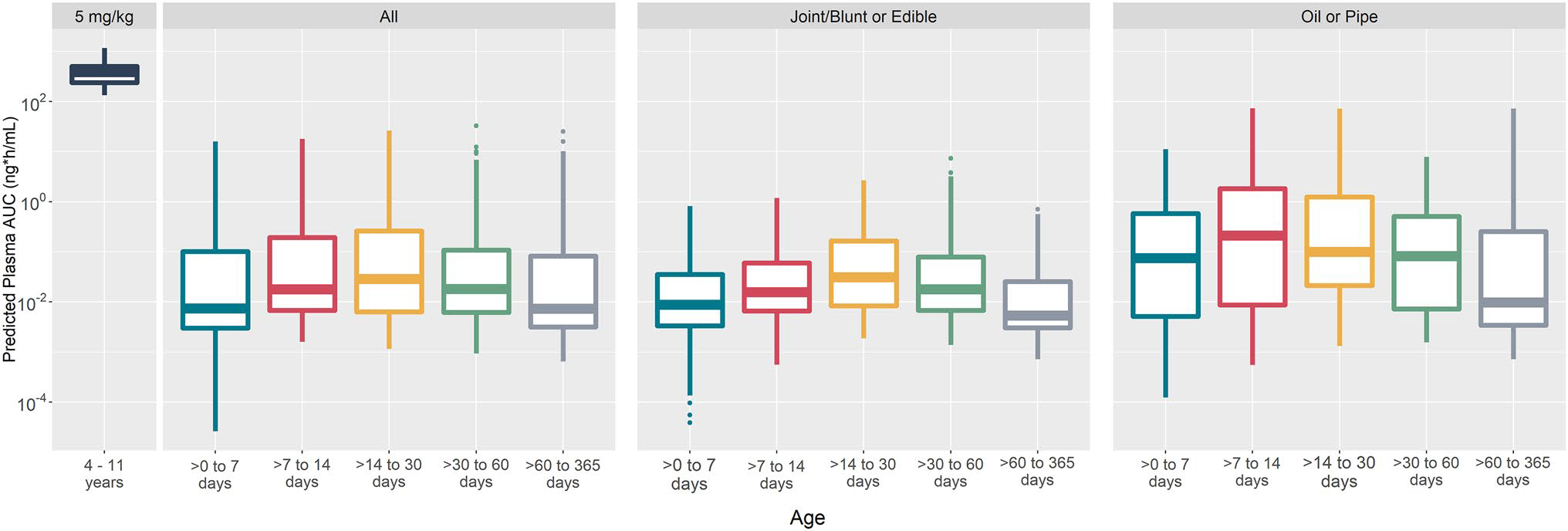
The existing human milk research biorepository contained 200 samples from 181 unique breastfeeding mothers for whom self-reported administration data and CBD concentrations had previously been measured. Samples that were above the lower limit of quantification with only one maternal administration type revealed that administration type, i.e., joint/blunt or edible versus oil or pipe, resulted in significantly different subgroups in terms of milk concentrations. Resulting simulated infant doses (ng/kg) were described by lognormal distributions with geometric means and geometric standard deviations: 0.61 ± 2.41 all concentrations, 0.10 ± 0.37 joint/blunt or edible, and 2.23 ± 8.15 oil or pipe. Doses administered to breastfed infants had exposures magnitudes lower than exposures in children aged 4-11 years administered the lowest therapeutic dose for approved indications, and low upper area under the curve ratios.
Based on real-world use, breastfeeding infants are predicted to receive very small exposures of CBD through milk. Studies examining adverse reactions will provide further insight into potential risk.
了解哺乳期婴儿接触大麻二酚(CBD)的情况,可以更好地了解潜在风险。本研究旨在预测服用 CBD 及其含 CBD 产品的哺乳期母亲的婴儿 CBD 暴露情况。
使用从现有的母乳研究生物样本库中收集的数据,预测婴儿剂量并确定亚组,分析此前获得的母乳中 CBD 浓度。开发的儿科生理基于药代动力学模型,模拟给虚拟母乳喂养婴儿施用模拟 CBD 剂量。将预测的母乳喂养婴儿的暴露量和上 AUC 比值与儿童批准适应证的最低治疗剂量进行比较。
现有的母乳研究生物样本库包含 181 位独特哺乳期母亲的 200 个样本,这些母亲之前曾报告过用药数据和 CBD 浓度。仅有一种母体用药类型且低于定量下限的样本表明,用药类型(即联合/钝器或可食用与油或管)导致母乳浓度存在明显不同的亚组。模拟婴儿剂量(ng/kg)呈对数正态分布,几何平均值和几何标准差分别为:所有浓度 0.61±2.41、联合/钝器或可食用 0.10±0.37、油或管 2.23±8.15。给予母乳喂养婴儿的剂量导致的暴露量低于批准适应证中 4-11 岁儿童接受最低治疗剂量的暴露量,且 AUC 比值较低。
基于真实世界的使用情况,预测通过母乳摄入 CBD 的母乳喂养婴儿的暴露量非常小。研究不良反应将进一步深入了解潜在风险。