Muthu Lakshmi Bavithra Chandramohan, Murugan Marimuthu, Pavithran Shanmugasundaram, Naveena Kathirvel
Department of Agricultural Entomology, Tamil Nadu Agricultural University, Coimbatore, India.
Centre for Plant Protection Studies, Tamil Nadu Agricultural University, Coimbatore, India.
Front Mol Biosci. 2023 Sep 6;10:1257859. doi: 10.3389/fmolb.2023.1257859. eCollection 2023.
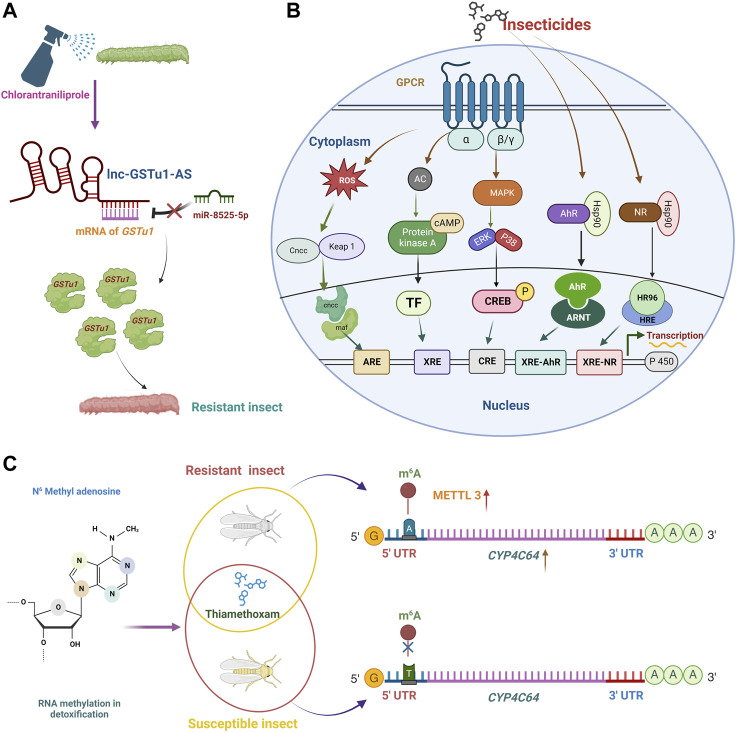
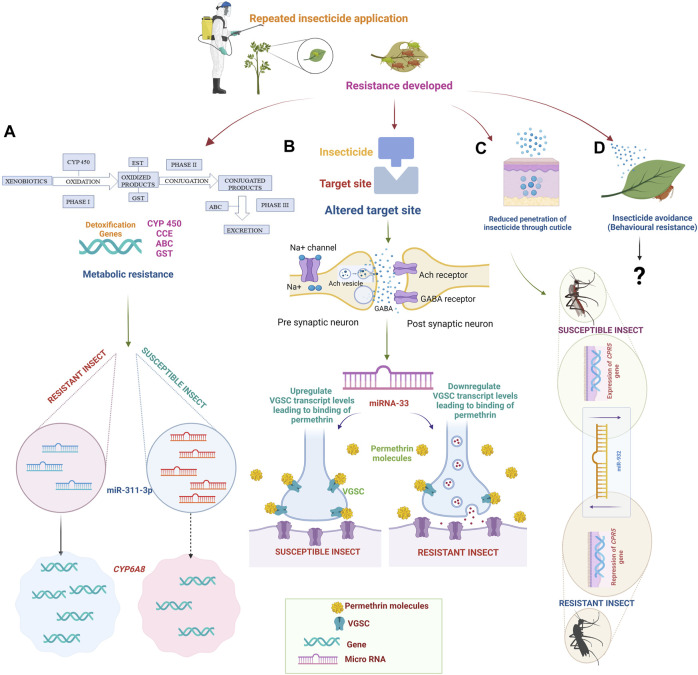
Insecticide resistance in insects severely threatens both human health and agriculture, making insecticides less compelling and valuable, leading to frequent pest management failures, rising input costs, lowering crop yields, and disastrous public health. Insecticide resistance results from multiple factors, mainly indiscriminate insecticide usage and mounted selection pressure on insect populations. Insects respond to insecticide stress at the cellular level by modest yet significant genetic propagations. Transcriptional, co-transcriptional, and post-transcriptional regulatory signals of cells in organisms regulate the intricate processes in gene expressions churning the genetic information in transcriptional units into proteins and non-coding transcripts. Upregulation of detoxification enzymes, notably cytochrome P450s (CYPs), glutathione S-transferases (GSTs), esterases [carboxyl choline esterase (CCE), carboxyl esterase (CarE)] and ATP Binding Cassettes (ABC) at the transcriptional level, modification of target sites, decreased penetration, or higher excretion of insecticides are the noted insect physiological responses. The transcriptional regulatory pathways such as AhR/ARNT, Nuclear receptors, CncC/Keap1, MAPK/CREB, and GPCR/cAMP/PKA were found to regulate the detoxification genes at the transcriptional level. Post-transcriptional changes of non-coding RNAs (ncRNAs) such as microRNAs (miRNA), long non-coding RNAs (lncRNA), and epitranscriptomics, including RNA methylation, are reported in resistant insects. Additionally, genetic modifications such as mutations in the target sites and copy number variations (CNV) are also influencing insecticide resistance. Therefore, these cellular intricacies may decrease insecticide sensitivity, altering the concentrations or activities of proteins involved in insecticide interactions or detoxification. The cellular episodes at the transcriptional and post-transcriptional levels pertinent to insecticide resistance responses in insects are extensively covered in this review. An overview of molecular mechanisms underlying these biological rhythms allows for developing alternative pest control methods to focus on insect vulnerabilities, employing reverse genetics approaches like RNA interference (RNAi) technology to silence particular resistance-related genes for sustained insect management.
昆虫的抗药性严重威胁着人类健康和农业,使杀虫剂的吸引力和价值降低,导致害虫管理频繁失败、投入成本上升、作物产量下降以及严重的公共卫生问题。抗药性是由多种因素造成的,主要是杀虫剂的滥用以及对昆虫种群不断增加的选择压力。昆虫在细胞水平上通过适度但显著的基因传播来应对杀虫剂压力。生物体中细胞的转录、共转录和转录后调控信号调节基因表达中的复杂过程,将转录单元中的遗传信息转化为蛋白质和非编码转录本。在转录水平上,解毒酶的上调,特别是细胞色素P450(CYPs)、谷胱甘肽S-转移酶(GSTs)、酯酶[羧基胆碱酯酶(CCE)、羧酸酯酶(CarE)]和ATP结合盒(ABC),靶位点的修饰,杀虫剂渗透减少或排泄增加,都是昆虫常见的生理反应。发现诸如芳烃受体/芳香烃受体核转运蛋白(AhR/ARNT)、核受体、CncC/Keap1、丝裂原活化蛋白激酶/环磷腺苷效应元件结合蛋白(MAPK/CREB)和G蛋白偶联受体/环磷酸腺苷/蛋白激酶A(GPCR/cAMP/PKA)等转录调控途径在转录水平上调节解毒基因。在抗性昆虫中报道了非编码RNA(ncRNAs)如微小RNA(miRNA)、长链非编码RNA(lncRNA)的转录后变化以及包括RNA甲基化在内的表观转录组学变化。此外,诸如靶位点突变和拷贝数变异(CNV)等基因修饰也影响着抗药性。因此,这些细胞层面的复杂变化可能会降低昆虫对杀虫剂的敏感性,改变参与杀虫剂相互作用或解毒的蛋白质的浓度或活性。本文综述了昆虫中与抗药性反应相关的转录和转录后水平的细胞过程。对这些生物学节律潜在分子机制的概述有助于开发替代害虫控制方法,聚焦于昆虫的脆弱点,采用RNA干扰(RNAi)技术等反向遗传学方法使特定的抗性相关基因沉默,以实现持续的害虫管理。