Earth and Planets Laboratory, Carnegie Institution for Science, Washington, DC 20015.
Earth Life Science Institute, Tokyo Institute of Technology, Tokyo 152-8550, Japan.
Proc Natl Acad Sci U S A. 2023 Oct 10;120(41):e2307149120. doi: 10.1073/pnas.2307149120. Epub 2023 Sep 25.
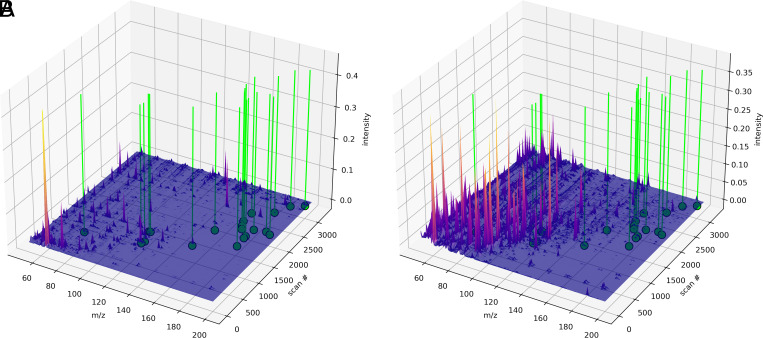
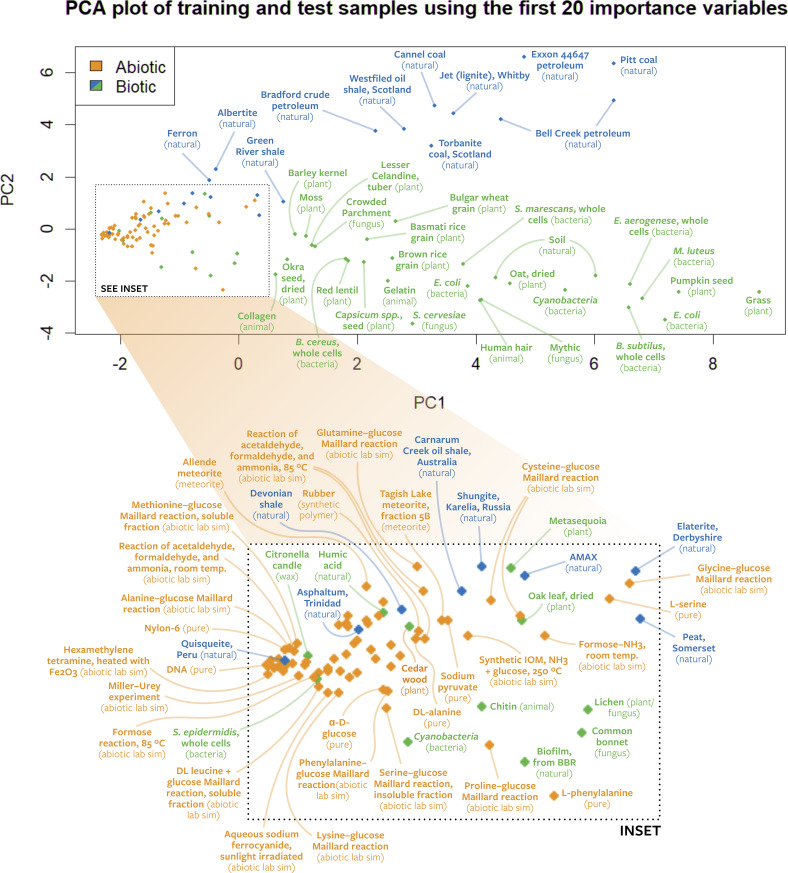
The search for definitive biosignatures-unambiguous markers of past or present life-is a central goal of paleobiology and astrobiology. We used pyrolysis-gas chromatography coupled to mass spectrometry to analyze chemically disparate samples, including living cells, geologically processed fossil organic material, carbon-rich meteorites, and laboratory-synthesized organic compounds and mixtures. Data from each sample were employed as training and test subsets for machine-learning methods, which resulted in a model that can identify the biogenicity of both contemporary and ancient geologically processed samples with ~90% accuracy. These machine-learning methods do not rely on precise compound identification: Rather, the relational aspects of chromatographic and mass peaks provide the needed information, which underscores this method's utility for detecting alien biology.
寻找明确的生物特征——过去或现在生命的明确标记——是古生物学和天体生物学的核心目标。我们使用热裂解-气相色谱法与质谱法分析了化学性质不同的样本,包括活细胞、地质处理过的化石有机材料、富碳陨石以及实验室合成的有机化合物和混合物。每个样本的数据都被用作机器学习方法的训练和测试子集,这些方法产生了一个可以识别当代和古代地质处理样本生物成因的模型,准确率约为 90%。这些机器学习方法不依赖于精确的化合物识别:相反,色谱和质谱峰的关系方面提供了所需的信息,这突出了这种方法在检测外星生物方面的实用性。