Amereh Meitham, Seyfoori Amir, Dallinger Briana, Azimzadeh Mostafa, Stefanek Evan, Akbari Mohsen
Department of Mechanical Engineering, University of Victoria, Victoria, BC V8P 5C2, Canada.
Laboratory for Innovations in MicroEngineering (LiME), Department of Mechanical Engineering, University of Victoria, Victoria, BC V8P 5C2, Canada.
Biomimetics (Basel). 2023 Sep 11;8(5):421. doi: 10.3390/biomimetics8050421.
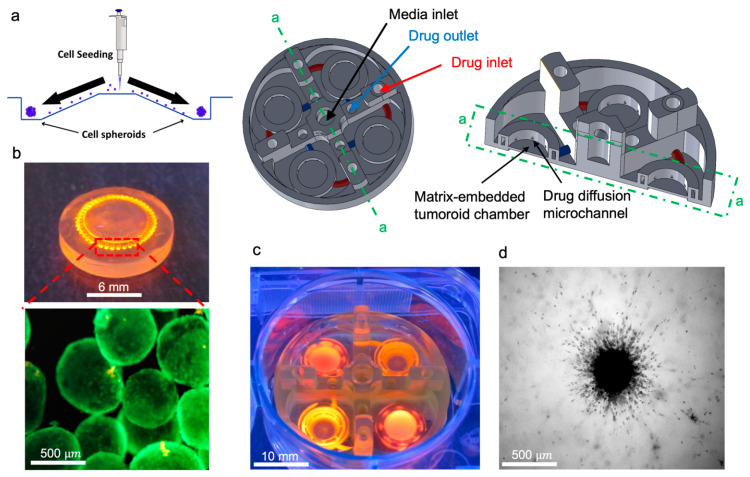
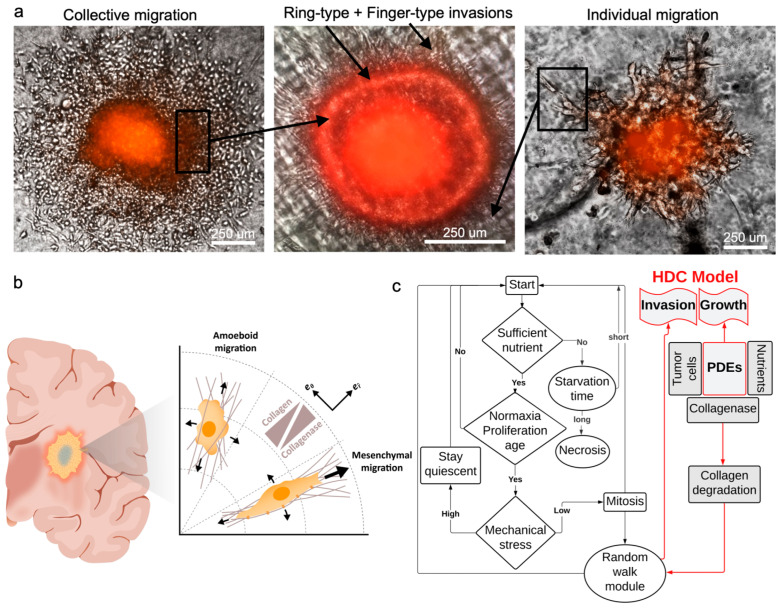
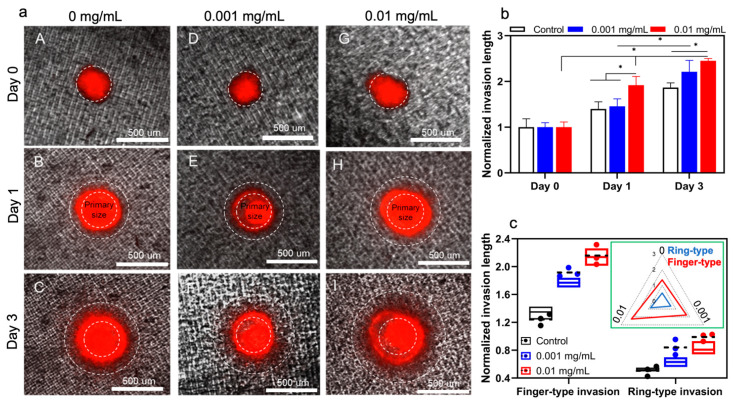
Glioblastoma multiform (GBM) tumor progression has been recognized to be correlated with extracellular matrix (ECM) stiffness. Dynamic variation of tumor ECM is primarily regulated by a family of enzymes which induce remodeling and degradation. In this paper, we investigated the effect of matrix stiffness on the invasion pattern of human glioblastoma tumoroids. A 3D-printed tumor-on-a-chip platform was utilized to culture human glioblastoma tumoroids with the capability of evaluating the effect of stiffness on tumor progression. To induce variations in the stiffness of the collagen matrix, different concentrations of collagenase were added, thereby creating an inhomogeneous collagen concentration. To better understand the mechanisms involved in GBM invasion, an in silico hybrid mathematical model was used to predict the evolution of a tumor in an inhomogeneous environment, providing the ability to study multiple dynamic interacting variables. The model consists of a continuum reaction-diffusion model for the growth of tumoroids and a discrete model to capture the migration of single cells into the surrounding tissue. Results revealed that tumoroids exhibit two distinct patterns of invasion in response to the concentration of collagenase, namely ring-type and finger-type patterns. Moreover, higher concentrations of collagenase resulted in greater invasion lengths, confirming the strong dependency of tumor behavior on the stiffness of the surrounding matrix. The agreement between the experimental results and the model's predictions demonstrates the advantages of this approach in investigating the impact of various extracellular matrix characteristics on tumor growth and invasion.
多形性胶质母细胞瘤(GBM)的肿瘤进展已被认为与细胞外基质(ECM)硬度相关。肿瘤ECM的动态变化主要由一类诱导重塑和降解的酶调控。在本文中,我们研究了基质硬度对人胶质母细胞瘤类肿瘤侵袭模式的影响。利用3D打印的芯片上肿瘤平台培养人胶质母细胞瘤类肿瘤,该平台能够评估硬度对肿瘤进展的影响。为了诱导胶原基质硬度的变化,添加了不同浓度的胶原酶,从而产生不均匀的胶原浓度。为了更好地理解GBM侵袭所涉及的机制,使用了一个计算机模拟混合数学模型来预测肿瘤在不均匀环境中的演变,从而能够研究多个动态相互作用变量。该模型由一个用于类肿瘤生长的连续反应扩散模型和一个用于捕捉单个细胞向周围组织迁移的离散模型组成。结果显示,类肿瘤根据胶原酶浓度表现出两种不同的侵袭模式,即环形和指状模式。此外,较高浓度的胶原酶导致更大的侵袭长度,证实了肿瘤行为对周围基质硬度的强烈依赖性。实验结果与模型预测之间的一致性证明了这种方法在研究各种细胞外基质特征对肿瘤生长和侵袭影响方面的优势。