Functional Bio-integrated Electronics and Energy Management Lab, School of Electrical and Electronic Engineering, Yonsei University, 50 Yonsei-ro, Seodaemun-gu, Seoul 03722, Republic of Korea.
Department of Biomedical Sciences, College of Medicine, Korea University, 73 Goryeodae-ro, Seongbuk-gu, Seoul 02841, Republic of Korea.
Sci Adv. 2023 Sep 29;9(39):eadi8918. doi: 10.1126/sciadv.adi8918. Epub 2023 Sep 27.
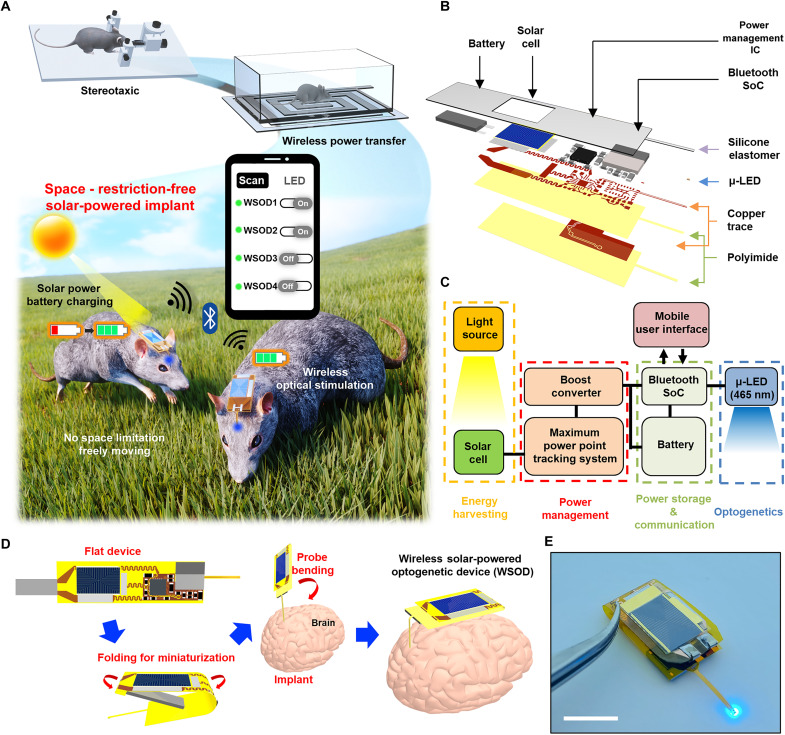
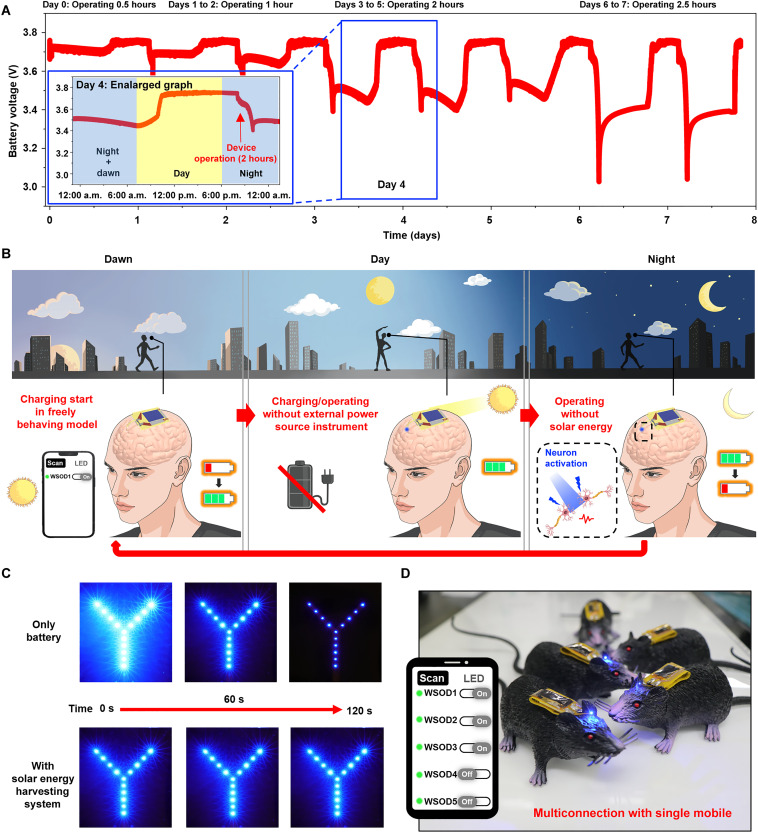
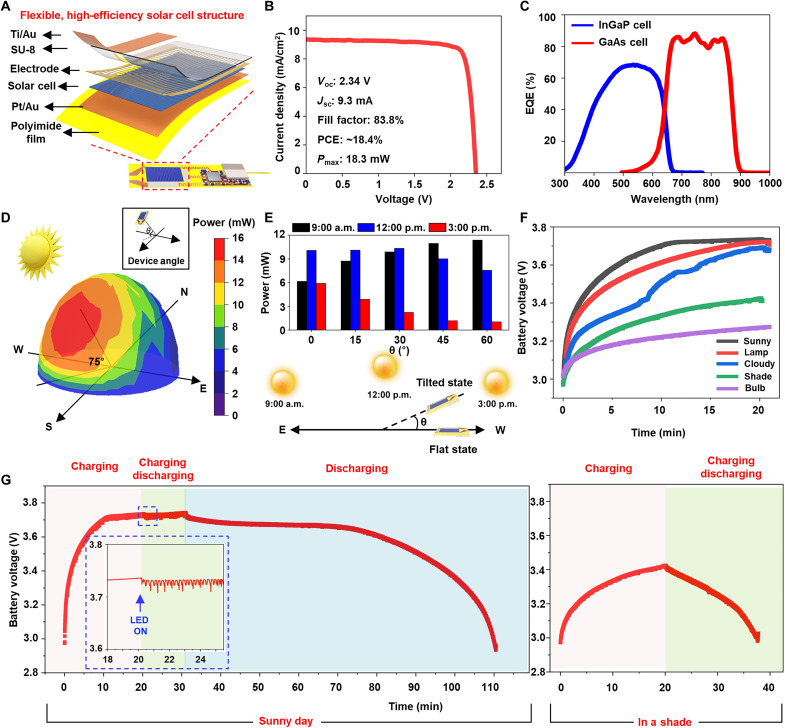
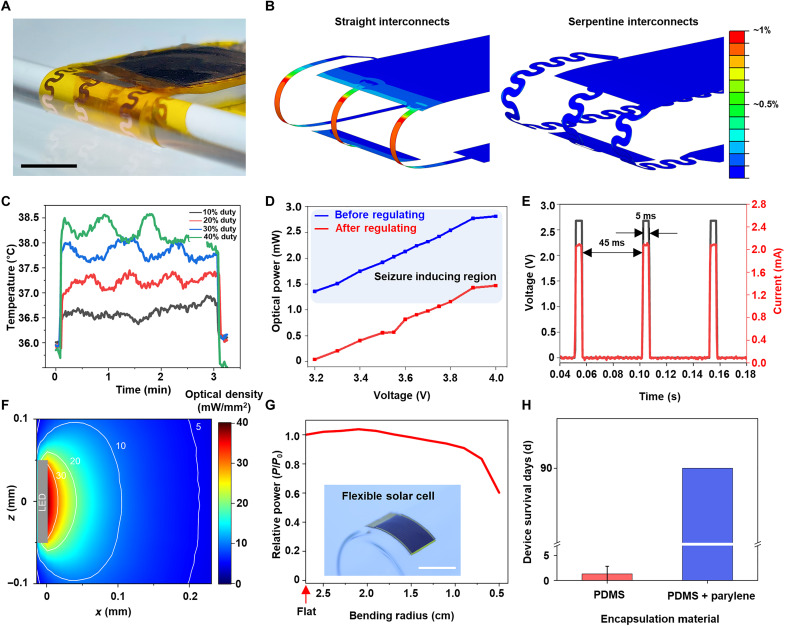
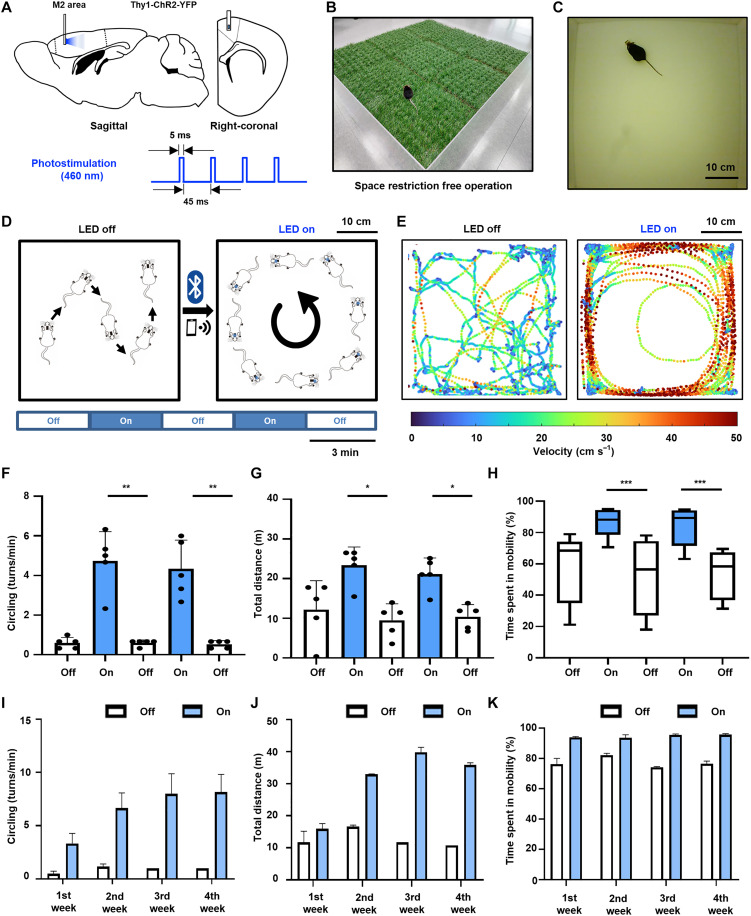
Numerous wireless optogenetic systems have been reported for practical tether-free optogenetics in freely moving animals. However, most devices rely on battery-powered or coil-powered systems requiring periodic battery replacement or bulky, high-cost charging equipment with delicate antenna design. This leads to spatiotemporal constraints, such as limited experimental duration due to battery life or animals' restricted movement within specific areas to maintain wireless power transmission. In this study, we present a wireless, solar-powered, flexible optoelectronic device for neuromodulation of the complete freely behaving subject. This device provides chronic operation without battery replacement or other external settings including impedance matching technique and radio frequency generators. Our device uses high-efficiency, thin InGaP/GaAs tandem flexible photovoltaics to harvest energy from various light sources, which powers Bluetooth system to facilitate long-term, on-demand use. Observation of sustained locomotion behaviors for a month in mice via secondary motor cortex area stimulation demonstrates the notable capabilities of our device, highlighting its potential for space-free neuromodulating applications.
已经有许多无线光遗传学系统被报道用于自由活动动物的无绳光遗传学,但大多数设备依赖于电池或线圈供电系统,需要定期更换电池或使用笨重、高成本的充电设备和精细的天线设计。这导致了时空限制,例如由于电池寿命限制实验持续时间或动物在特定区域内的受限运动以维持无线功率传输。在本研究中,我们提出了一种用于完整自由行为对象神经调节的无线、太阳能供电、柔性光电设备。该设备提供了无需更换电池或其他外部设置(包括阻抗匹配技术和射频发生器)的慢性操作。我们的设备使用高效、薄的 InGaP/GaAs 串联柔性光伏电池从各种光源中收集能量,为蓝牙系统供电,以方便长期按需使用。通过对次级运动皮层区域刺激的小鼠进行长达一个月的持续运动行为观察,证明了我们设备的显著性能,突出了其在无空间神经调节应用中的潜力。