He Jiangping, Lin Lihui, Chen Jiekai
Center for Cell Lineage and Atlas (CCLA), Bioland Laboratory (Guangzhou Regenerative Medicine and Health Guangdong Laboratory), Guangzhou 510320, China.
Key Laboratory of Regenerative Biology of the Chinese Academy of Sciences and Guangdong Provincial Key Laboratory of Stem Cell and Regenerative Medicine, Guangzhou Institutes of Biomedicine and Health, Chinese Academy of Sciences, Guangzhou 510530, China.
Biophys Rep. 2022 Jun 30;8(3):158-169. doi: 10.52601/bpr.2022.210041.
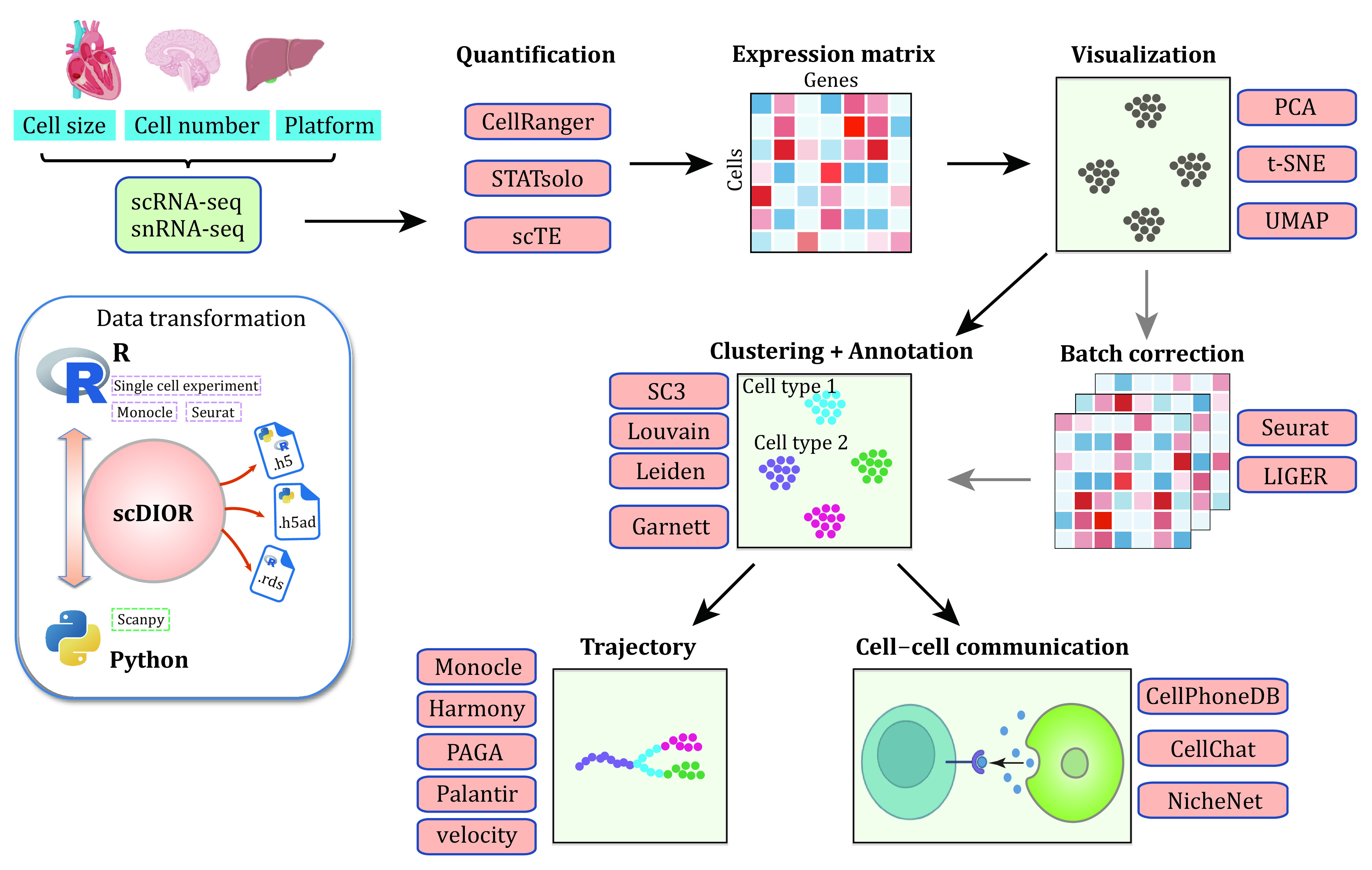
Single-cell RNA sequencing (scRNA-seq) is a revolutionary tool to explore cells. With an increasing number of scRNA-seq data analysis tools that have been developed, it is challenging for users to choose and compare their performance. Here, we present an overview of the workflow for computational analysis of scRNA-seq data. We detail the steps of a typical scRNA-seq analysis, including experimental design, pre-processing and quality control, feature selection, dimensionality reduction, cell clustering and annotation, and downstream analysis including batch correction, trajectory inference and cell-cell communication. We provide guidelines according to our best practice. This review will be helpful for the experimentalists interested in analyzing their data, and will aid the users seeking to update their analysis pipelines.
单细胞RNA测序(scRNA-seq)是探索细胞的一项革命性工具。随着已开发的scRNA-seq数据分析工具数量不断增加,用户选择并比较它们的性能具有挑战性。在此,我们概述scRNA-seq数据计算分析的工作流程。我们详细介绍典型scRNA-seq分析的步骤,包括实验设计、预处理和质量控制、特征选择、降维、细胞聚类和注释,以及下游分析,包括批次校正、轨迹推断和细胞间通信。我们根据最佳实践提供指导方针。本综述将有助于对分析其数据感兴趣的实验人员,并将帮助寻求更新其分析流程的用户。