Bourez Pierre H, Vallet Guillaume T, Fournier Philippe
Department of Rehabilitation, Laval University, Quebec City, QC G1V 0A6, Canada.
Centre for Interdisciplinary Research in Rehabilitation and Social Integration (CIRRIS), Centre Intégré Universitaire de Santé et de Services Sociaux de La Capitale-Nationale (CIUSSS-CN), Quebec City, QC G1M 2S8, Canada.
Brain Sci. 2023 Sep 17;13(9):1338. doi: 10.3390/brainsci13091338.
Student audiology training in tinnitus evaluation and management is heterogeneous and has been found to be insufficient. We designed a new clinical simulation laboratory for training students on psychoacoustic measurements of tinnitus: one student plays the role of the tinnitus patient, wearing a device producing a sound like tinnitus on one ear, while another student plays the role of the audiologist, evaluating their condition. The objective of the study was to test this new clinical simulation laboratory of tinnitus from the perspective of the students.
This study reports the findings from twenty-one audiology students (20 female and 1 male, mean age = 29, SD = 7.7) who participated in this laboratory for a mandatory audiology class at the Laval University of Quebec. Three students had hearing loss (one mild, two moderate). All students played the role of both the clinician and the patient, alternately. They also had to fill out a questionnaire about their overall experience of the laboratory.
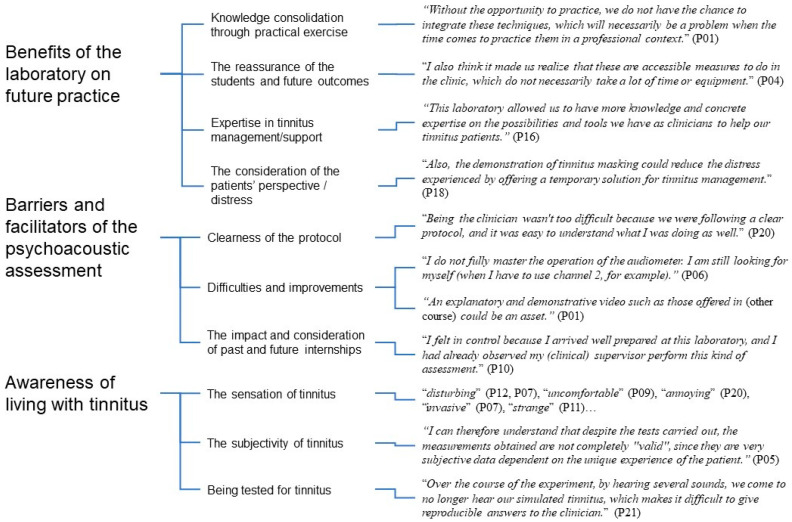
The qualitative analysis revealed three main themes: "Benefits of the laboratory on future practice", "Barriers and facilitators of the psychoacoustic assessment", and "Awareness of living with tinnitus". The participants reported that this experience would have a positive impact on their ability to manage tinnitus patients in their future career.
This fast, cheap, and effective clinical simulation method could be used by audiology and other healthcare educators to strengthen students' skills and confidence in tinnitus evaluation and management. The protocol is made available to all interested parties.
听力学专业学生在耳鸣评估与管理方面的培训参差不齐,且已被发现存在不足。我们设计了一个新的临床模拟实验室,用于培训学生进行耳鸣的心理声学测量:一名学生扮演耳鸣患者的角色,在一只耳朵上佩戴一个发出类似耳鸣声音的设备,而另一名学生扮演听力学家的角色,评估其病情。本研究的目的是从学生的角度测试这个新的耳鸣临床模拟实验室。
本研究报告了21名听力学专业学生(20名女性和1名男性,平均年龄 = 29岁,标准差 = 7.7)的研究结果,他们参加了魁北克拉瓦尔大学一门必修的听力学课程的这个实验室。三名学生有听力损失(一名轻度,两名中度)。所有学生都轮流扮演临床医生和患者的角色。他们还必须填写一份关于他们对实验室总体体验的问卷。
定性分析揭示了三个主要主题:“实验室对未来实践的益处”、“心理声学评估的障碍和促进因素”以及“对耳鸣生活的认识”。参与者报告说,这种经历将对他们未来职业生涯中管理耳鸣患者的能力产生积极影响。
这种快速、廉价且有效的临床模拟方法可供听力学及其他医疗保健教育工作者使用,以增强学生在耳鸣评估与管理方面的技能和信心。该方案已提供给所有感兴趣的各方。