Silva Amanda Thaís Ferreira, Gonçalves Juliano Leonel, Dantas Stéfani Thais Alves, Rall Vera Lúcia Mores, de Oliveira Pollyanne Raysa Fernandes, Dos Santos Marcos Veiga, Peixoto Rodolfo de Moraes, Mota Rinaldo Aparecido
Department of Veterinary Medicine, Federal Rural University of Pernambuco, Recife 52171-900, Brazil.
Department of Large Animal Clinical Sciences, College of Veterinary Medicine, Michigan State University, East Lansing, MI 48824, USA.
Antibiotics (Basel). 2023 Aug 23;12(9):1353. doi: 10.3390/antibiotics12091353.
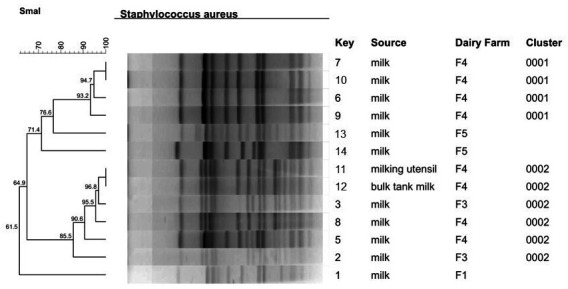
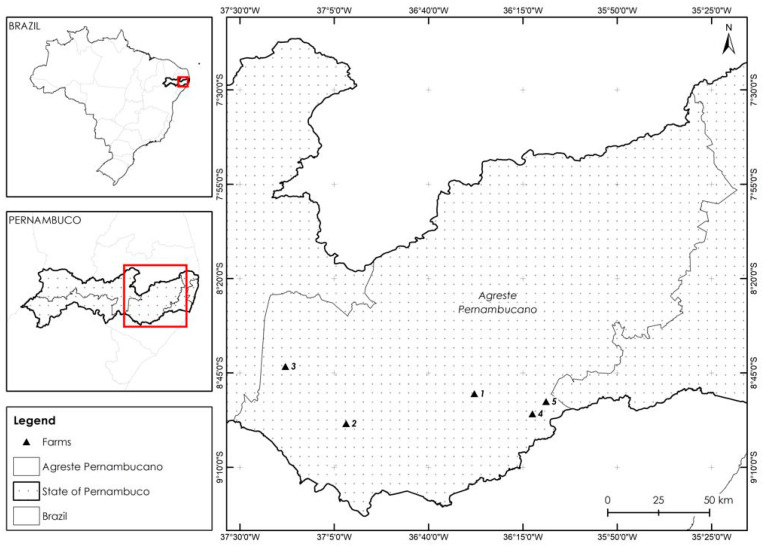
The core objective of this study was to genetically and phenotypically characterize subclinical mastitis-causing multidrug-resistant (MDRSA). In addition, risk factors associated with subclinical mastitis caused by MDRSA were investigated. Bacterial cultures were performed on 2120 mammary quarters, 40 swabs of milk utensils, 5 bulk tank milk samples, and 11 nostril and 11 hand swabs from milkers from five dairy farms. Matrix-assisted laser desorption/ionization time-of-flight mass spectrometry (MALDI-TOF MS) was conducted for identification. Antimicrobial resistance was screened phenotypically using the disk diffusion test in all isolates. A biofilm formation assay; detection of genes associated with beta-lactam resistance, efflux pump, and biofilm formation; and pulsed-field gel electrophoresis (PFGE) were performed in all MDRSA isolates. Multi-locus sequence typing (MLST) was carried out in cefoxitin-resistant MDRSA isolates. A total of 188 isolates from milk as well as two from milking utensils and one from bulk tank milk were identified. Most of the isolates (92.7%; 177 of 191) showed beta-lactam resistance, and 7% (14 of 191) were MDRSA. Interestingly, 36% (5 of 14) of MDRSA isolates were cefoxitin-resistant, but none carried or genes. Based on PFGE results, it was observed that strains were more likely to be unique to a specific herd. Two clonal complexes were identified, CC97 (ST126; commonly livestock-associated) and CC1 (ST7440; usually community-associated). To the best of our knowledge, this is the first report of ST7440 isolated from bovine mastitis in Brazil. The risk factor results underscored the importance of considering parity, stage of lactation, SCC, milk production, and herd size when studying the risk of subclinical mastitis and antimicrobial resistance in . Thus, to implement effective strategies to prevent subclinical mastitis in dairy herds and to minimize MDRSA spread, it is important to understand MDRSA strains' distribution and their antimicrobial resistance profile.
本研究的核心目标是对引起亚临床乳腺炎的耐多药金黄色葡萄球菌(MDRSA)进行基因和表型特征分析。此外,还调查了与MDRSA引起的亚临床乳腺炎相关的风险因素。对来自五个奶牛场的2120个乳腺象限、40个奶具拭子、5个奶罐奶样品以及11个挤奶工的鼻孔拭子和11个手部拭子进行了细菌培养。采用基质辅助激光解吸/电离飞行时间质谱(MALDI-TOF MS)进行鉴定。对所有分离株采用纸片扩散法进行表型抗菌药物敏感性筛选。对所有MDRSA分离株进行了生物膜形成试验、与β-内酰胺耐药性、外排泵和生物膜形成相关基因的检测以及脉冲场凝胶电泳(PFGE)。对耐头孢西丁的MDRSA分离株进行多位点序列分型(MLST)。共鉴定出188株来自牛奶的分离株,以及2株来自奶具和1株来自奶罐奶的分离株。大多数分离株(92.7%;191株中的177株)表现出β-内酰胺耐药性,7%(191株中的14株)为MDRSA。有趣的是,36%(14株中的5株)的MDRSA分离株对头孢西丁耐药,但均未携带 或 基因。根据PFGE结果,观察到菌株更有可能是特定牛群所特有的。鉴定出两个克隆复合体,CC97(ST126;通常与家畜相关)和CC1(ST7440;通常与社区相关)。据我们所知,这是巴西首次从牛乳腺炎中分离出ST7440的报告。风险因素结果强调了在研究 中亚临床乳腺炎和抗菌药物耐药性风险时考虑胎次、泌乳阶段、体细胞计数、产奶量和牛群规模的重要性。因此,为了实施有效的策略来预防奶牛群中的亚临床乳腺炎并尽量减少MDRSA的传播,了解MDRSA菌株的分布及其抗菌药物耐药性谱非常重要。