Wurcel Alysse G, Guardado Rubeen, Ortiz Christina, Bornmann Charles R, Gillis Joseph, Huang Kristin, Doron Shira, Campion Maureen, Blumenthal Kimberly G
Tufts University School of Medicine, Boston, Mass.
Department of Medicine, Division of Geographic Medicine and Infectious Diseases, Tufts Medical Center, Boston, Mass.
J Allergy Clin Immunol Glob. 2022 Oct 26;2(1):93-96. doi: 10.1016/j.jacig.2022.09.004. eCollection 2023 Feb.
A key strategy to combat the public health crisis of antimicrobial resistance is to use appropriate antibiotics, which is difficult in patients with a penicillin allergy label.
Our aim was to investigate racial and ethnic differences related to penicillin allergy labeling and referral to allergy/immunology in primary care.
This was a retrospective study of Tufts Medical Center's Boston-based primary care patients in 2019. Univariable and multivariable logistic regression models were used to examine demographic associations with (1) penicillin allergy label and (2) allergist referral.
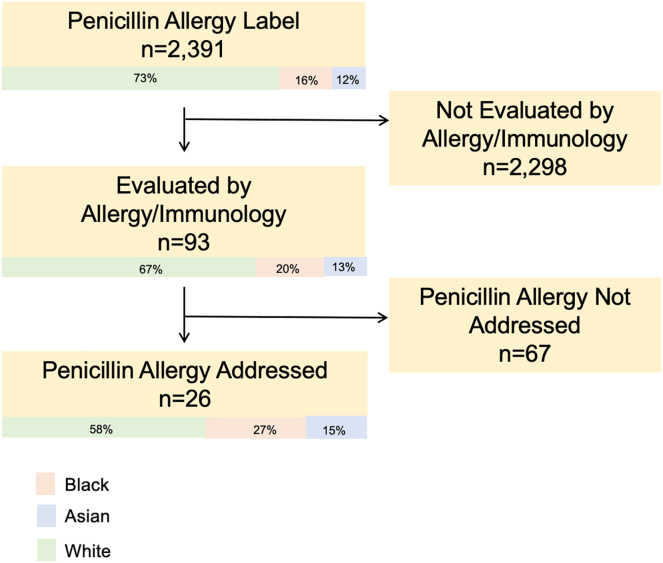
Of 21,918 primary care patients, 2,391 (11%) had a penicillin allergy label; of these, 249 (10%) had an allergist referral. In multivariable logistic regression models, older age (adjusted odds ratio [aOR] = 1.06 [95% CI = 1.04-1.09]) and female sex (aOR = 1.58 [95% CI = 1.44-1.74]) were associated with higher odds of penicillin allergy label carriage. Black race (aOR = 0.77 [95% CI = 0.69-0.87]) and Asian race (aOR = 0.47 [95% CI = 0.41-0.53]) were associated with lower odds of penicillin allergy label carriage. In multivariable regression, allergist referral was associated with female sex (aOR = 1.52 [95% CI = 1.10-2.10]) and Black race (aOR = 1.74 [95% CI = 1.25-2.45]). Of 93 patients (37%) who completed their allergy visit, 26 (28%) had received penicillin allergy evaluation or were scheduled to receive a penicillin allergy evaluation at a future visit.
There were racial differences in penicillin allergy labeling and referral. Allergy referral for penicillin allergy assessment was rare. Larger studies are needed to assess penicillin allergy labeling and delabeling with an equity focus on optimizing patient health outcomes.
应对抗生素耐药性这一公共卫生危机的一项关键策略是使用合适的抗生素,然而对于有青霉素过敏标签的患者而言,做到这一点颇具难度。
我们的目的是调查在初级保健中,与青霉素过敏标签及转诊至过敏/免疫学专科相关的种族和民族差异。
这是一项对2019年塔夫茨医疗中心位于波士顿的初级保健患者进行的回顾性研究。使用单变量和多变量逻辑回归模型来检验人口统计学因素与以下两项的关联:(1)青霉素过敏标签;(2)转诊至过敏症专科医生处。
在21918名初级保健患者中,2391名(11%)有青霉素过敏标签;其中,249名(10%)转诊至过敏症专科医生处。在多变量逻辑回归模型中,年龄较大(调整后的优势比[aOR]=1.06[95%置信区间(CI)=1.04 - 1.09])和女性(aOR = 1.58[95%CI = 1.44 - 1.74])与携带青霉素过敏标签的较高几率相关。黑人种族(aOR = 0.77[95%CI = 0.69 - 0.87])和亚洲种族(aOR = 0.47[95%CI = 0.41 - 0.53])与携带青霉素过敏标签的较低几率相关。在多变量回归中,转诊至过敏症专科医生处与女性(aOR = 1.52[95%CI = 1.10 - 2.10])和黑人种族(aOR = 1.74[95%CI = 1.25 - 2.45])相关。在完成过敏门诊就诊的93名患者(37%)中,26名(28%)接受了青霉素过敏评估或计划在未来就诊时接受青霉素过敏评估。
在青霉素过敏标签及转诊方面存在种族差异。因青霉素过敏进行评估而转诊至过敏症专科医生处的情况很罕见。需要开展更大规模的研究,以公平为重点评估青霉素过敏标签的标注及去除,从而优化患者的健康结局。