McGurk Meghan D, Cacal Stephanie L, Vu Uyen, Sentell Tetine, Beckelman Toby, Lee Jessica, Yang Alyssa, Pirkle Catherine M
University of Hawai'i at Mānoa, Honolulu, Hawai'i.
Hawai'i State Department of Health, Honolulu, Hawai'i.
J Healthy Eat Act Living. 2021 Apr 1;1(2):63-73. eCollection 2021.
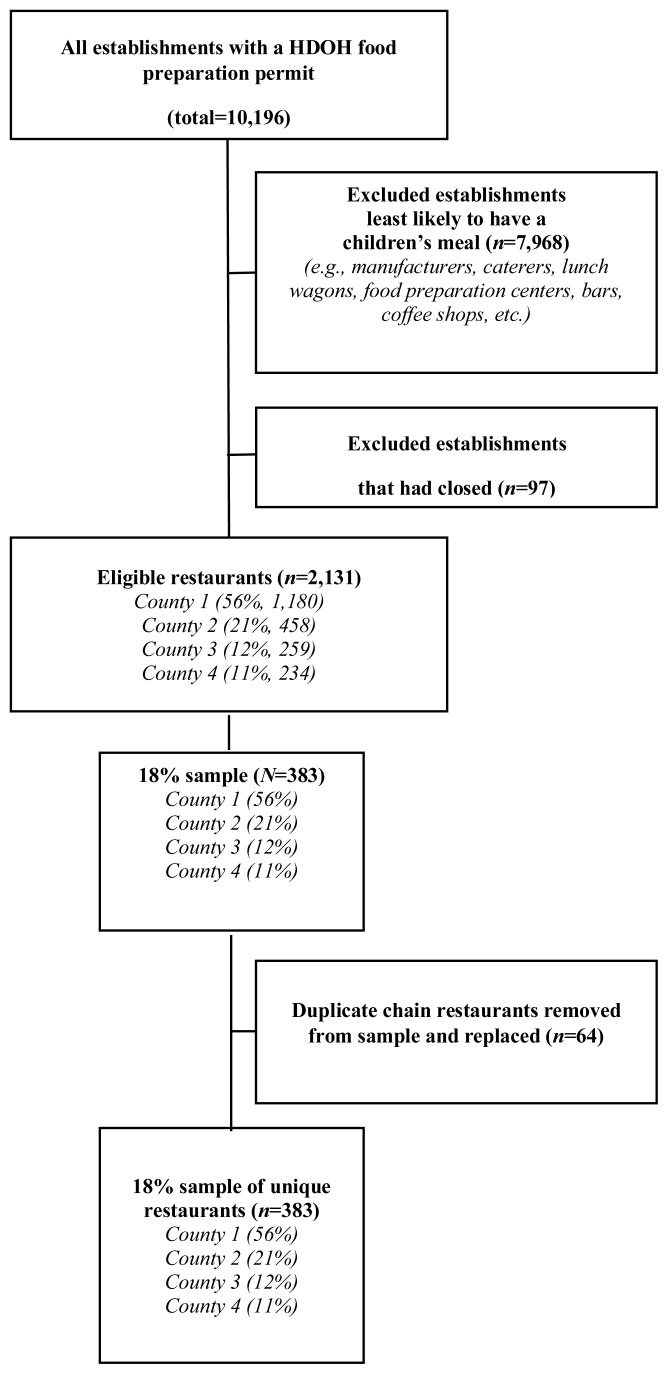
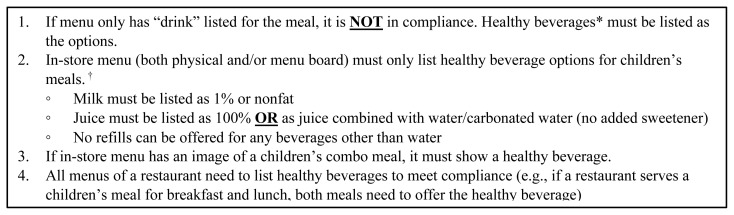
In January 2020, Hawai'i became the second state with a healthy default beverage (HDB) law, requiring restaurants to offer HDBs with their children's meals. This observational study presents baseline characteristics of restaurants with a children's menu and meal. The study describes pre-law beverage options to inform future HDB policy language, implementation, and evaluation. Between November and December 2019, data were collected from a statewide sample of unique restaurants ( = 383) with health inspection permits. Restaurants were assessed separately for a children's menu and meal using website reviews, telephone calls, and in-person visits. Meals were evaluated for pre-law beverage type and compliance. Logistic regression was used to estimate the likelihood of having a children's menu and meal. Most of the restaurants were full-service (70.2%) and non-chains (67.9%). While 49.3% of restaurants had a children's menu, only 16.7% had a children's meal. Significant predictors of having a children's menu were being full-service, national/international or local chains, neighbor island (non-Honolulu) locations, and hotel locations. Only being a national/international chain significantly predicted having a children's meal. Although 35.9% of children's meals offered a non-sugar-sweetened beverage (SSB) option, only 3.1% offered law-compliant beverages. Inclusion of an SSB default option (60.9%) and not specifying the type of default beverage were the predominant factors for pre-law non-compliance. Results support the need for HDB regulations, especially for national/international chains, which were most likely to have children's meals, and provide data to inform policies in other jurisdictions.
2020年1月,夏威夷成为第二个颁布健康默认饮品(HDB)法的州,该法律要求餐厅在儿童餐中提供健康默认饮品。这项观察性研究呈现了设有儿童菜单和儿童餐的餐厅的基线特征。该研究描述了法律颁布前的饮品选择,以为未来的健康默认饮品政策措辞、实施和评估提供参考。2019年11月至12月期间,从全州范围内具有健康检查许可证的383家独特餐厅的样本中收集了数据。通过网站评论、电话和实地走访,分别对餐厅的儿童菜单和儿童餐进行评估。评估儿童餐的法律颁布前饮品类型及合规情况。使用逻辑回归来估计设有儿童菜单和儿童餐的可能性。大多数餐厅是全方位服务餐厅(70.2%)且为非连锁餐厅(67.9%)。虽然49.3%的餐厅有儿童菜单,但只有16.7%的餐厅有儿童餐。设有儿童菜单的显著预测因素包括为全方位服务餐厅、全国/国际或本地连锁餐厅、邻岛(非火奴鲁鲁)地区的餐厅以及酒店餐厅。只有作为全国/国际连锁餐厅能显著预测设有儿童餐。虽然35.9%的儿童餐提供了非含糖甜味饮料(SSB)选项,但只有3.1%的儿童餐提供符合法律规定的饮品。包含含糖甜味饮料默认选项(60.9%)以及未明确默认饮品类型是法律颁布前不合规的主要因素。研究结果支持了对健康默认饮品法规的需求,特别是对于最有可能提供儿童餐食的全国/国际连锁餐厅,并为其他司法管辖区的政策提供了参考数据。