Lindow Thomas, Maanja Maren, Schelbert Erik B, Ribeiro Antônio H, Ribeiro Antonio Luiz P, Schlegel Todd T, Ugander Martin
Kolling Institute, Royal North Shore Hospital, University of Sydney, Sydney, Australia.
Department of Clinical Physiology, Research and Development, Växjö Central Hospital, Region Kronoberg, Sweden.
Eur Heart J Digit Health. 2023 Jul 25;4(5):384-392. doi: 10.1093/ehjdh/ztad045. eCollection 2023 Oct.
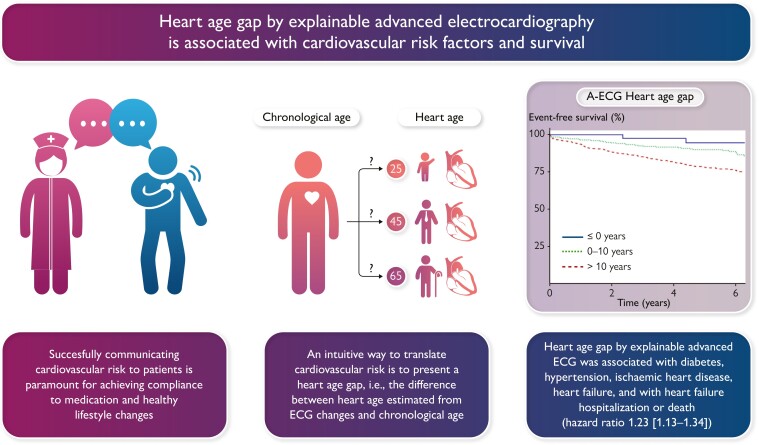
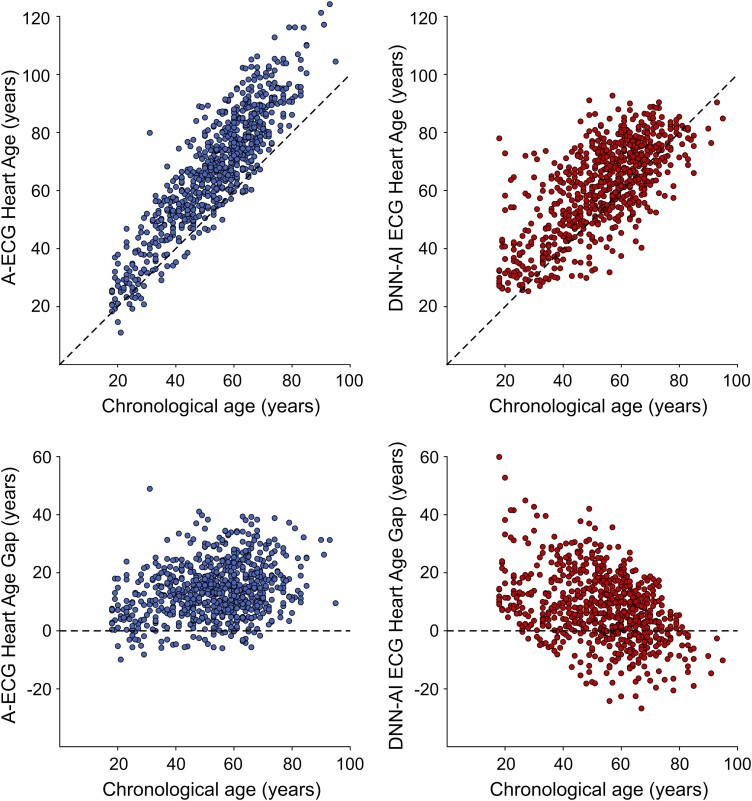
Deep neural network artificial intelligence (DNN-AI)-based Heart Age estimations have been presented and used to show that the difference between an electrocardiogram (ECG)-estimated Heart Age and chronological age is associated with prognosis. An accurate ECG Heart Age, without DNNs, has been developed using explainable advanced ECG (A-ECG) methods. We aimed to evaluate the prognostic value of the explainable A-ECG Heart Age and compare its performance to a DNN-AI Heart Age.
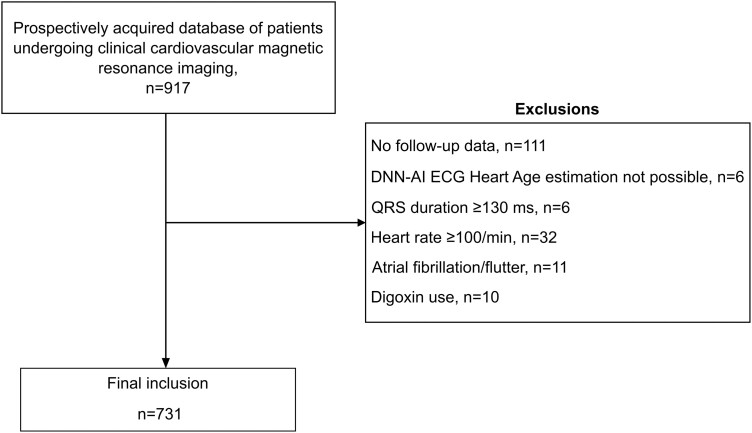
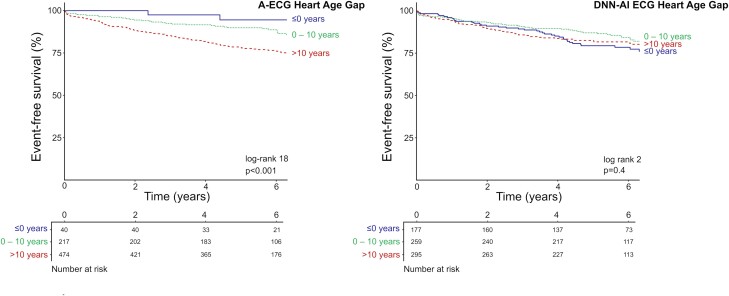
Both A-ECG and DNN-AI Heart Age were applied to patients who had undergone clinical cardiovascular magnetic resonance imaging. The association between A-ECG or DNN-AI Heart Age Gap and cardiovascular risk factors was evaluated using logistic regression. The association between Heart Age Gaps and death or heart failure (HF) hospitalization was evaluated using Cox regression adjusted for clinical covariates/comorbidities. Among patients [ = 731, 103 (14.1%) deaths, 52 (7.1%) HF hospitalizations, median (interquartile range) follow-up 5.7 (4.7-6.7) years], A-ECG Heart Age Gap was associated with risk factors and outcomes [unadjusted hazard ratio (HR) (95% confidence interval) (5 year increments): 1.23 (1.13-1.34) and adjusted HR 1.11 (1.01-1.22)]. DNN-AI Heart Age Gap was associated with risk factors and outcomes after adjustments [HR (5 year increments): 1.11 (1.01-1.21)], but not in unadjusted analyses [HR 1.00 (0.93-1.08)], making it less easily applicable in clinical practice.
A-ECG Heart Age Gap is associated with cardiovascular risk factors and HF hospitalization or death. Explainable A-ECG Heart Age Gap has the potential for improving clinical adoption and prognostic performance compared with existing DNN-AI-type methods.
基于深度神经网络人工智能(DNN-AI)的心脏年龄估计方法已被提出并用于表明心电图(ECG)估计的心脏年龄与实际年龄之间的差异与预后相关。已使用可解释的高级心电图(A-ECG)方法开发了一种无需DNN的准确ECG心脏年龄。我们旨在评估可解释的A-ECG心脏年龄的预后价值,并将其性能与DNN-AI心脏年龄进行比较。
将A-ECG和DNN-AI心脏年龄应用于接受临床心血管磁共振成像的患者。使用逻辑回归评估A-ECG或DNN-AI心脏年龄差距与心血管危险因素之间的关联。使用针对临床协变量/合并症进行调整的Cox回归评估心脏年龄差距与死亡或心力衰竭(HF)住院之间的关联。在患者中[ = 731,103例(14.1%)死亡,52例(7.1%)HF住院,中位(四分位间距)随访5.7(4.7 - 6.7)年],A-ECG心脏年龄差距与危险因素和结局相关[未调整的风险比(HR)(95%置信区间)(每5年增加):1.23(1.13 - 1.34),调整后的HR 1.11(1.01 - 1.22)]。DNN-AI心脏年龄差距在调整后与危险因素和结局相关[HR(每5年增加):1.1(1.01 - 1.21)],但在未调整分析中不相关[HR 1.00(0.93 - 1.08)],这使得其在临床实践中不太容易应用。
A-ECG心脏年龄差距与心血管危险因素以及HF住院或死亡相关。与现有的DNN-AI型方法相比,可解释的A-ECG心脏年龄差距具有提高临床应用和预后性能的潜力。